
By ENLOSA: Global Business Solutions (EGBS) | August 2026
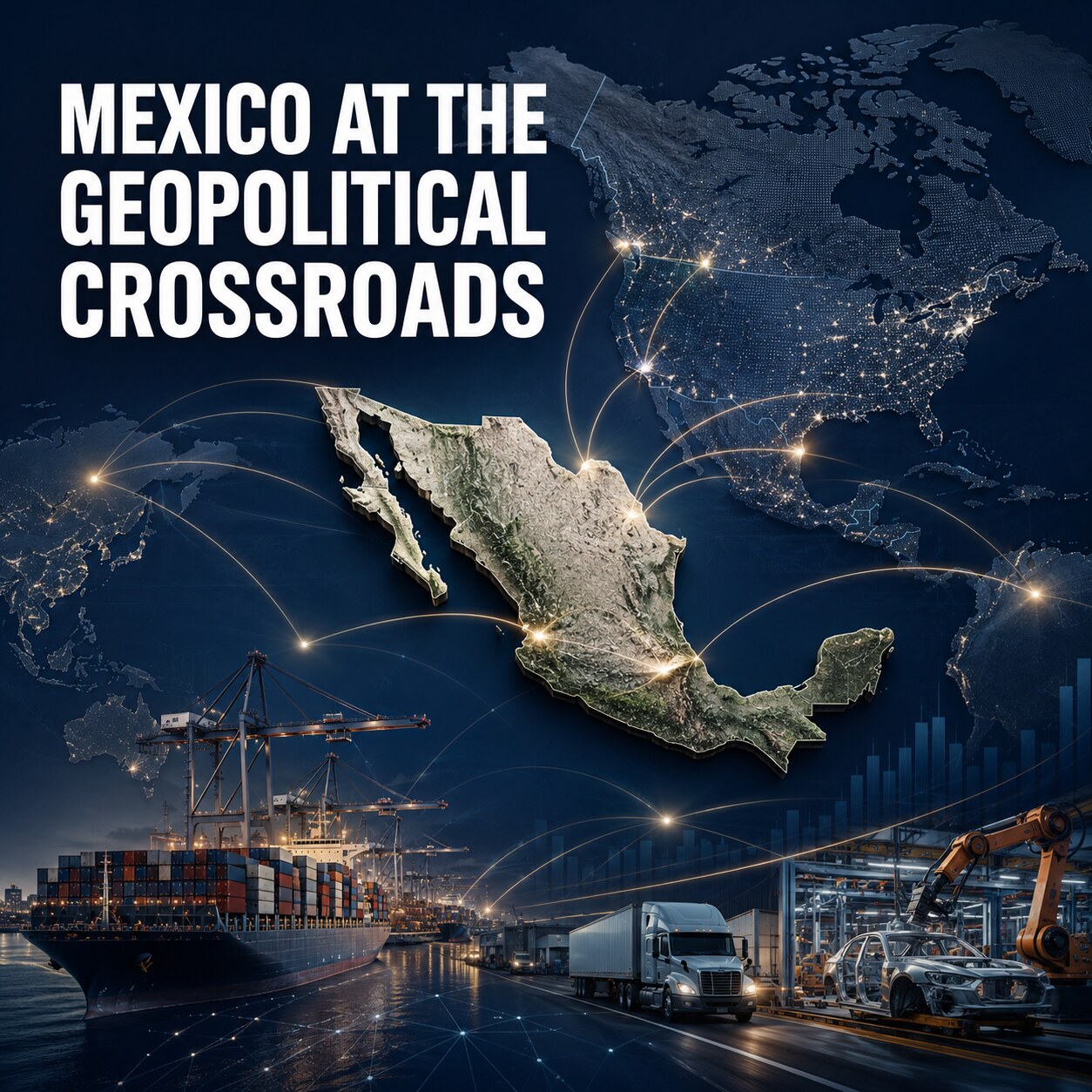
Mexico has become one of the most strategically important countries in the global economy. Its location beside the United States, extensive manufacturing base, network of trade agreements, competitive workforce and access to both the Atlantic and Pacific make it a natural platform for companies seeking resilient supply chains.
At the same time, Mexico sits at the intersection of several geopolitical pressures: intensifying competition between the United States and China, changes in U.S. trade and industrial policy, migration and security concerns, domestic institutional reforms, energy constraints and the first joint review of the United States-Mexico-Canada Agreement (USMCA), known in Mexico as T-MEC.
For international companies, the result is neither a simple opportunity nor a reason to retreat. Mexico remains a compelling investment destination—but success now requires more disciplined geopolitical analysis, regulatory preparation and supply-chain design.
From NAFTA to USMCA: Integration Is Deeper, but More Conditional
NAFTA ended when the USMCA entered into force on July 1, 2020. The new agreement preserved duty-free regional trade while adding tighter automotive rules of origin, stronger labor enforcement, digital-trade provisions and a scheduled joint review every six years.
That distinction matters in 2026. The review is not automatically an expiration of the agreement. The three governments can confirm their intention to extend it; if they do not, annual reviews may follow until the agreement reaches its current 2036 sunset date. Nevertheless, uncertainty about the process can delay capital expenditure, supplier commitments and long-term contracts.
Current negotiations show where the pressure points lie. U.S. and Mexican officials have discussed automotive rules of origin, steel and aluminum, agriculture, labor, economic security, regulatory compatibility and concerns about third-country “free-riding.” These issues reflect a wider U.S. objective: North American integration must also strengthen regional security and reduce strategic dependence on China.
For investors, USMCA compliance can no longer be treated as a customs formality. Companies must understand the origin of their components, the regional value content of their products, labor obligations throughout the supplier network and the exposure created by Chinese capital, technology or inputs.
Mexico’s Position in the Reorganization of Global Trade
Mexico’s strongest geopolitical advantage is its role as a bridge between global production and the North American consumer market. In January 2025, Mexico ranked as the United States’ largest goods-trading partner, representing 14.5% of total U.S. goods trade. This relationship spans automobiles, electronics, medical devices, aerospace, appliances, food, energy and industrial machinery.
Nearshoring has reinforced this position. Companies are seeking shorter transportation routes, lower inventory risk and alternatives to Asia-centered supply chains. Mexico can offer all three, particularly when production qualifies for USMCA preferences.
However, nearshoring is not simply the relocation of a factory. It requires dependable electricity and water, transportation capacity, secure corridors, available industrial land, qualified labor and suppliers capable of meeting North American quality and traceability standards. These conditions vary significantly by state and municipality. A successful Mexico strategy therefore begins with location-specific due diligence—not national averages.
Foreign Investment: Strong Headline Numbers, More Selective Decisions
Mexico reported a record US$40.9 billion in foreign direct investment in 2025, its fifth consecutive annual record. The figure confirms continued confidence in Mexico’s long-term industrial relevance, although headline totals should be interpreted carefully because reinvested earnings by established companies can represent a substantial share of inflows.
New investment decisions are becoming more selective. Investors are weighing the advantages of market access and manufacturing depth against several domestic concerns:
- Legal and regulatory predictability following institutional and judicial changes
- Security risks affecting personnel, cargo and facilities
- Electricity availability, grid connections and the treatment of private energy projects
- Water scarcity in high-growth industrial regions
- Customs administration, tax compliance and permitting timelines
- Fiscal pressure, including the government’s continuing support for PEMEX
These concerns do not affect every project equally. Export manufacturing with secured utilities, a well-qualified site and transparent compliance systems may remain highly attractive. Projects dependent on discretionary permits, scarce infrastructure or uncertain energy supply may require additional time, capital and contractual protection.
The Domestic Political Agenda and Its Commercial Impact
President Claudia Sheinbaum’s administration has promoted Plan México as a strategy to expand domestic and foreign investment, develop industrial capacity and strengthen regional value chains. This agenda can support infrastructure development, supplier localization and workforce growth.
Yet investors also seek clarity regarding the implementation of constitutional and institutional reforms. The commercial question is not ideological; it is practical. Companies need confidence that contracts will be enforced, regulators will act consistently and disputes can be resolved impartially and efficiently.
Security remains another material operating issue. Organized crime can raise insurance, logistics and employee-protection costs, especially on selected transport routes and in vulnerable regions. Companies should avoid treating Mexico as a single risk category. Security conditions, state capacity and investment facilitation differ widely across the country.
Mexico, China and the New Rules of Economic Security
One of the most important geopolitical developments is growing scrutiny of Chinese participation in North American supply chains. Mexico benefits from importing machinery, components and capital from Asia, but U.S. policymakers are increasingly focused on whether non-USMCA countries are using Mexico as a route to obtain preferential access to the U.S. market.
This will likely produce more demanding rules-of-origin verification, investment screening, customs enforcement and supply-chain disclosure. Companies with Chinese inputs or ownership should not assume that final assembly in Mexico is enough to secure preferential treatment.
The broader implication is clear: Mexico’s future advantage will depend not only on proximity to the United States, but on its credibility as a trusted North American production partner.
What This Means for Global Trade
Mexico’s geopolitical evolution will affect companies far beyond North America.
First, stronger regional rules may redirect trade and investment from Asia toward Mexico, the United States and Canada. Second, tighter origin enforcement could raise compliance costs and force manufacturers to replace suppliers. Third, uncertainty around tariffs or the USMCA review may encourage companies to hold additional inventory, negotiate flexible pricing and diversify ports and border crossings. Fourth, Mexico’s ability to expand reliable energy and infrastructure will help determine how much global manufacturing can realistically move into the region.
The World Bank projected Mexico’s real GDP growth at 1.3% in 2026 and identified prolonged USMCA uncertainty and domestic policy uncertainty as downside risks to investment. At the same time, it expected continued export growth and foreign direct investment inflows near 2% of GDP. The message is balanced: Mexico’s fundamentals remain meaningful, but opportunity will not eliminate execution risk.
A Practical Agenda for Investors and Exporters
Companies considering Mexico should take five immediate actions:
- Model multiple USMCA outcomes. Test the impact of stricter origin requirements, targeted tariffs, slower border processing and annual reviews.
- Map the complete supply chain. Identify the country of origin, ownership and compliance exposure of critical suppliers—not only tier-one vendors.
- Conduct state- and site-level diligence. Validate power, water, security, labor availability, logistics and permitting before committing capital.
- Strengthen customs and labor compliance. Maintain auditable records and prepare for greater enforcement throughout the supplier network.
- Build flexibility into contracts and operations. Use tariff-adjustment clauses, alternative sourcing, dual logistics routes and phased investments where appropriate.
For operating-model support, explore EGBS Global Manufacturing & Nearshoring and Supply Chain, SIOP & Working Capital.
Conclusion: Mexico Remains Essential—but Strategy Must Evolve
Mexico is not merely a lower-cost manufacturing location. It is becoming a central pillar of North American economic security and one of the principal beneficiaries of global supply-chain reorganization.
The country’s opportunity is substantial: privileged market access, industrial expertise, geographic proximity and record foreign investment. Its risks are equally real: trade-policy uncertainty, institutional change, infrastructure limitations, security concerns and closer scrutiny of non-regional content.
For global businesses, the correct response is not to wait for perfect certainty. It is to make better-informed decisions, develop credible scenarios and design investments that can adapt as the geopolitical environment changes. Companies that combine Mexico’s structural advantages with rigorous risk management will be best positioned to compete in the next era of North American trade.
About ENLOSA: Global Business Solutions (EGBS)
EGBS helps companies evaluate international opportunities, improve operational performance and develop resilient market-entry and supply-chain strategies. To discuss your Mexico or North American growth plans, contact info@enlosa.com, call +1-877-246-1109, or visit enlosa.com.
Discuss a Mexico, nearshoring, or North American manufacturing strategy with EGBS.
This article is provided for general informational purposes and does not constitute legal, tax or investment advice.
Sources
- U.S. Trade Representative: Third bilateral negotiating round related to the 2026 USMCA Joint Review
- U.S. Trade Representative: First U.S.-Mexico bilateral round related to the Joint Review
- World Bank: Mexico Macro Poverty Outlook, April 2026
- Mexico Secretariat of Economy: Foreign Direct Investment, year-end 2025
- U.S. Census Bureau: Top Trading Partners, January 2025
Leave a Reply