
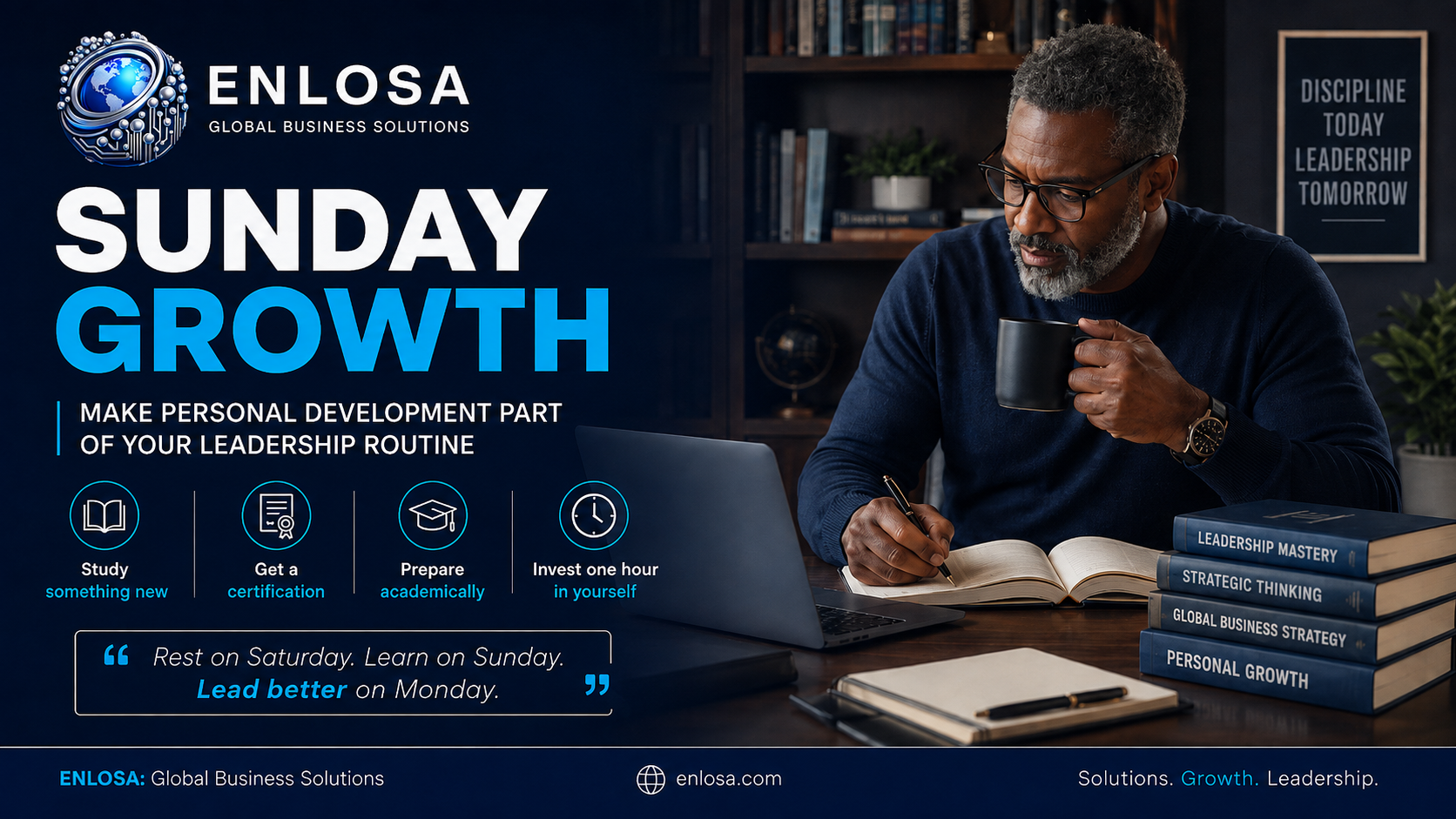
Sunday, August 23, 2026
There is an interesting point in almost every career when experience starts doing two very different things for us.
It gives us confidence.
But it can also make us comfortable.
After years of solving problems, leading teams, managing difficult situations, and learning through successes and mistakes, it becomes easy to believe that experience alone will carry us through the next stage of our careers.
I don’t think it will.
The world around us keeps changing whether we are ready or not.
Technology changes. Industries change. Customers change. Leadership expectations change. Artificial intelligence is changing how work gets done. New generations are entering the workforce with different expectations. Business models that worked ten years ago are being challenged today.
So experience matters enormously.
But experience without continued learning can eventually become outdated experience.
We Should Never Stop Being Students
One of the things I increasingly appreciate about leadership is that the more you learn, the more you realize how much there still is to understand.
That is not a weakness. It is actually one of the healthiest places a leader can be.
You can have decades of experience and still sit down on a Sunday morning and study something you do not fully understand.
You can be an operations executive and study finance. A finance leader can learn more about supply chain. A manufacturing leader can study artificial intelligence. A CEO can learn more about organizational psychology. An experienced executive can go back and take a certification course.
None of that diminishes your experience. It makes your experience more relevant.
Certifications Still Have Value
I have heard experienced professionals say: “At this point in my career, I don’t need another certification.”
Maybe.
A certification will never replace twenty or thirty years of real experience. But that is not really the point.
The right certification gives us a structured reason to study again. It exposes us to updated methodologies. It introduces terminology and approaches that may not have existed when we first learned our profession. It can also force us to challenge some of the assumptions we have accumulated over the years.
And yes, sometimes it strengthens professional credibility. There is nothing wrong with that either.
The important question is not: “Do I need another certificate on my wall?”
The better question is: “What do I need to learn next?”
Experience and Academic Preparation Should Work Together
There is something powerful about combining practical experience with structured academic learning.
Experience teaches us: This worked.
Study helps us understand: Why did it work?
And deeper learning pushes us to ask: Would it still work today?
That last question matters, because one of the biggest risks experienced leaders face is repeating solutions that worked beautifully in a business environment that no longer exists.
The purpose of personal development is not to erase experience. It is to keep upgrading it.
Make Personal Development Intentional
Most leaders are very good at creating development plans for other people.
We tell our employees to take courses. We encourage emerging leaders to find mentors. We talk about succession planning. We identify skill gaps. We recommend certifications. We create career paths.
But how often do we create the same kind of development plan for ourselves?
Personal development should not stop when someone becomes a director, vice president, COO, CEO, consultant, or business owner.
If anything, the responsibility to keep learning becomes greater.
One Hour on Sunday
Personal development does not always require going back to school. Sometimes it simply requires protecting an hour.
- One hour to read.
- One hour to complete a course module.
- One hour to research a certification.
- One hour to understand a new technology.
- One hour to study an industry you know very little about.
- One hour to listen to a university lecture.
- One hour to practice another language.
- One hour to revisit a management concept you learned twenty years ago and see how it has evolved.
- One hour to take notes.
- One hour to become slightly better than you were yesterday.
That may not sound dramatic. But repeated every week, it becomes more than fifty hours of deliberate development every year. Over several years, that compounds.
A Question Worth Asking Yourself
This Sunday, instead of asking only: “What do I need to accomplish next week?”
Try asking: “What am I learning today that will make me better six months from now?”
That question is different. It moves our attention away from the immediate task list and toward the person we are becoming.
Our Perspective
At ENLOSA: Global Business Solutions, we believe continuous improvement should apply to people just as much as it applies to processes and organizations.
Businesses improve when their people improve. Teams become stronger when their leaders become stronger. And leaders become stronger when they remain curious enough to admit that there is always something else to learn.
So study. Take the course. Get the certification. Read the book. Ask questions. Learn something outside your area of expertise. Challenge something you think you already know.
Your title does not mean you have finished learning. Your experience does not mean there is nothing left to study. And your previous success does not guarantee that yesterday’s knowledge will solve tomorrow’s problems.
Personal development is not something we complete. It is something we continue.
Rest when you need to. Learn when you can. Keep developing. And show up Monday a little more prepared than you were the week before.
ENLOSA: Global Business Solutions
Strategy. Leadership. Execution.
#Leadership #PersonalDevelopment #ContinuousLearning #ExecutiveLeadership #LeadershipDevelopment #ProfessionalDevelopment #ContinuousImprovement #BusinessStrategy #ENLOSA #GlobalBusiness
Leave a Reply