
Tuesday, August 25, 2026
It is one of the most common sentences in business:
“We have a people problem.”
Sometimes that is true.
Sometimes the wrong person is in the wrong role.
Sometimes an employee is simply not performing.
Sometimes behavior, capability, attitude, or accountability really is the issue.
But before we label something a people problem, leaders should ask a harder question:
Did we create the conditions for that person to succeed?
Because many performance problems do not start with the employee.
They start with unclear expectations, inconsistent leadership, poor communication, weak processes, missing training, conflicting priorities, or a lack of accountability.
And those are leadership problems.
People Cannot Deliver Against Moving Targets
One of the fastest ways to frustrate a team is to constantly change priorities without explaining why.
Monday, cost is the priority.
Tuesday, customer responsiveness becomes the priority.
Wednesday, inventory reduction suddenly dominates the discussion.
Thursday, a new project becomes “urgent.”
By Friday, the team is working hard but is no longer sure what success actually means.
Then leadership asks:
“Why is execution so inconsistent?”
People cannot consistently deliver against moving targets.
Leaders have to create clarity.
That means explaining what matters most, what can wait, what has changed, and why.
A team can handle change.
What destroys confidence is change without context.
Accountability Starts With Clear Expectations
Leaders often say they want accountability.
But accountability is impossible when expectations are vague.
“Do better.”
“Be more proactive.”
“Improve communication.”
“Take more ownership.”
Those statements may sound reasonable, but they are not specific enough to manage performance.
What does “better” mean?
What does ownership look like?
What exactly should improve?
By when?
How will we know?
Before holding someone accountable for missing an expectation, leadership has to make sure the expectation was actually clear.
A good leader should be able to answer:
What result did I ask for?
Did the employee understand it?
Did they have the authority to act?
Did they have the tools and information needed?
Did I provide feedback early enough to help them correct course?
If the answer to several of those questions is no, the performance problem may not belong entirely to the employee.
Training Matters More Than We Admit
Businesses sometimes expect people to perform jobs they were never properly prepared to do.
A strong individual contributor is promoted into management.
A technically excellent engineer suddenly becomes responsible for leading people.
A buyer is expected to become a strategic sourcing leader.
A production supervisor is asked to run continuous improvement.
A functional expert is moved into a cross-functional leadership role.
And then we assume they will figure it out.
Some do.
Many struggle.
That does not mean the promotion was a mistake.
It may mean the organization failed to provide the development necessary for the next level.
Leadership development should not begin after someone starts failing.
It should begin before the new responsibility arrives.
Processes Can Make Good People Look Bad
This is something operations leaders should understand particularly well.
A broken process can make a capable employee appear ineffective.
Imagine asking someone to deliver excellent customer service when:
order information is inaccurate,
inventory visibility is poor,
approvals take days,
planning constantly changes,
systems do not communicate,
priorities conflict,
and nobody has authority to solve the underlying problem.
Eventually, customers become frustrated.
Then management concludes:
“Customer service needs to improve.”
Maybe.
But perhaps customer service is simply where the organization’s broken processes become visible.
Before replacing people, leaders should examine the system surrounding them.
Sometimes changing the process creates a larger performance improvement than changing the person.
Leadership Behavior Sets the Standard
Employees pay very close attention to what leaders tolerate.
If meetings start late every week, punctuality is clearly not important.
If missed commitments have no consequences, accountability is optional.
If leaders ignore disrespectful behavior from high performers, values are negotiable.
If executives constantly bypass established processes, employees quickly learn that the process is not really the process.
Culture is shaped less by what leaders say and more by what leaders repeatedly allow.
That is why leadership behavior matters so much.
The team is always watching.
Feedback Should Not Be a Surprise
Another common leadership failure is waiting too long to address performance.
For months, someone struggles.
Their manager notices.
Colleagues notice.
Customers may even notice.
But nobody has the uncomfortable conversation.
Then eventually the situation becomes serious and the employee hears:
“Your performance has not been meeting expectations.”
And sometimes their first reaction is:
“Why didn’t anyone tell me?”
Feedback should not arrive as a surprise.
Good leaders address performance early.
Clearly.
Respectfully.
And with enough time for the person to improve.
That is not avoiding accountability.
That is responsible leadership.
High Standards and Strong Leadership Can Coexist
Looking at leadership first does not mean lowering standards.
It does not mean tolerating poor performance.
And it certainly does not mean keeping someone indefinitely in a role they cannot perform.
There are times when a person is simply not the right fit.
There are times when expectations have been clear, resources have been provided, coaching has happened, and performance still does not improve.
At that point, leadership has a responsibility to act.
But there is an important difference between accountability and blame.
Strong organizations do both things well:
They hold people accountable.
And they hold leadership accountable for creating the environment in which people are expected to perform.
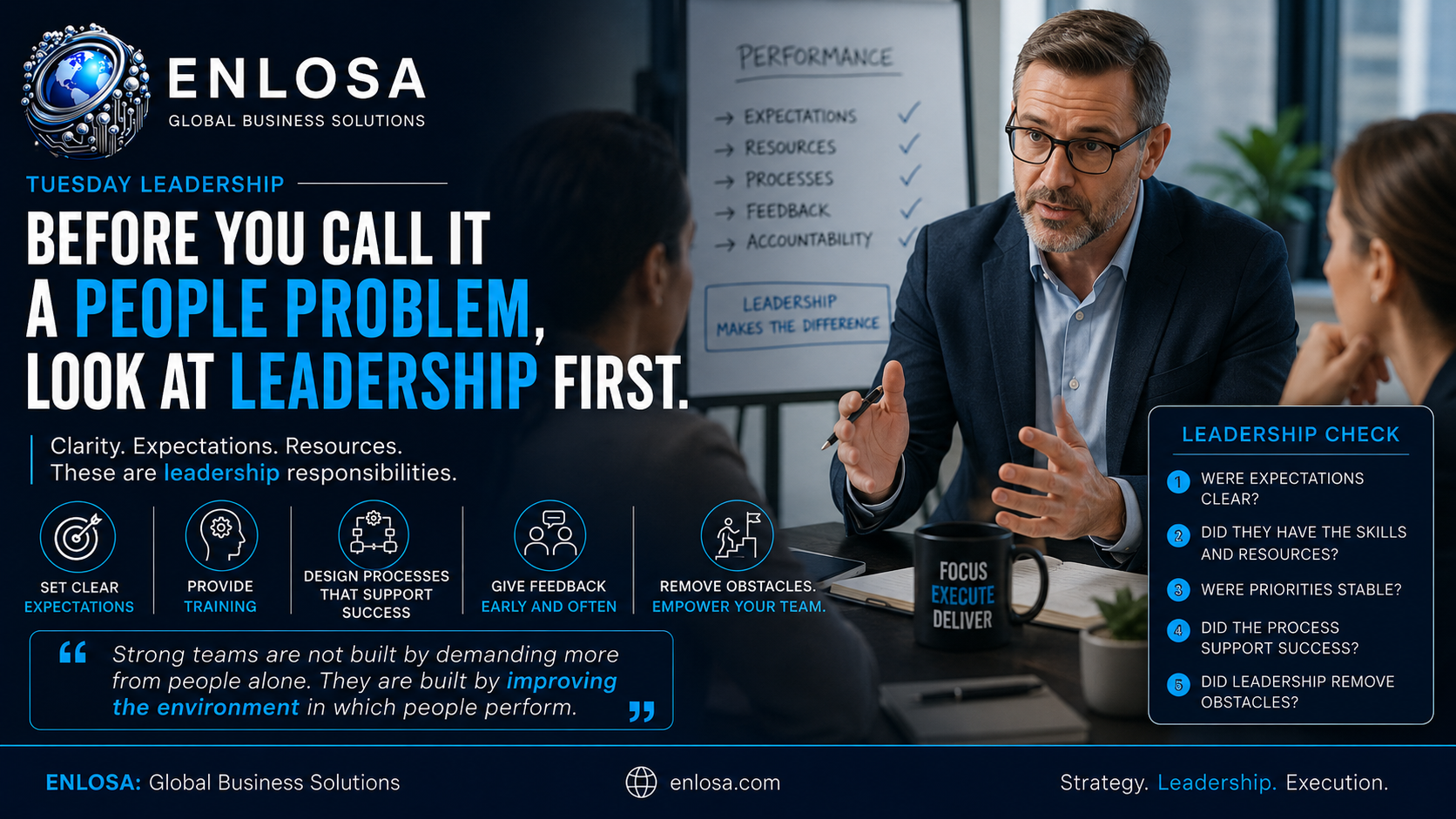
A Simple Leadership Check Before Calling It a People Problem
When performance is not where it needs to be, ask five questions:
Were expectations completely clear?
Did the person have the skills, training, and resources to succeed?
Were priorities stable enough for them to execute?
Did the process help or hinder performance?
Did leadership provide timely feedback and remove obstacles?
If the answer to all five is yes, then you may truly have an individual performance problem.
If several answers are no, leadership probably has work to do first.
Our Perspective
At ENLOSA: Global Business Solutions, we believe sustainable performance comes from aligning people, processes, systems, accountability, and leadership.
People matter enormously.
But even strong people struggle inside unclear or poorly designed organizations.
Leadership is responsible for creating clarity.
Leadership is responsible for setting standards.
Leadership is responsible for developing capability.
Leadership is responsible for removing unnecessary obstacles.
And leadership is responsible for making difficult people decisions when necessary.
So, the next time someone says:
“We have a people problem,”
ask one more question before deciding what to do:
“What part of this problem belongs to leadership?”
That question may be uncomfortable.
It may also be the one that actually improves the organization.
Strong teams are not built by demanding more from people alone. They are built by improving the environment in which people are expected to perform.
ENLOSA: Global Business Solutions
Strategy. Leadership. Execution.
Leave a Reply