
Friday, August 28, 2026
Every organization talks about values.
Integrity. Respect. Teamwork. Customer focus. Excellence. Accountability.
But values are not proven by what is written on a wall, published on a website, or presented during an all-hands meeting.
They are proven by what leaders do when commitments are missed, standards are challenged, results fall short, and difficult conversations become necessary.
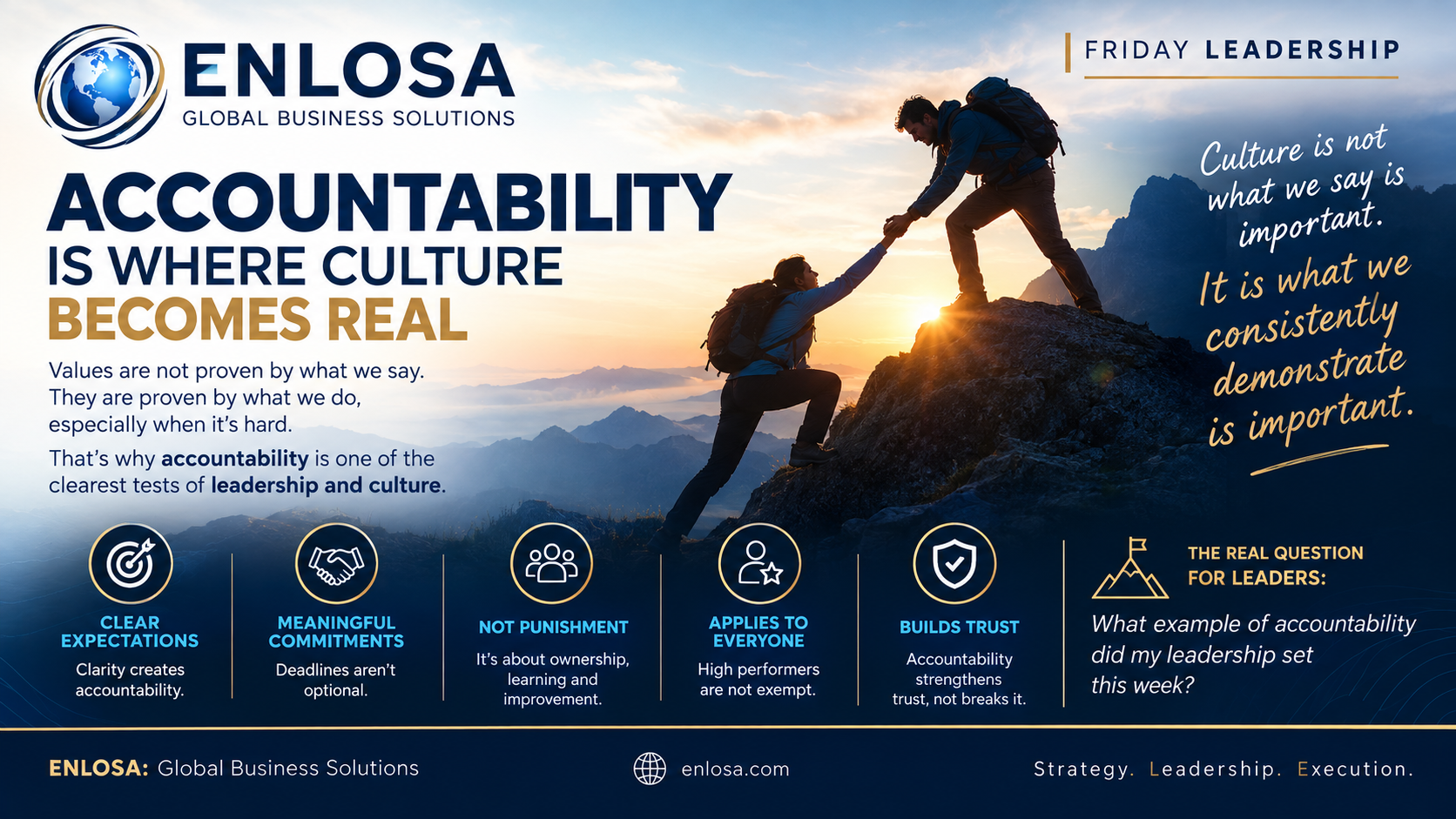
That is why accountability is where culture becomes real.
Accountability Starts With Leadership
It is easy to ask employees to take ownership.
It is harder for leaders to apply the same standard to themselves.
Strong leaders are willing to say:
“I made the wrong decision.”
“I did not communicate this clearly.”
“I committed to this and did not deliver.”
“I should have addressed this sooner.”
Those statements do not weaken leadership.
They strengthen credibility.
People pay close attention to whether the standards being demanded from the organization also apply to those leading it.
Accountability cannot simply flow downward.
It has to start at the top.
Clear Expectations Come Before Accountability
You cannot hold someone accountable for an expectation they never clearly understood.
“Improve performance.”
“Take more ownership.”
“Move faster.”
“Communicate better.”
Those may be reasonable intentions, but they are not sufficiently clear expectations.
Effective accountability starts with clarity:
What result is expected?
Who owns it?
When is it due?
How will success be measured?
What authority does the person have to make decisions?
What resources are available?
Before asking why someone failed, leaders should first ask whether success was clearly defined.
Accountability without clarity quickly becomes blame.
Commitments Must Mean Something
A culture begins to weaken when commitments quietly become optional.
An action item moves from one meeting to the next.
A deadline is repeatedly extended.
A project remains “almost complete.”
A problem is discussed several times but nobody clearly owns the solution.
Eventually, people learn the real standard.
Deadlines are negotiable.
Commitments are flexible.
Follow-through is optional.
Strong organizations operate differently.
When a commitment is missed, the conversation is not immediately about punishment.
It is about understanding reality:
What did we commit to?
What happened?
Why was there a gap?
What did we learn?
What needs to change?
Who owns the next action?
When will it be complete?
That is accountability in action.
Accountability Is Not Punishment
This distinction is important.
Mistakes happen.
Markets change.
Customers change priorities.
Suppliers fail.
Forecasts are wrong.
Projects encounter unexpected problems.
Good leaders understand that.
Accountability is not about finding somebody to blame every time something goes wrong.
It is about ownership, learning, correction, and improvement.
A blame culture encourages people to hide problems.
An accountability culture encourages people to expose problems early enough to solve them.
That difference can dramatically affect performance.
Accountability Must Apply to Everyone
This is one of the most important tests of organizational culture.
Sometimes a high-performing employee produces extraordinary results but consistently violates behavioral standards.
Maybe it is a salesperson generating significant revenue.
A technical expert considered indispensable.
An operations leader delivering excellent numbers.
Or a senior executive with considerable influence.
Then someone says:
“Yes, but look at their results.”
That is exactly when leadership values are tested.
If accountability changes depending on title, tenure, revenue contribution, technical expertise, or personal influence, accountability is not really a value.
It becomes a suggestion.
High performance should absolutely be recognized.
But performance should never create immunity from the standards expected of everyone else.
Consistent standards build credibility. Selective standards destroy it.
Accountability Builds Trust
Accountability and trust are sometimes treated as opposing ideas.
They should not be.
When handled well, accountability strengthens trust.
People trust colleagues who do what they say they will do.
They trust managers who address problems directly and respectfully.
They trust leaders who acknowledge their own mistakes.
They trust organizations where the same standards apply consistently.
And they trust teams where issues are surfaced early instead of hidden until they become crises.
Trust does not come from avoiding difficult conversations.
It comes from knowing those conversations will be handled fairly.
What Leaders Tolerate Becomes Culture
Culture is shaped through dozens of small moments every week.
A missed commitment nobody addresses.
A disrespectful comment leadership ignores.
A quality problem that gradually becomes accepted.
A meeting where actions are assigned but never reviewed.
A manager who repeatedly arrives unprepared.
An executive who operates under different rules.
Each time leadership ignores something, the organization receives a message:
This is acceptable here.
That is why leaders need to remember:
What you repeatedly tolerate eventually becomes part of the culture.
Accountability Should Create Better People, Not Fearful People
The objective should never be to create an organization where everyone is afraid to make mistakes.
Fear rarely produces sustained excellence.
Instead, leaders should create an environment where people understand that they are expected to own their actions, communicate problems early, ask for help when necessary, learn from mistakes, and follow through on commitments.
Accountability should help people grow.
The best accountability conversation does not simply ask:
“Who caused this?”
It also asks:
“How do we make sure we are better because this happened?”
That changes the conversation completely.
A Simple Friday Accountability Review
Before finishing the week, ask yourself:
- What did I commit to, and did I deliver?
- Were expectations clear for the people I lead?
- What commitment was missed and still needs to be addressed?
- What obstacle should leadership have removed sooner?
- Did I apply the same standards to everyone—including high performers?
- What behavior did I tolerate that could become tomorrow’s standard?
And then ask the most important question:
What example of accountability did my leadership set this week?
Our Perspective
At ENLOSA: Global Business Solutions, we believe accountability is one of the critical links between strategy, leadership, culture, and execution.
Strategy establishes direction.
Leadership creates clarity.
People make commitments.
Execution produces results.
And accountability ensures those commitments do not disappear somewhere in between.
Healthy accountability is not about creating fear.
It is about creating ownership.
Clear expectations.
Consistent standards.
Constructive conversations.
Learning.
Trust.
And better results.
Organizations become stronger when people know what is expected, understand that commitments matter, and trust that standards will be applied consistently.
But leaders must demonstrate that behavior first.
Because accountability is not something leaders impose on an organization.
It is something leaders demonstrate every day.
As the week ends, perhaps the best leadership question is also the simplest:
What did I say mattered this week—and did my actions prove it?
ENLOSA: Global Business Solutions
Strategy. Leadership. Execution.
#Accountability #Leadership #ExecutiveLeadership #OrganizationalCulture #LeadershipDevelopment #StrategyExecution #OperationalExcellence #PerformanceManagement #BusinessTransformation #ENLOSA
Leave a Reply