
Friday, September 4, 2026
Most organizations have values.
Integrity. Respect. Accountability. Safety. Customer focus. Teamwork. Excellence.
They appear on websites, office walls, employee handbooks, presentations, and leadership-development materials.
But employees do not decide what an organization’s culture is by reading the values statement.
They watch what actually happens.
They watch who gets promoted. They watch which behavior gets rewarded. They watch what happens when a high performer treats people badly. They watch whether leaders keep commitments. They watch whether someone can raise a difficult issue without paying a price. They watch what happens when doing the right thing becomes expensive.
And from those observations, employees learn the organization’s real values.
That is why three leadership ideas are deeply connected:
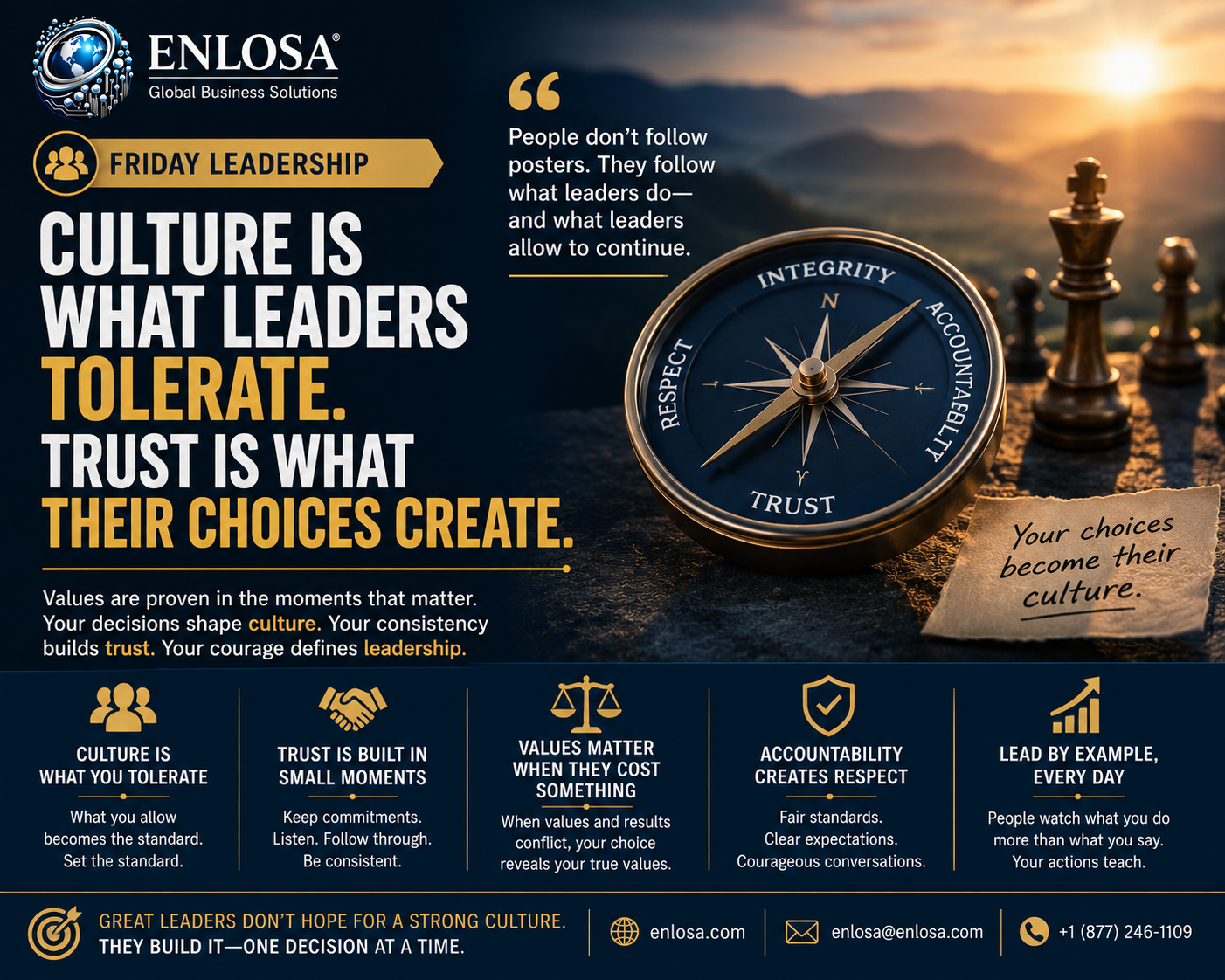
Culture is what leaders tolerate.
Trust is built—or destroyed—in small moments.
And values become credible only when leaders are willing to pay a price for them.
Culture Is Not What Leadership Announces
Leaders influence culture every day, often without realizing it.
A manager misses commitments repeatedly and nothing happens. A high performer produces extraordinary results but destroys relationships. A senior executive behaves in ways that would never be accepted from someone lower in the organization. A safety concern is raised but quietly pushed aside because production is behind schedule. A customer problem is hidden until quarter-end numbers are reported. A leader interrupts people constantly but talks about respect.
Everyone notices.
The organization learns something every time leadership responds—or fails to respond.
What leaders consistently tolerate eventually becomes organizational permission.
That is why culture is not primarily an HR initiative.
It is a leadership operating system.
Performance Does Not Excuse Behavior
One of the most difficult cultural tests occurs when the person creating the problem is also creating significant business results.
The individual may generate revenue, close important deals, deliver projects, possess unique technical expertise, have strong customer relationships, or consistently exceed financial targets.
That creates a temptation:
“Yes, the behavior is a problem—but look at the results.”
That sentence can be extremely expensive.
The Financial Times recently highlighted the case of senior banker Vis Raghavan, examining his departure from JPMorgan and subsequent move to Citigroup. The FT framed the situation as an organizational-behavior question involving the tension between strong financial performance, leadership conduct, corporate governance, and workplace culture.
Source: Financial Times — Leadership, performance and behavior in the Citi/JPMorgan case
The broader leadership question applies far beyond banking:
How much unacceptable behavior are organizations willing to tolerate from people who produce exceptional results?
If the answer is “more than we would tolerate from everyone else,” employees understand immediately that performance outranks values.
And once that message becomes credible, culture begins to change.
The High Performer Exception Is One of Culture’s Biggest Risks
Imagine two employees.
Employee A consistently delivers results and treats people with respect.
Employee B produces slightly better results but intimidates colleagues, hoards information, avoids accountability, and damages collaboration.
If Employee B receives the larger promotion because “results are what matter,” the organization has made a cultural decision.
It does not matter what the values poster says.
The decision said:
How you achieve the result matters less than the result itself.
That message spreads quickly.
Strong cultures therefore require two dimensions of performance:
What did you accomplish?
And:
How did you accomplish it?
Both should matter.
Trust Is Built in Small Moments
Trust is sometimes discussed as though it were a major corporate initiative.
Usually it is much simpler.
Trust accumulates through hundreds of small interactions.
A leader says they will follow up Friday. Do they? A difficult issue is raised in a meeting. Does the leader listen—or punish the person who raised it? A mistake happens. Does leadership investigate the system—or immediately look for someone to blame? A confidential conversation occurs. Does it remain confidential? A leader makes the wrong decision. Do they acknowledge it? A customer receives a commitment. Does the organization honor it when honoring it becomes inconvenient?
None of these moments seems transformational by itself.
Together, they define whether people believe leadership.
Trust is the accumulated evidence that words and actions are reasonably consistent.
When Words and Reality Separate
Few things damage trust faster than a large gap between what leaders say and what employees experience.
Boeing’s experience provides an important leadership case.
During U.S. Senate hearings examining Boeing’s safety culture in 2024, an expert panel member testified that workers heard leadership talking about safety while some employees nevertheless felt pressure to move aircraft through production quickly. Whistleblower testimony also raised concerns about employees fearing retaliation when challenging manufacturing practices. Boeing disputed significant parts of the allegations and said retaliation was prohibited, while also reporting a substantial increase in employee reporting through its internal portal.
Source: Associated Press — Senate scrutiny of Boeing’s safety culture
The leadership lesson extends beyond aviation.
An organization can say: Safety first. But employees determine whether safety truly comes first by watching what happens when safety conflicts with schedule.
An organization can say: Speak up. Employees decide whether they believe it by watching what happens to the person who actually speaks up.
An organization can say: Quality matters. Employees learn the truth when quality threatens a shipment date.
The strongest evidence of culture appears when two priorities conflict.
That is when employees discover which priority is real.
Values Matter Most When They Cost Something
Integrity is easy when being honest has no consequences. Customer service is easy when helping the customer costs very little. Safety is easy when production is on schedule. Respect is easy when everyone agrees. Accountability is easy when the person responsible is junior. Transparency is easy when the news is good.
Values become meaningful when there is a trade-off.
Imagine the decision costs a major sale, a quarterly target, a production shipment, a talented executive, a customer, a bonus, political capital, time, or someone’s promotion.
That is the moment when values move from words to leadership.
If a value disappears whenever it becomes expensive, it was probably never a value. It was a preference.
Leadership Decisions Create Cultural Precedent
Employees remember precedent.
“This happened before.” “That person was allowed to do it.” “Nothing happened last time.” “They’ll never challenge her because she delivers the numbers.” “That rule only applies below the executive level.”
These observations become part of organizational knowledge.
This is why leaders should be careful about dismissing behavior as an isolated incident.
Every exception creates a reference point.
The next manager can point to it. The next employee can rationalize against it. Eventually the exception becomes normal.
Culture often deteriorates gradually—not because leadership officially changed the rules, but because leadership repeatedly made exceptions to them.
When Leadership Acts, It Also Sends a Message
The opposite is equally true.
Decisive leadership action creates cultural information.
The Financial Times reported this week that BP appointed Ian Tyler as permanent chair following a turbulent period that included the removal of former chair Albert Manifold over what BP described as “unacceptable conduct.” Manifold has disputed the allegations. The FT noted that Tyler’s appointment comes as BP seeks stability and faces what one governance specialist characterized as a significant trust deficit.
Source: Financial Times — BP appoints new chair amid effort to restore stability and trust
What matters from a leadership perspective is the principle.
Organizations occasionally face moments when performance, stability, reputation, and behavior collide.
Whatever leadership chooses becomes visible evidence of organizational priorities.
Leadership cannot eliminate the cost of difficult decisions.
Sometimes enforcing standards creates disruption.
But refusing to enforce them also has a cost.
The difference is that the second cost is often hidden inside the culture.
The Cost of Waiting
Another important example comes from Nestlé.
The Financial Times reported in 2025 on governance turmoil surrounding former CEO Laurent Freixe and former chair Paul Bulcke. The FT reported that Freixe’s undisclosed relationship with a subordinate had been described by current and former executives as an “open secret,” while investors questioned whether the board had reacted quickly enough. The episode contributed to wider concerns about governance and confidence in leadership.
Source: Financial Times — Governance and leadership lessons from Nestlé
The lesson is not about one company.
It is about delay.
When problematic behavior becomes widely known but leadership does not respond, employees stop asking:
“Does leadership know?”
They start asking:
“Why is leadership allowing it?”
That changes the meaning of the situation.
What began as one person’s behavior becomes a leadership decision.
Silence Is Also a Decision
Leaders sometimes believe that avoiding an issue preserves harmony.
Often it does the opposite.
When a leader avoids addressing poor behavior, strong employees become frustrated, managers lose confidence in organizational standards, people become more cautious about speaking up, political behavior increases, trust decreases, and high performers who behave well begin wondering why they should continue holding themselves to a higher standard.
Eventually, people conclude that accountability is selective.
That conclusion can be far more damaging than the original behavior.
Leadership silence is rarely culturally neutral.
Trust Requires Consistency Across Levels
One of the quickest ways to damage culture is to create different rules for different levels of the organization.
If a frontline employee would be disciplined for something but a senior executive receives an exception, employees notice. If managers are told to control expenses while executives ignore the same discipline, employees notice. If employees are expected to meet commitments while leadership repeatedly changes priorities without explanation, employees notice. If leaders demand accountability but rarely acknowledge their own mistakes, employees notice.
Hierarchy will always involve different responsibilities.
It should not require different ethical standards.
Values become strongest when employees believe:
The standard becomes more demanding as responsibility increases—not less.
Accountability Without Trust Becomes Fear
Accountability is essential.
But accountability and trust must work together.
Accountability without trust can become fear.
Trust without accountability can become complacency.
High-performing cultures need both.
Employees should believe: I can raise a problem. I can admit a mistake. I can challenge an assumption. I will be treated fairly. And I am still responsible for my commitments.
That combination creates psychological safety without eliminating performance expectations.
Strong leaders do not choose between humanity and accountability.
They create environments where both can coexist.
Difficult Conversations Are Cultural Investments
Many cultural problems persist because leaders postpone uncomfortable conversations.
Maybe tomorrow. Maybe after quarter-end. Maybe after the project launches. Maybe after the customer meeting. Maybe when things calm down.
They rarely do.
Meanwhile, everyone else sees the behavior continuing.
A ten-minute difficult conversation avoided today can become a six-month cultural problem.
Great leaders understand something important:
Addressing behavior early is usually kinder—and less expensive—than allowing it to become a crisis.
Expectations should be clear. Feedback should be direct. The individual should have the opportunity to understand the concern and change. Accountability should be proportionate.
But avoiding the issue is not leadership.
Every Promotion Is a Cultural Announcement
Promotions are among the strongest cultural signals organizations send.
When you promote someone, you are not simply changing their title.
You are effectively telling the organization:
We want more of this.
More of this performance. More of this leadership style. More of these behaviors. More of these decisions. More of this example.
That is why organizations should evaluate leadership candidates beyond technical performance.
Can they develop people? Can they create trust? Can they handle disagreement? Can they accept accountability? Can they communicate honestly? Can they make difficult decisions without unnecessarily damaging relationships? Can they achieve results in a way that strengthens rather than weakens the organization?
A promotion should multiply capability.
Not multiply dysfunction.
Leaders Have to Model What They Ask From Others
Culture cannot be delegated.
Senior leadership cannot ask managers to create accountability if executives avoid it. Executives cannot demand transparency from employees while selectively communicating important information. Leaders cannot ask employees to collaborate while protecting organizational silos. They cannot ask people to accept feedback if they become defensive whenever they receive it. They cannot demand cost discipline while behaving as though seniority provides an exemption.
People watch leaders more carefully than leaders sometimes realize.
The higher the position, the stronger the signal.
Every senior leader is teaching the organization how leadership works.
Values Are Operational Decisions
Values should influence actual business decisions.
Consider safety. Does it influence production decisions?
Quality. Does it affect shipment decisions?
Customer commitment. Does it affect how claims are resolved?
Respect. Does it influence promotions?
Integrity. Does it affect how financial information is reported?
Development. Does it influence how talent is allocated?
Accountability. Does it apply to senior leadership?
If the answer is no, the organization does not have a values system.
It has communications material.
A Friday Leadership and Culture Review
Before finishing the week, leadership teams should ask:
- What behavior did we reward this week?
- What behavior did we tolerate that we should have addressed?
- Did anyone receive an exception because they are a high performer or senior leader?
- Where did our actions reinforce—or contradict—our stated values?
- Did we keep the commitments we made to our people?
- Did employees have enough trust to tell us something we might not want to hear?
- What difficult conversation are we postponing?
- What behavior are people learning from watching the leadership team?
- When our values and short-term results conflicted, which one won?
- What did my team learn this week about whether they can trust my word?
Those questions can reveal more about organizational culture than another employee-engagement presentation.
Our Perspective
At EGBS — ENLOSA: Global Business Solutions, we believe culture is created through leadership decisions repeated over time.
Not slogans. Not posters. Not annual meetings.
Decisions.
Who gets promoted. What gets rewarded. What gets challenged. What gets ignored. Whether commitments are kept. Whether difficult truths can travel upward. Whether standards apply equally. And whether leaders are willing to protect organizational values when doing so carries a cost.
Trust develops the same way.
One conversation. One commitment. One decision. One response to a mistake. One difficult moment at a time.
Eventually those moments become the organization’s reputation with its own people.
That reputation becomes culture.
So this Friday, perhaps the question is not:
“What are our company values?”
Most leaders already know what is written on the wall.
The more useful questions are:
“What behavior are we tolerating today that is quietly becoming part of our culture?”
“What did our choices teach employees about whether they can trust us?”
And perhaps the hardest one:
“When living our values costs something, are we still willing to live them?”
Because culture is not what leadership says when everything is easy.
Culture is what leadership chooses when the decision becomes difficult.
And trust is what remains after employees see the choice.
ENLOSA: Global Business Solutions
Strategy. Leadership. Execution.
Sources
- Financial Times — BP appoints new chair amid effort to restore stability and trust
- Financial Times — Leadership, performance and behavior in the Citi/JPMorgan case
- Financial Times — Governance and leadership lessons from Nestlé
- Associated Press — Senate scrutiny of Boeing’s safety culture
#Leadership, #Culture, #Trust, #Values, #Accountability, #BusinessEthics, #ExecutiveLeadership, #OrganizationalCulture, #LeadershipDevelopment, #EmployeeEngagement, #CorporateGovernance, #EGBS
Leave a Reply