
Thursday, September 3, 2026
Executives are expected to have a view of the future.
Where will the economy go? What will customers want? Which technologies will win? What will happen to tariffs? Where should we manufacture? Which markets will grow? How much capacity will we need? What will interest rates do?
We build forecasts, strategic plans, budgets, scenarios, and five-year models trying to answer those questions.
There is nothing wrong with forecasting.
The problem begins when we confuse a forecast with a strategy.
The future does not have to follow our assumptions.
Recent developments across trade, manufacturing, energy, technology, and global supply chains offer a useful reminder: conditions can change faster than an organization’s planning process.
The objective of strategy therefore should not be to predict one future perfectly.
It should be to create an organization capable of succeeding across several plausible futures.
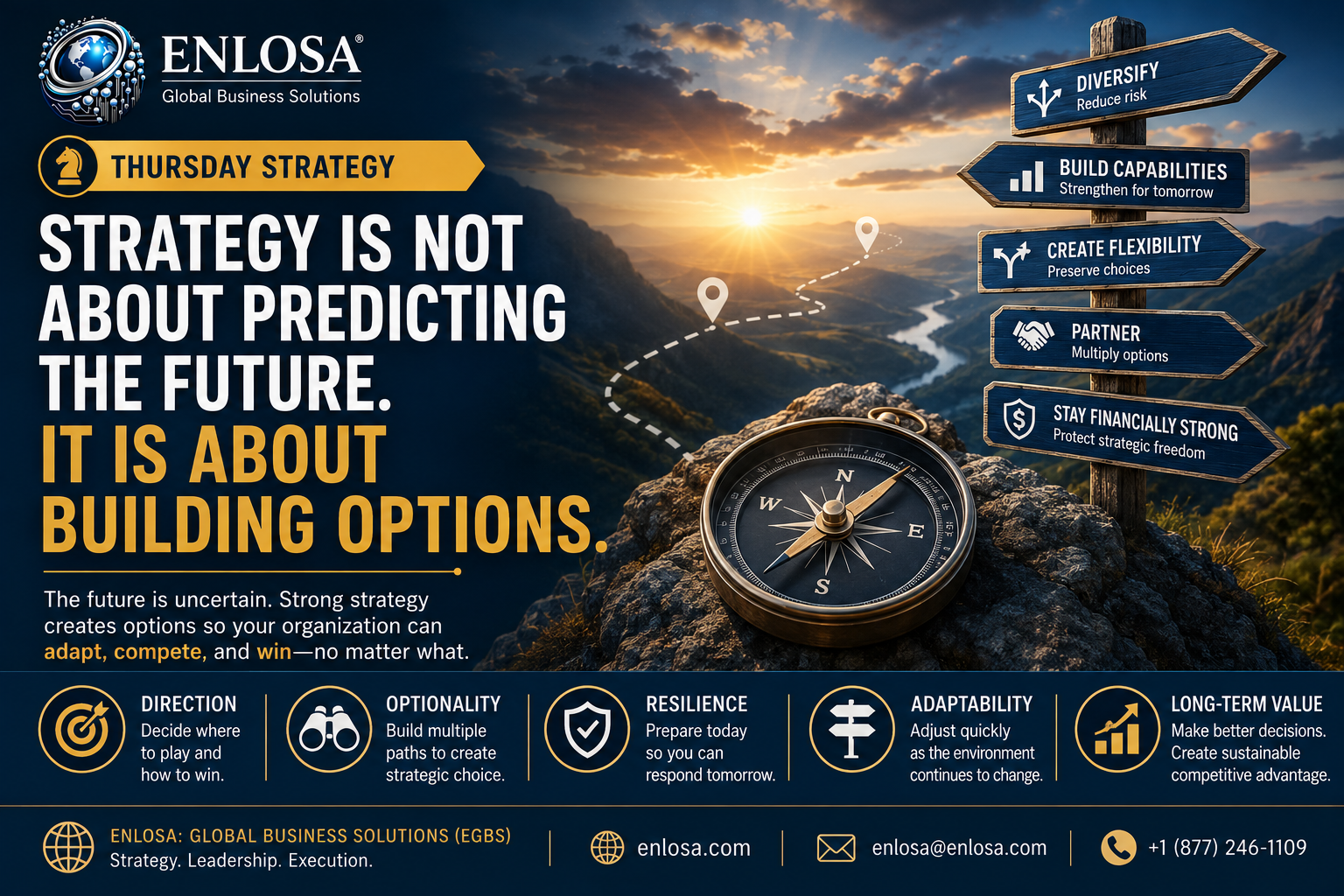
Great strategy builds options.
A Plan Usually Assumes a Future
Most strategic plans contain assumptions.
Customer demand will grow by a certain amount. A particular country will remain competitive. A supplier will continue providing a critical component. Interest rates will behave within a range. A technology will mature on schedule. Energy will remain available. A regulation will remain relatively stable. A competitor will react in a predictable way.
Those assumptions are necessary.
But they are still assumptions.
A business becomes vulnerable when the strategy only works if most of them are correct.
The question leaders should ask is not simply:
“What do we think will happen?”
It is also:
“What will we do if it doesn’t?”
That second question is where strategic optionality begins.
Look at the Business Environment Right Now
The external environment provides plenty of examples.
Trade policy remains fluid. The Financial Times has reported on continuing uncertainty around U.S. trade policy, including recurring reviews, investigations, negotiations, and potential policy changes that complicate long-term sourcing and investment decisions.
Source: Financial Times — U.S. trade policy remains in flux
Reuters also reported in late August that the U.S. administration was considering additional semiconductor tariffs that could extend beyond chips themselves to products containing them, including laptops, gaming consoles, and data-center servers. The framework was still subject to change.
Source: Reuters reporting — U.S. semiconductor tariff considerations
For executives responsible for global supply chains, that distinction matters.
You may have a forecast for tariffs.
But your strategy needs to work if the forecast is wrong.
Diversification Is an Option—Not a Guarantee
Supply-chain diversification has become one of the most common responses to geopolitical and trade uncertainty.
It makes sense.
But simply moving production from one country to another does not automatically create resilience.
Reuters recently examined Shein’s effort to establish Vietnam as a significant export base. Changing tariff conditions, labor constraints, and the unique capabilities of the company’s Chinese supplier network complicated that strategy.
Source: Reuters — Shein’s Vietnam diversification experience
That is an important strategy lesson.
An option has value only if it is operationally viable.
Having three suppliers on a spreadsheet does not create resilience if only one is truly qualified.
Having plants in three countries does not create flexibility if products cannot be transferred efficiently between them.
Having alternate logistics routes does not help if they have never been tested.
Strategic optionality requires more than identifying alternatives.
It requires developing them.
Resilience Has to Exist Before the Disruption
A major earthquake in southern Japan in July provided another reminder.
Reuters reported that automobile and semiconductor plants were forced to halt operations after the quake. Japanese manufacturers had spent years strengthening supply resilience following earlier disasters, making the event an important test of whether those investments actually reduced vulnerability.
Source: Reuters — Japan earthquake and manufacturing resilience
This is precisely how strategic options should work.
You do not build the alternative supply chain after the factory stops.
You do not qualify the second supplier after the first supplier fails.
You do not develop a recovery plan after the disruption begins.
By then, the organization is reacting.
The value of the option comes from developing it before it is required.
Optionality Does Not Mean Maximum Redundancy
Resilience can become expensive.
Duplicating every factory, supplier, inventory position, and technology platform would consume enormous amounts of capital.
That is not good strategy either.
The objective is not to create maximum redundancy.
It is to understand where the organization is most exposed and deliberately create options where the consequences of failure would be greatest.
Optionality should be proportional to strategic risk.
Sometimes the Best Option Is a Partnership
Building options does not always mean owning everything yourself.
The Associated Press recently reported on German manufacturers facing increasing competition from Chinese industrial companies. German material-handling company Jungheinrich is partnering with Chinese manufacturer EP Equipment on a lower-cost forklift offering, while Volkswagen has pursued an “in China, for China” development model as it adapts to a different competitive environment.
Source: Associated Press — German manufacturers adapt to changing Chinese competition
Whether those strategies ultimately succeed will depend on execution.
But the underlying principle is worth examining.
Faced with a changing competitive environment, the companies are not simply asking:
“How do we defend the existing model?”
They are exploring different ways to compete.
That is optionality.
Options Matter in Growth Markets Too
Strategic options are not only about protecting against downside risk.
They can also create access to upside.
Reuters reported in August that Nvidia invested in infrastructure developer Cloverleaf, a company that works with utilities, energy providers, and investors to secure power and infrastructure for AI data-center sites.
Source: Reuters — Nvidia invests in AI infrastructure developer Cloverleaf
This is interesting strategically because the constraint is moving.
The opportunity is no longer only access to computing technology.
Power. Land. Cooling. Site availability. Grid connections. Construction. Infrastructure execution.
A company that waits until those constraints are obvious to everyone may discover that competitors have already secured the best options.
You build options before their value becomes obvious.
Build Options Around Your Critical Dependencies
Every business has dependencies.
Some are visible. Others are hidden inside the operating model.
A company may believe its competitive advantage is its product while its true dependency is a specialized supplier. Another may believe its advantage is technology when the real constraint is engineering talent. A manufacturer may have excess factory space but insufficient electrical capacity. A global company may have suppliers in multiple countries but discover they all depend on the same tier-two source.
That is why leaders need to look beyond the first layer of the organization.
Ask:
Where are we dependent on one supplier, one geography, one technology, one customer, one individual, one channel, one source of capital, or one assumption?
Those concentrations are where strategic options can become extremely valuable.
Supply Chain Options
For operations and supply-chain leaders, optionality often starts with supply architecture.
Dual sourcing can matter. Regional sourcing can matter. Nearshoring can matter. Internal manufacturing capability can matter. Strategic inventory can matter. Supplier-development programs can matter.
But none of those choices should become ideology.
Reuters reported recently that U.S. officials are examining gaps in domestic manufacturing supply chains as foreign manufacturing investment increases, with particular attention to whether the component ecosystem exists to support larger manufacturing ambitions.
Source: Reuters — U.S. manufacturing supply-chain gaps and investment
That is a crucial point.
A factory does not operate independently.
Manufacturing depends on an ecosystem.
Materials. Components. Tooling. Equipment. Maintenance. Labor. Engineering. Logistics. Energy. Suppliers.
Creating manufacturing optionality therefore means understanding the entire value chain—not simply changing the address of the final assembly plant.
Capacity Options
Capacity is another strategic lever.
Companies often approach capacity planning with two extremes.
Too little capacity creates service failures, lost revenue, overtime, premium freight, and operational instability.
Too much creates poor asset utilization and weak returns.
Strategic capacity planning should therefore include options.
Can production move between plants? Can contract manufacturers provide surge capacity? Can equipment be added modularly? Can lines manufacture multiple product families? Can labor be flexed? Can tooling be transferred? Can processes be replicated? Could an existing distribution facility support light manufacturing if necessary?
The best capacity strategy may not be the lowest-cost answer under one forecast.
It may be the configuration that performs reasonably well across several demand scenarios.
Technology Options
Technology strategy has the same challenge.
Many organizations want to select the winning technology early.
Sometimes that creates an advantage.
Sometimes it creates lock-in.
AI is moving particularly quickly. A platform considered essential today may become commoditized. A model may improve. A vendor may disappear. A new architecture may dramatically reduce cost. Regulation may change.
Organizations therefore need enough technology commitment to move forward without creating unnecessary dependence on one future.
That might mean modular architectures, interoperable systems, clean data foundations, API-based integration, pilot programs, multiple technology partners, or contractual flexibility.
The objective is not indecision.
The objective is avoiding irreversible commitments before uncertainty has been reduced enough to justify them.
Talent Is Also an Option
Organizations rarely think about talent as strategic optionality.
They should.
A company with only one person who understands a critical process has a single-source risk. A leadership team with no internal successors has a capacity constraint. A company entering a new technology without developing internal expertise becomes dependent on outside providers.
Cross-training. Succession planning. Leadership development. Technical academies. Knowledge transfer. International assignments. Rotational programs.
Those initiatives do more than develop employees.
They create organizational options.
Capital Creates Strategic Freedom
Perhaps the most overlooked option is financial capacity.
Companies that consume every available dollar during good times have fewer choices when conditions change.
Liquidity. Debt capacity. Cash generation. Working-capital discipline. Portfolio management. Capital allocation.
These are not simply finance metrics.
They influence strategic freedom.
A company with financial flexibility can acquire a competitor when valuations fall, build capacity when others are cutting investment, secure inventory during shortages, fund a technology transition, enter a new market, or absorb a temporary disruption without making decisions that damage the long-term business.
Financial strength creates choices.
And choices create strategic leverage.
Do Not Confuse Optionality With Indecision
There is an important distinction.
Building options does not mean refusing to choose.
Strategy still requires commitment.
Companies still need to decide where to play, how to win, where to invest, what capabilities to build, and what not to do.
The purpose of optionality is not to avoid commitment.
It is to avoid unnecessary fragility.
A company can make a decisive strategic choice while preserving alternative paths if critical assumptions change.
Commit to the direction. Preserve flexibility in the path.
A Thursday Strategic Options Review
Before your next strategy meeting, consider these questions:
- What assumptions must be true for our current strategy to succeed?
- Which of those assumptions are outside our control?
- Where are we dependent on one supplier, geography, customer, technology, individual, channel, or source of capacity?
- Which dependency would create the greatest business impact if it failed?
- What alternative have we already developed—not merely identified?
- Where would a small investment today create a valuable strategic option tomorrow?
- Which decisions can remain flexible, and which require commitment now?
- If our current assumptions are wrong, what options have we created?
That final question deserves serious discussion.
Our Perspective
At EGBS — ENLOSA: Global Business Solutions, we believe strategy should provide direction without creating unnecessary rigidity.
The external environment will continue to change.
Trade policies will move. Technology will evolve. Competitors will respond. Customer expectations will shift. Supply chains will be disrupted. New markets will emerge.
Some forecasts will be correct.
Others will not.
The organizations best positioned for that environment will not necessarily be the ones with the most accurate five-year predictions.
They will be the organizations that understand their dependencies, identify their critical risks, deliberately build capabilities, and preserve enough flexibility to respond when reality differs from the plan.
That means developing suppliers before they are needed. Building talent before positions become vacant. Creating capacity alternatives before demand exceeds supply. Maintaining financial flexibility before opportunities appear. Testing technologies before committing the entire organization. And establishing partnerships before the market forces the conversation.
Strategy should tell an organization where it intends to go.
Strategic options determine how many ways it has to get there.
So this Thursday, perhaps the leadership question is not:
“Are we confident in our forecast?”
It is:
“If our forecast is wrong, are we still positioned to win?”
Because the strongest strategy is not the one that predicts the future perfectly.
It is the one that gives the organization choices when the future refuses to cooperate.
ENLOSA: Global Business Solutions
Strategy. Leadership. Execution.
Sources
- Financial Times — U.S. trade policy remains in flux
- Associated Press — German manufacturers adapt to changing Chinese competition
- Reuters — U.S. manufacturing supply-chain gaps and investment
- Reuters — Shein’s Vietnam diversification experiment
- Reuters — Japan earthquake tests manufacturing supply-chain resilience
- Reuters — Nvidia invests in AI infrastructure developer Cloverleaf
#Strategy, #StrategicPlanning, #BusinessStrategy, #OperationalExcellence, #SupplyChain, #Resilience, #RiskManagement, #Manufacturing, #Transformation, #ExecutiveLeadership, #StrategyExecution, #EGBS
Leave a Reply