
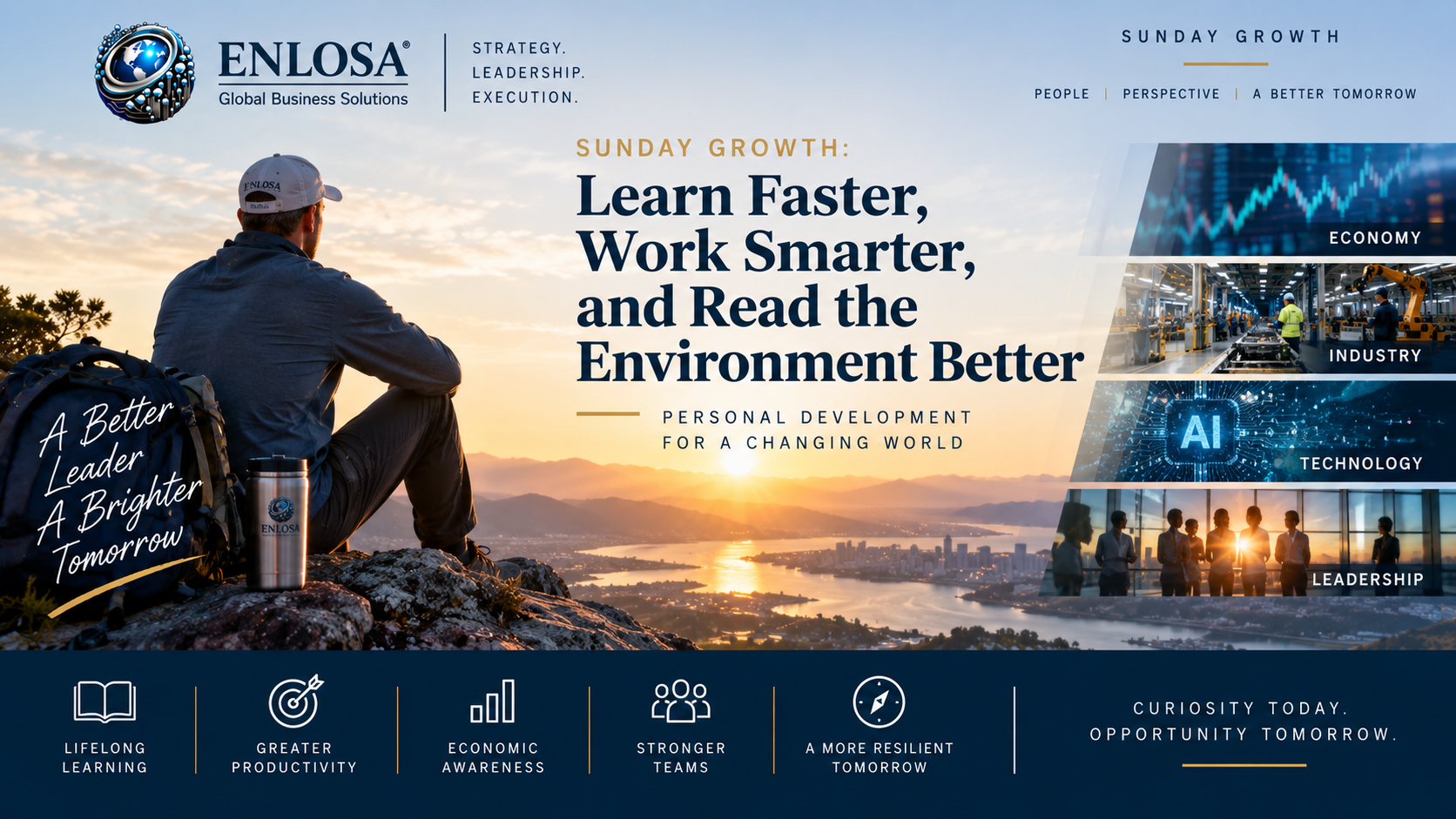
Sunday, September 6, 2026
Leadership development is often discussed as if it were separate from economic performance.
It is not.
The latest U.S. employment, productivity and manufacturing data point toward an environment that is growing, but changing quickly. Companies are hiring, manufacturers are producing more, technology is reshaping work, input costs remain elevated, and leaders are being asked to make decisions with increasingly mixed signals.
That combination creates an important personal-development question for every executive:
Are you developing as quickly as the environment around you is changing?
The U.S. Bureau of Labor Statistics reported Friday that nonfarm payroll employment increased by 162,000 in August, while unemployment remained at 4.1%. Employment patterns continue shifting across sectors, with the information industry losing jobs even while other areas added workers.
U.S. Bureau of Labor Statistics — Employment Situation, August 2026
One day earlier, BLS reported that nonfarm business productivity increased at a 1.4% annualized rate during the second quarter, while manufacturing productivity increased 2.4% and durable-manufacturing productivity increased 3.6%. Manufacturing unit labor costs declined 0.3% during the quarter.
U.S. Bureau of Labor Statistics — Productivity and Costs, Second Quarter 2026
Meanwhile, the Institute for Supply Management reported that U.S. manufacturing expanded for an eighth consecutive month in August, with its Manufacturing PMI at 54.6%. Production and employment remained in expansion, but growth moderated and the Prices Index remained elevated at 71.1%.
Institute for Supply Management — August 2026 Manufacturing PMI
The Federal Reserve’s latest Beige Book adds another layer: conditions vary considerably by geography and sector, businesses continue facing cost pressures, AI-related infrastructure and data-center investment are creating pockets of substantial activity, and some manufacturers remain cautious about demand.
Federal Reserve — Beige Book, September 2026
None of these signals, by itself, tells leaders what happens next.
Together, however, they make one thing clear:
Standing still professionally is becoming increasingly risky.
Your Experience Is Valuable. It Is Not a Permanent Competitive Advantage.
Many senior executives have spent twenty, thirty or even forty years building experience.
That experience matters.
Pattern recognition matters.
Judgment matters.
Having lived through recessions, acquisitions, capacity constraints, supply disruptions, labor shortages, plant launches, technology changes and difficult leadership situations creates capabilities that cannot be downloaded from software.
But experience can become dangerous when it turns into certainty.
The leadership practices that produced success ten years ago will not automatically produce success over the next ten.
Artificial intelligence is changing knowledge work. Automation is changing manufacturing. Data availability is accelerating decision cycles. Supply chains are being reconsidered. Workforce expectations are changing. Capital remains expensive enough that investment discipline matters. And geopolitical developments increasingly affect operations thousands of miles away.
The leadership question is therefore not whether your previous experience remains relevant.
It does.
The question is:
What are you adding to it?
Build a Career Moat Through Continuous Learning
Companies talk frequently about competitive advantage.
Leaders should think about their own professional competitive advantage in similar terms.
What capabilities would make you difficult to replace?
Industry knowledge? Operational expertise? Financial literacy? AI fluency? Strategic thinking? Supply-chain expertise? Negotiation? Communication? Developing people? Cross-cultural leadership? Understanding acquisitions?
The strongest executives rarely rely on only one.
Their advantage comes from combinations.
An operations leader who understands finance becomes more valuable. A finance leader who understands manufacturing becomes more effective. A supply-chain executive who understands commercial strategy sees decisions differently. A CEO who understands AI well enough to challenge both technologists and operators becomes better equipped to allocate capital.
And experienced leaders who continue learning often become more valuable precisely because they can combine new capabilities with decades of judgment.
That is the moat.
Not knowledge alone.
Knowledge integrated with experience.
Productivity Starts With How Leaders Use Their Own Time
The latest productivity numbers are encouraging for U.S. industry.
But productivity should not only be something executives expect from factories, warehouses or employees.
Leaders should examine their own productivity with the same seriousness.
Look at your calendar.
How much of your week is spent reviewing information someone else could summarize? Attending meetings where no decision is required? Responding to issues that should have been resolved one or two organizational levels below you? Preparing presentations instead of thinking? Approving transactions that do not warrant executive attention? Moving between meetings without enough time to think?
Technology can help.
AI can prepare summaries, analyze information, organize ideas and reduce administrative work.
But technology does not solve the fundamental question:
What should you be doing with the time you recover?
If AI saves a senior executive five hours per week and those five hours simply become five more hours of email, the organization has gained very little.
Recovered capacity should move toward higher-value leadership work.
Customer conversations. Talent development. Strategic thinking. Problem solving. Supplier relationships. Operational observation. Building the next generation of leaders. Making difficult decisions.
The objective is not simply to become busier faster.
It is to become more effective.
Economic Literacy Is Becoming a Leadership Competency
There is another capability executives increasingly need:
Understanding the economic environment well enough to ask better questions.
You do not need to become an economist.
But a senior leader should understand what indicators such as employment, productivity, inflation, manufacturing activity, interest rates and consumer demand might mean for the business.
The latest ISM manufacturing report provides a good example.
Manufacturing remains in expansion.
That sounds positive.
But underneath the headline, new orders and production were still growing at slower rates, employment growth moderated, supplier deliveries slowed further, and raw-material prices remained elevated.
Those signals might generate very different questions depending on the company.
Should we build inventory? Reduce it? Add capacity? Delay investment? Renegotiate supplier agreements? Adjust pricing? Accelerate automation? Hire now while talent is available? Protect cash?
The data does not make those decisions.
Leaders do.
But leaders who understand the environment can make better decisions than those operating only from internal reports.
Develop a Personal Economic Dashboard
Executives routinely review company KPIs.
Consider creating a small external dashboard as well.
Not fifty indicators.
Perhaps eight or ten.
Manufacturing PMI. Employment growth. Unemployment. Inflation. Interest rates. Productivity. Commodity prices relevant to your business. Freight or logistics indicators. Customer-industry demand. One or two indicators specific to your sector.
Then ask one question every month:
What has changed outside the company that might require us to change something inside it?
That habit alone can sharpen strategic awareness.
The Federal Reserve Beige Book is particularly useful because it reminds leaders that the U.S. economy is not one economy. Conditions can vary substantially by industry and geography.
National averages provide context.
Your markets provide reality.
Protect Time for Thinking
There is a paradox in senior leadership.
As responsibility increases, time for uninterrupted thinking often decreases.
The calendar fills. Problems escalate. People want decisions. Meetings multiply.
And eventually the executive becomes so occupied running the organization that there is little time left to think about where the organization is going.
That is dangerous.
Thinking time is not empty time.
It is leadership work.
A useful Sunday exercise is to ask:
Where did my attention go last week?
Then:
Where should it go next week?
Those two answers are frequently different.
Five Questions for Your Sunday Leadership Review
- What am I learning right now? Not what book is sitting on the nightstand. What capability are you deliberately developing?
- What am I still doing that someone else should own? Leadership capacity is often trapped inside work the leader should have delegated months ago.
- What external change deserves more of my attention? Economy, AI, customer behavior, competition, regulation, technology, labor or geopolitics.
- Where could technology improve my personal productivity? Not because technology is fashionable, but because executive attention is expensive.
- What should I understand better six months from now than I understand today?
That final question may be the most important.
Because development rarely happens accidentally.
Our Perspective
At EGBS — ENLOSA: Global Business Solutions, we believe organizations cannot transform faster than their leaders are willing to develop.
Strategy matters.
Technology matters.
Operational excellence matters.
AI matters.
But behind every one of them sits leadership judgment.
The leaders who remain effective through changing economic cycles are rarely those who know everything.
They are the ones who remain curious enough to keep learning, disciplined enough to use their time well, and humble enough to recognize when the environment is changing faster than their assumptions.
Experience gives leaders perspective.
Learning keeps that perspective relevant.
Productivity creates capacity.
Economic literacy improves judgment.
Together, they create something increasingly valuable:
A leader capable of adapting before circumstances force the organization to adapt.
So this Sunday, before thinking about everything your organization needs to improve, consider one more difficult question:
What does the leader need to improve?
Because your company is not the only thing that needs a strategy for the future.
You do too.
ENLOSA: Global Business Solutions
Strategy. Leadership. Execution.
enlosa@enlosa.com | +1 (877) 246-1109
References
- U.S. Bureau of Labor Statistics — “The Employment Situation — August 2026,” September 4, 2026.
Direct source - U.S. Bureau of Labor Statistics — “Productivity and Costs — Second Quarter 2026, Revised,” September 3, 2026.
Direct source - Institute for Supply Management — “August 2026 ISM Manufacturing PMI Report,” September 1, 2026.
Direct source - Federal Reserve — “Beige Book,” September 2, 2026.
Direct source
#SundayGrowth, #LeadershipDevelopment, #ExecutiveLeadership, #ContinuousLearning, #Productivity, #Manufacturing, #Economy, #Strategy, #PersonalDevelopment, #EGBS
Leave a Reply