
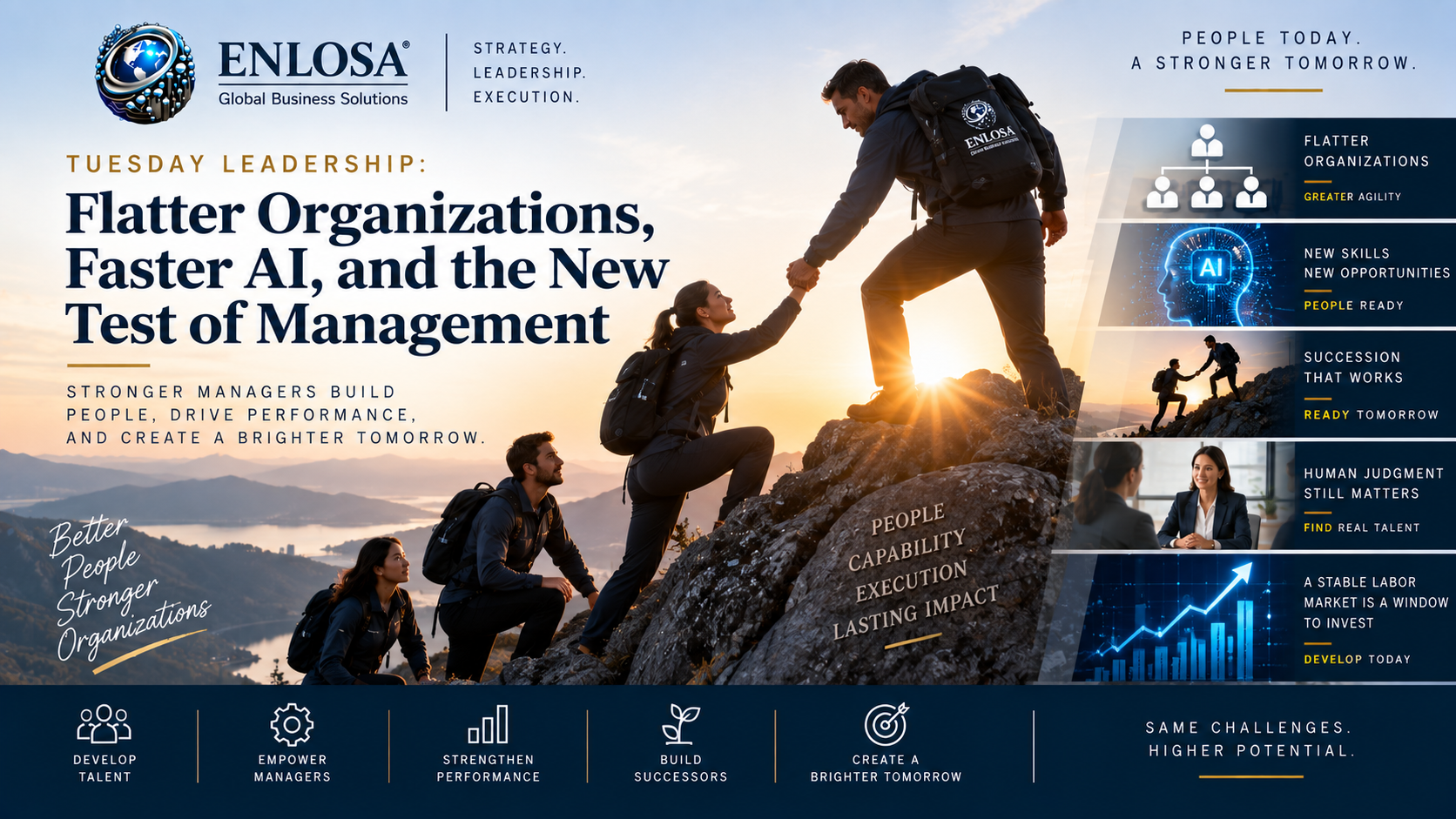
Tuesday, September 8, 2026
Organizations are becoming flatter. AI is changing work faster. Traditional hiring signals are becoming noisier. Critical skills are moving. And succession risk is becoming harder to ignore.
Taken separately, each of these developments looks like another workforce trend.
Taken together, they point to something much more important:
The quality of management is becoming more—not less—important.
Corporate America is actively reconsidering management layers. The Wall Street Journal reported this week that companies including Uber, Intel, Google, Coinbase and Axon have been reducing “micro-teams,” widening spans of control and expecting managers to become more active player-coaches. Uber’s restructuring includes a 20% reduction in managers as the company attempts to simplify operations and reduce organizational complexity.
The Wall Street Journal — Corporate America Is Axing the “Micro-Team” Boss
At the same time, companies are investing aggressively in building skills for an AI-driven workforce. Cognizant announced September 7 that it plans to hire 1,500 U.S. college graduates, expand new AI-era professional job families to 15,000 people and double its global AI-skilling commitment to two million people by 2030.
Cognizant — Invests in America’s AI-Era Workforce
The message for CEOs, COOs and operating leaders should be clear.
Removing management layers does not remove leadership work.
It simply changes who must perform it—and raises the consequences when they cannot.
A Flatter Organization Still Needs Leadership
There are legitimate reasons to simplify organizations.
Too many layers slow communication.
Small teams can create unnecessary management positions.
Decisions move upward when they should remain closer to the customer or operation.
Managers become coordinators of coordinators.
Information gets filtered through multiple levels before reaching the person who can act.
Flattening can improve all of that.
But removing a box from an organization chart does not eliminate the work the person inside that box was supposed to perform.
Someone still needs to establish priorities.
Someone still needs to coach employees.
Someone still has to resolve conflict.
Someone has to recognize deteriorating performance.
Someone must develop the next leader.
Someone must translate strategy into daily expectations.
Someone must make decisions when the answer is unclear.
The danger is creating an organization with fewer managers but no plan for redistributing those responsibilities.
When spans of control increase, remaining managers need stronger systems, clearer decision rights and better leadership capabilities.
Otherwise, “flatter” simply becomes another word for overloaded.
The important question is not:
How many managers can we remove?
It is:
What leadership capability must remain after we remove the layer?
Stop Developing People for Jobs That Are Already Changing
Organizational design is only half the issue.
The work itself is changing.
Cognizant’s September 7 workforce announcement is notable because the company is not merely talking about buying more AI. It is simultaneously creating new job categories, recruiting graduates into those roles and expanding workforce training. Its broader workforce research argues that AI is reshaping roles faster than many organizations are adapting.
That creates a practical problem for mid-market companies.
Many still develop employees based on the job they currently perform.
But development should increasingly be based on the capabilities the company will need next.
Consider a manufacturing planner.
The future job may involve less manual spreadsheet manipulation and more interpretation of AI-generated scenarios.
A buyer may spend less time collecting supplier information and more time negotiating, managing risk and making commercial decisions.
A supervisor may spend less time compiling production reports and more time coaching people and removing constraints.
A finance manager may move from reporting what happened toward helping operations anticipate what is likely to happen.
Training people only for today’s responsibilities creates tomorrow’s skill gap.
A better question is:
Which roles in our organization will look materially different two years from now—and what are we doing today to prepare the people occupying them?
Succession Planning Cannot Begin When Someone Resigns
There is another reason development matters.
Eventually, people leave.
SHRM reported September 2 that roughly four in ten talent-management executives identified creating a succession strategy as a major 2026 priority. Its central recommendation is important: effective succession should operate as a long-term, enterprise-wide system rather than a series of emergency replacement decisions.
SHRM — How to Know if Succession Planning Is Working in 2026 and Beyond
For mid-market and family-owned companies, succession risk can be particularly concentrated.
One plant manager knows the operation better than everyone else.
One sales leader owns the relationships with the largest customers.
One purchasing manager understands the supplier network.
One technician knows how to make an aging production line run.
One family member carries relationships that were built over decades.
The organization may look adequately staffed while being dangerously dependent on a handful of people.
A name on a succession chart is not a succession plan.
The real test is readiness.
Could the successor make the decisions?
Do they understand the financial consequences?
Have they managed difficult people?
Have they dealt with a major customer?
Have they led through an operational problem?
Have they had enough exposure to senior leadership?
Would the team accept their authority?
If not, they may be a candidate.
They are not yet a successor.
Ask:
If one of our five most important leaders left tomorrow, who could actually perform the role Monday morning?
AI Makes Human Judgment More Important
AI is also changing how organizations identify talent.
SHRM reported September 1 that AI is reshaping talent acquisition on both sides of the hiring process. Employers are automating sourcing, screening, communications and market analysis, while candidates are using AI to generate and tailor applications at increasing scale.
SHRM — How AI Will Transform the Talent Acquisition Function
The World Economic Forum highlighted the consequence September 2: when large numbers of applicants can generate polished résumés and applications quickly, traditional candidate signals become harder to distinguish. Referrals and human assessment may consequently become more valuable—but organizations also need safeguards to prevent networks and automated systems from simply reinforcing bias.
World Economic Forum — Human Connections and Hiring in the Age of AI
This is not an argument against AI in recruiting.
It is an argument for better managers.
Technology can help identify candidates.
It cannot eliminate the need to evaluate judgment, curiosity, accountability, communication, learning agility, character, problem-solving, ability to work with others, and leadership potential.
The same principle applies after hiring.
AI can surface performance data.
It can recommend training.
It can summarize feedback.
But a manager still needs to know the person.
The leadership advantage will not come from choosing between technology and human judgment.
It will come from knowing where each belongs.
A Stable Labor Market Is the Time to Develop People
The latest U.S. employment data gives employers another reason to act now.
The Bureau of Labor Statistics reported September 4 that nonfarm payrolls increased by 162,000 in August, unemployment remained at 4.1%, and manufacturing employment increased by 16,000. Manufacturing workweeks also edged up to 40.5 hours.
U.S. Bureau of Labor Statistics — The Employment Situation, August 2026
This is not a labor market in which employers should assume talented people have nowhere else to go.
Nor should companies wait until labor becomes extremely tight before becoming serious about retention.
The best time to develop high performers is before they become flight risks.
The best time to cross-train employees is before a critical person leaves.
The best time to expose future leaders to difficult decisions is before the promotion.
The best time to ask employees what they want from their careers is before another company asks them.
Retention should not begin with a counteroffer.
Development should begin much earlier.
Five Actions for Tuesday’s Leadership Review
- Audit spans of control—not just headcount. For every manager, ask whether the team size, complexity and responsibilities allow that manager to coach, communicate and make decisions effectively.
- Identify the five roles changing fastest. Determine how AI, automation, customer expectations and operating requirements will alter those jobs during the next two years. Build the skills now.
- Test succession readiness. For every mission-critical leadership position, distinguish between “possible successor” and “ready successor.” Give candidates experiences that close the gap.
- Upgrade how managers evaluate talent. Use AI where it improves efficiency, but retain human judgment around capability, character, adaptability and leadership potential.
- Ask your best people where they want to grow. Do not assume the next promotion, assignment or career path is obvious. Ask. Listen. Then decide what development opportunities the organization can realistically create.
The Manager Is Becoming the Critical Integration Point
Organizations are increasingly asking managers to integrate things that once sat in separate functions.
Technology. People. Performance. Culture. Change. Data. Development. Execution.
That is a much more sophisticated job than supervising tasks.
A manager may now need to interpret an AI recommendation, challenge the data behind it, explain a decision to employees, coach someone through a capability gap, maintain accountability and still deliver the operating result.
That is why organizations should be careful when celebrating reductions in management layers.
Fewer managers can be good.
Weaker management cannot.
A flatter company without strong managers will not necessarily become faster.
It may simply create more decisions with fewer people capable of making them.
Our Perspective
At EGBS — ENLOSA: Global Business Solutions, we believe organizational capability is created where strategy, people and execution intersect.
AI will change jobs.
Organization structures will change.
Management layers may become thinner.
Recruiting will become more automated.
The skills companies need will continue evolving.
But one principle is unlikely to disappear:
People still need leadership.
The organizations that perform best will not necessarily have the most managers.
They will have the right managers.
Managers who can make decisions. Develop people. Understand technology. Recognize talent. Hold standards. Build successors. Translate strategy into execution. And create organizational capacity rather than organizational dependency.
So this Tuesday, instead of asking only whether your organization has the right structure, ask something more important:
Do the managers inside that structure have the capability to lead what comes next?
Because flatter organizations do not reduce the need for leadership.
They expose the quality of it.
ENLOSA: Global Business Solutions
Strategy. Leadership. Execution.
enlosa@enlosa.com | +1 (877) 246-1109
References
- The Wall Street Journal — “Corporate America Is Axing the ‘Micro-Team’ Boss,” September 3, 2026.
Direct source - Cognizant — “Cognizant Invests in America’s AI-Era Workforce,” September 7, 2026.
Direct source - SHRM — “How to Know if Succession Planning is Working in 2026 and Beyond,” September 2, 2026.
Direct source - SHRM — “How AI Will Transform the Talent Acquisition Function,” September 1, 2026.
Direct source - World Economic Forum — “Why Human Connections Are Once Again a Hiring Advantage in the Age of AI,” September 2, 2026.
Direct source - U.S. Bureau of Labor Statistics — “The Employment Situation — August 2026,” September 4, 2026.
Direct source
#TuesdayLeadership, #LeadershipDevelopment, #TalentDevelopment, #SuccessionPlanning, #FutureOfWork, #ArtificialIntelligence, #Management, #OrganizationalDevelopment, #HighPerformers, #EGBS
Leave a Reply