
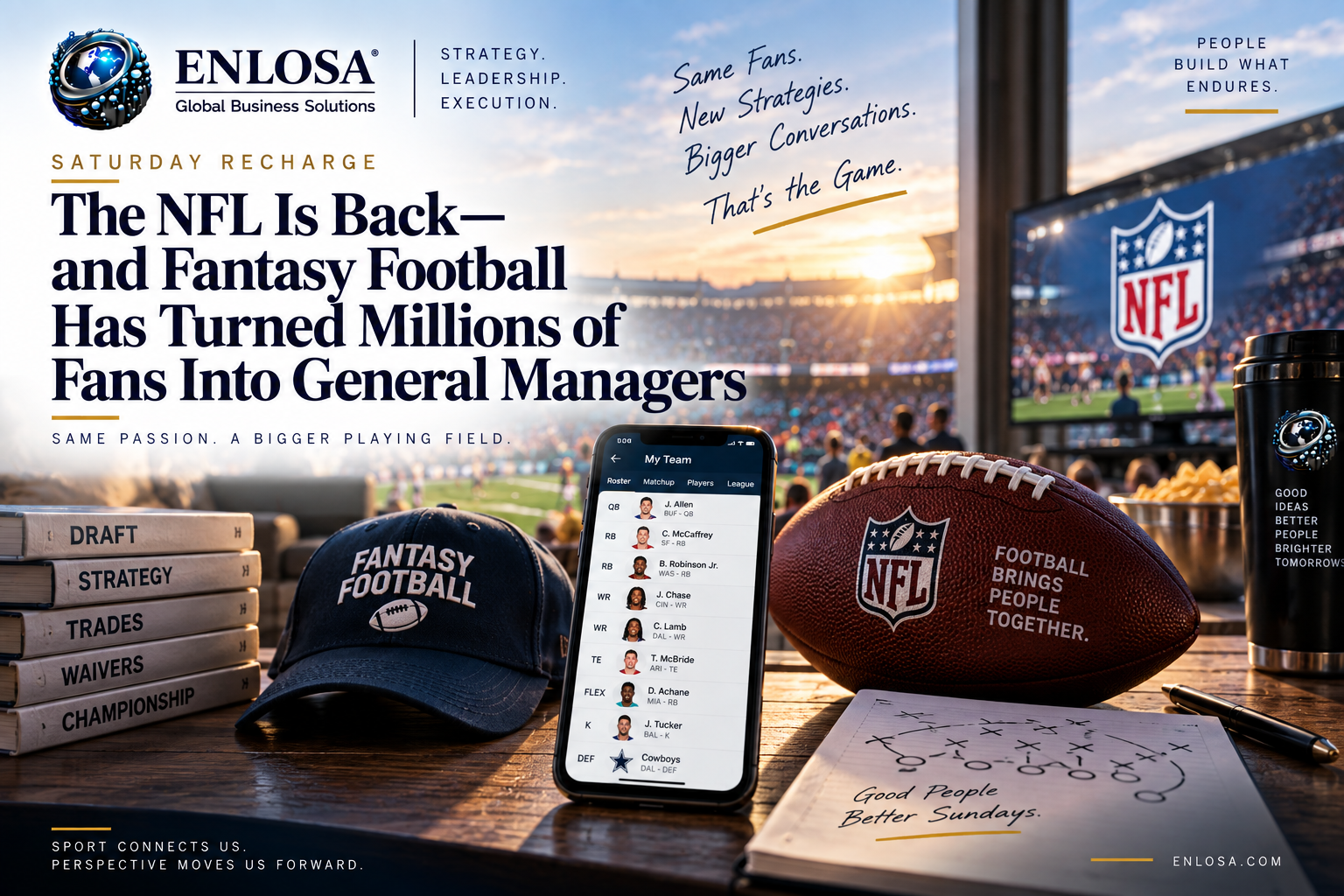
Saturday, September 12, 2026
For millions of Americans, September has its own rhythm.
Summer begins to fade. Weekends start filling with familiar rituals. Friends reconnect in group chats. Televisions come back on Sunday afternoons. Team jerseys come out of closets.
And suddenly people who have spent the previous seven months running companies, managing plants, meeting customers, raising families and solving everyday problems become very opinionated football executives.
The NFL is back.
The 2026 regular season officially opened Wednesday, September 9, with the defending Super Bowl champion Seattle Seahawks hosting the New England Patriots. The opening week then moved halfway around the world, with the San Francisco 49ers and Los Angeles Rams scheduled for the NFL’s first regular-season game in Melbourne, Australia, before the traditional Sunday schedule arrives on September 13.
National Football League — 2026 NFL Schedule and Week 1
That international opening is another reminder of what the NFL has become.
It is no longer simply an American Sunday-afternoon sports league.
It is a global entertainment ecosystem.
And increasingly, watching the game is only one part of the experience.
For millions of fans, another competition is taking place simultaneously on their phones.
Fantasy football.
The Game Inside the Game
Fantasy football has fundamentally changed the way many people experience the NFL.
A fan may still love the Miami Dolphins, Dallas Cowboys, Green Bay Packers or Pittsburgh Steelers.
But fantasy football introduces another layer.
Suddenly, the fan cares about the quarterback playing in another conference. A running back on a team he would normally never watch. A receiver catching passes during a late-afternoon game. A kicker attempting a field goal on Monday night. A player who gains one more yard before going out of bounds.
One touchdown can change an NFL game.
The same touchdown might simultaneously determine thousands—or millions—of fantasy matchups.
That changes attention.
Instead of asking only:
“Did my team win?”
the fantasy player begins asking:
How many targets did my receiver get? Who received the goal-line carries? Is that player injured? Who is available on waivers? Should I make a trade? What does the matchup look like next week?
And perhaps the most universal fantasy-football question:
Why did I leave that player on my bench?
Football becomes interactive.
Fantasy Football Is Becoming Part of the NFL Experience
This season brings an especially interesting change.
Beginning in 2026, the NFL no longer operates its own season-long NFL Fantasy Football game. ESPN Fantasy has become the official fantasy game of the NFL, with tools allowing former NFL Fantasy users to migrate leagues, settings and league history to ESPN.
ESPN — NFL Fantasy Is Moving to ESPN Fantasy
That decision illustrates how central fantasy has become to the broader sports ecosystem.
ESPN reported that its Fantasy app was the No. 1 fantasy sports app in July 2026, with 4.4 million unique users, according to Comscore data.
ESPN / Comscore — ESPN Digital & Social 2026
But the more interesting question is not how many people open a fantasy app.
It is:
Why do they keep coming back?
The answer contains some surprisingly useful lessons about human attention.
1. Fantasy Gives the Fan Something to Control
Watching football is fundamentally passive.
We can cheer. Complain. Celebrate. Question the coach. Question the referee. And, occasionally, explain loudly from our sofa what an NFL coordinator earning millions of dollars should obviously have done differently.
But we cannot affect the result.
Fantasy changes that feeling.
Now the fan makes decisions.
Draft the team. Set the lineup. Add a player. Drop another. Make a trade. Study matchups. Take a risk. Live with the result.
Academic research into what researchers call complementary digital experiences found that fantasy football can strengthen the underlying sports experience through five characteristics:
control, camaraderie, continuation, competition and customization.
Journal of Business Research — Fantasy Sports and Complementary Digital Experiences
That first word matters.
Control.
People naturally engage more deeply with an experience when they can participate instead of simply observe.
Fantasy football turns the spectator into a decision-maker.
For a few hours every week, everybody gets to be the GM.
2. Competition Makes the Experience Personal
Football already provides competition.
Fantasy adds another competition layered directly on top of it.
And this one may involve your brother. Your neighbor. Your college roommate. Your coworker. Your customer. Your old boss. Or the friend who has spent the last three months explaining why his draft strategy is statistically superior to everyone else’s.
Recent YouGov research provides an interesting picture.
Among Americans planning to play fantasy football in 2026, 67% identified competition as a reason for participating.
But competition is not the only attraction.
58% said fantasy makes the football season more interesting.
YouGov — NFL Fantasy Football Season in the U.S., 2026
That is a powerful engagement mechanism.
The NFL already provides the event.
Fantasy provides a reason for someone to care about more of the event.
A game between two teams that might otherwise have little relevance suddenly matters because your opponent has the quarterback and you have the receiver.
The product has expanded the customer’s reason to pay attention.
3. Fantasy Football Is Also a Social Network
One of the best parts of fantasy football often has very little to do with statistics.
It is the league itself.
The jokes. The trade offers. The terrible trade offers. The weekly trash talk. The draft-night traditions. The person who somehow forgets to set a lineup every season. The friend who proposes twelve trades before Week 2. And the league commissioner who has somehow transformed a recreational competition into an organization requiring bylaws.
YouGov found that 57% of people planning to play fantasy football this year cited socializing as a reason they participate.
YouGov — Fantasy Football Participation and Socializing
Recent academic research reinforces that idea.
A 2026 study examining fantasy football’s social role found evidence that participation can function as a way of maintaining connections and staying engaged with friends. Another recent qualitative study described fantasy sports as a social tool that can foster camaraderie and stimulate ongoing conversation.
Taylor & Francis — Fantasy Football and Social Connection
This may be fantasy football’s most human quality.
People who moved to different cities twenty years ago still draft together.
College friends who rarely see each other remain connected through a league.
Parents play with adult children.
Coworkers interact outside their organizational hierarchy.
For seventeen weeks, there is always something to talk about.
Fantasy football does not merely create users.
It creates communities.
4. The App Makes Every Moment Potentially Relevant
The smartphone changed fantasy football dramatically.
Years ago, fantasy participants might check a website after the games.
Today the experience follows the game almost continuously.
Injury notification. Touchdown alert. Score update. Player projection. Waiver news. Trade proposal. Lineup reminder. Breaking news. Monday-night matchup.
The game never entirely leaves the pocket.
YouGov found that nearly half—47%—of Americans planning to play fantasy football in 2026 consume fantasy-related content throughout the year, not only during football season.
YouGov — Fantasy Content Consumption, 2026
That is remarkable.
An 18-week regular season can generate a 12-month content relationship.
And fantasy participation appears to deepen actual NFL consumption.
Among 2026 fantasy players surveyed by YouGov, 31% described themselves as very heavy NFL viewers, watching 13 or more hours per week—nearly three times the rate among the broader group of U.S. adults interested in the NFL.
Earlier academic research reached a similar conclusion: fantasy participation increased consumption across television, internet, mobile and other sports media.
Sport Management Review — Fantasy Sports and Media Consumption
Fantasy does not replace football.
It gives people more reasons to watch football.
5. Every Week Starts Again
Perhaps fantasy football’s most effective engagement mechanism is also its simplest.
There is always another week.
Win Sunday? Enjoy it until Tuesday.
Lose badly? Tuesday brings waivers.
Wednesday brings roster decisions.
Thursday brings another game.
Sunday brings another opportunity.
A bad season can still produce a great weekly victory.
An injury changes the roster.
An unknown player suddenly emerges.
The person in last place beats the person in first.
The story keeps moving.
Research published in Entertainment Computing examined 698 fantasy-football players and found strong motivations associated with the experience mimicking real football and helping people maintain friendships.
Entertainment Computing — Continued Involvement in Fantasy Football
That continuing narrative matters.
The fantasy application is not asking someone to consume one piece of content.
It creates an ongoing story in which the user is one of the characters.
That is considerably more compelling.
What Fantasy Football Can Teach Business About Attention
There is an interesting business lesson here.
Many companies are fighting desperately for customer attention.
More emails. More advertising. More notifications. More content. More promotions.
But the strongest digital experiences frequently do something different.
They create participation.
Fantasy football provides an excellent example.
It combines:
Control — I make decisions.
Competition — I have something at stake.
Community — I share the experience with other people.
Customization — this is my roster.
Continuity — something changes every week.
Real-time feedback — I immediately see the consequences of my decisions.
The lesson for companies is not that every product needs to become a game.
It is that there is a fundamental difference between capturing attention and earning continued engagement.
Advertising can generate the first click.
Participation creates a reason to return.
But Attention Has a Cost
There is another side worth acknowledging.
Digital engagement can become excessive.
Anyone who has watched someone repeatedly refresh a fantasy matchup while sitting at dinner understands this.
Research examining 635 fantasy-football participants found that higher engagement and greater financial involvement could be associated with both positive mood and greater mental-health concerns for some participants. The researchers emphasized that the intensity of engagement matters when considering the overall experience.
Simulation & Gaming — Fantasy Football Involvement and Mental Health
That is useful perspective.
Fantasy football is entertainment.
It should remain entertainment.
There is a difference between enjoying competition with friends and allowing an application to dominate attention.
There is also an important distinction between traditional season-long fantasy sports and sports betting. They may increasingly coexist within the sports ecosystem, but they are not the same activity.
The Fantasy Sports & Gaming Association reported this summer that 31% of U.S. adults—approximately 82.8 million people—had participated in fantasy sports or sports betting during the previous twelve months, illustrating just how large the combined interactive-sports market has become.
Fantasy Sports & Gaming Association — 2026 Industry Research
Scale makes responsible engagement more important, not less.
Saturday Recharge
Saturday’s EGBS posts are intentionally different.
Monday is about execution. Tuesday is about people. Wednesday is about understanding the environment. Thursday is about strategy. Friday is about leadership and values.
Saturday should occasionally be about something simpler.
Enjoying life outside work.
For many people this weekend, that means football.
Sunday’s Week 1 schedule offers games throughout the afternoon, followed by Dallas against the New York Giants in prime time, while Denver visits Kansas City Monday night. The NFL is also expanding internationally this season, with nine regular-season games scheduled outside the traditional U.S. footprint, including Australia, Brazil, Mexico, England, Germany, Spain and France.
The league understands something important.
Sport works because it produces shared experiences.
Fantasy football intensifies that by making those experiences personal.
A touchdown in Cincinnati can suddenly matter to someone sitting in Florida.
A game in Seattle affects a fantasy league among friends in Arizona.
A receiver in Philadelphia becomes the subject of a Monday morning conversation in an office in Mexico.
Technology has taken something people already loved and added another layer of participation.
That is why millions keep opening the apps.
Not simply because there are statistics.
Because there is anticipation. Competition. Friendship. Identity. Hope. And next week.
Our Perspective
At EGBS — ENLOSA: Global Business Solutions, we spend much of the week thinking about serious things.
Strategy. Operations. Leadership. Markets. Supply chains. Performance.
Those things matter.
But leadership also requires knowing when to disconnect from them.
Sports can provide something businesses occasionally forget to protect:
Shared enjoyment without a strategic objective.
Watch the game. Argue about the call. Celebrate the touchdown. Enjoy the people around you.
And if you play fantasy football, check your lineup.
Preferably before kickoff.
Because while Monday will eventually arrive with priorities, meetings and execution challenges, this weekend offers something else.
Football is back.
And millions of temporary general managers are convinced that this year—finally—they drafted the championship team.
Enjoy Week 1.
ENLOSA: Global Business Solutions
Strategy. Leadership. Execution.
enlosa@enlosa.com | +1 (877) 246-1109
References
- National Football League — 2026 NFL Schedule and Week 1. The NFL’s 107th season opened September 9, with the opening week extending through Monday, September 14. Source
- YouGov — “NFL’s Fantasy Football Season Kicks Off: How Many Americans Are Playing in 2026?” August 2026. Survey of U.S. adults examining participation, motivations, media consumption and fantasy-football engagement. Source
- ESPN / Comscore — ESPN Digital & Social 2026. ESPN reported 4.4 million unique users for its Fantasy app in July 2026; ESPN Fantasy also became the NFL’s official fantasy game for the 2026 season. Source
- Fantasy Sports & Gaming Association / Angus Reid — 2026 Industry Research. Recent research tracks participation across fantasy sports and sports betting in the United States. Source
- Journal of Business Research — “Fantasy Sports and Beyond: Complementary Digital Experiences as Innovations for Enhancing Fan Experience.” Research identifies control, camaraderie, continuation, competition and customization as mechanisms through which fantasy football enhances the fan experience. Source
- Entertainment Computing — Revised Model for Initial and Continued Involvement in Fantasy Football, 2025. Research involving 698 players examines the factors underlying continued participation. Source
- Journal of Sport Behavior — Social Manifestations of Participating in Fantasy Sports, 2025. Research explores fantasy sports as a mechanism for camaraderie, maintaining relationships and ongoing social interaction. Source
- Simulation & Gaming — Fantasy Football Involvement and Mental Health, 2024. Study involving 635 fantasy-football players examines the relationship between intensity of engagement, social comparison, financial involvement and well-being. Source
#SaturdayRecharge, #NFL, #FantasyFootball, #NFLKickoff, #SportsBusiness, #FanEngagement, #DigitalEngagement, #CustomerExperience, #Leadership, #Recharge, #EGBS
Leave a Reply