
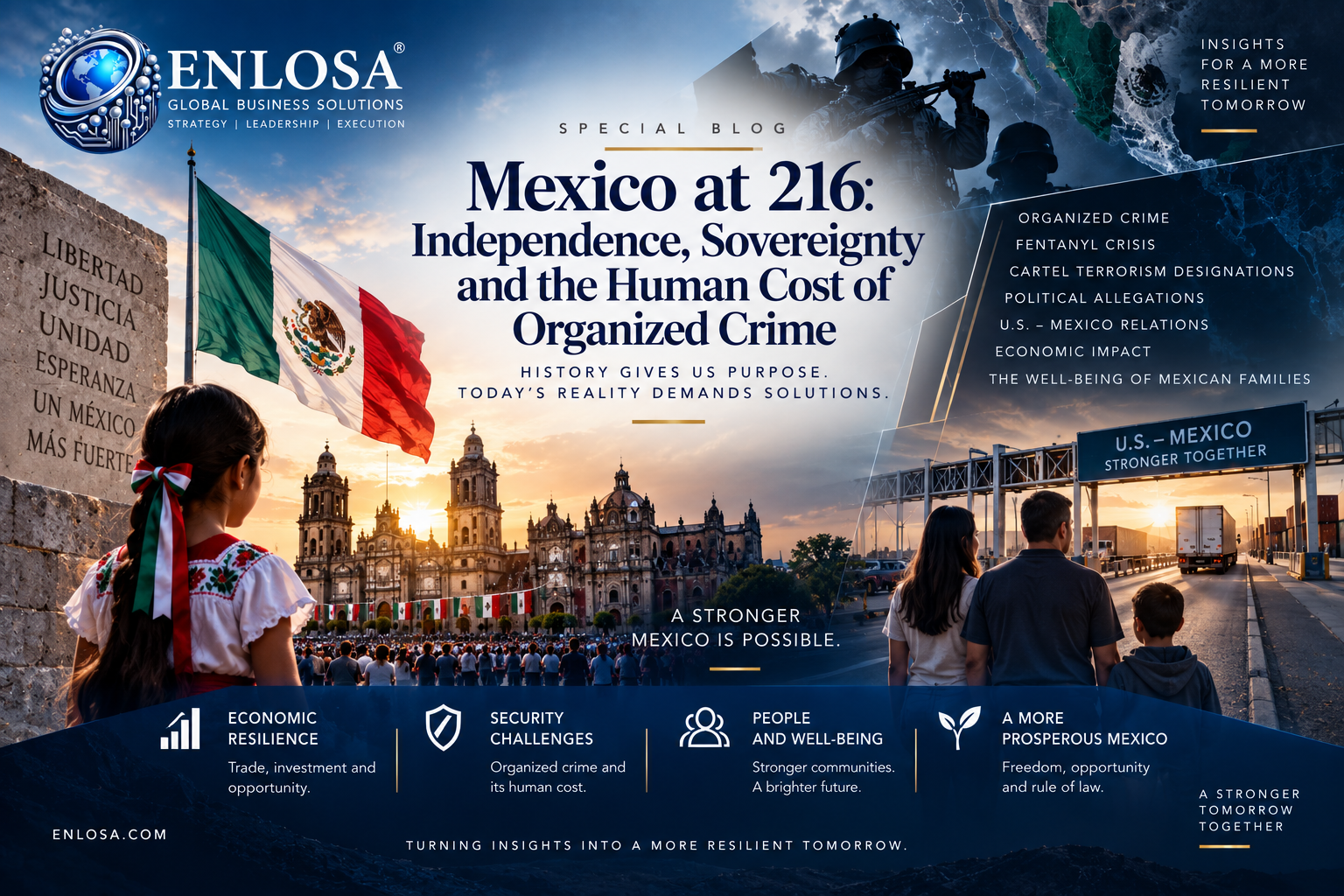
Special Independence Day Reflection — September 16, 2026
Every September 16, Mexico remembers the beginning of a struggle for independence that transformed the political future of a nation.
The bells. The flag. The Grito. The names of Hidalgo, Morelos, Allende, Guerrero and the men and women who fought for sovereignty.
Two hundred sixteen years after the uprising of 1810, independence remains one of the most powerful ideas in Mexican identity.
But in 2026, sovereignty is being discussed in a profoundly different geopolitical environment.
The United States has formally designated major Mexico-based drug cartels as Foreign Terrorist Organizations. U.S. prosecutors have charged senior Mexican public officials with allegedly collaborating with the Sinaloa Cartel. Washington has intensified sanctions against cartel financial networks. The fentanyl crisis has transformed organized crime from a bilateral law-enforcement problem into a U.S. national-security priority.
Mexican President Claudia Sheinbaum, meanwhile, has repeatedly rejected unilateral foreign intervention and insisted that security cooperation respect Mexican sovereignty. In September she again argued that the United States must also confront domestic drug consumption and the southbound flow of weapons, while stating that Mexican sovereignty is not negotiable.
Presidencia de México — September 10, 2026
Behind this geopolitical confrontation is a more important question:
What is the cost to ordinary Mexican people when organized crime becomes powerful enough to influence communities, legitimate markets, public institutions and the relationship between Mexico and its most important economic partner?
That question deserves attention on Independence Day.
Not as a partisan argument.
As a national economic and human one.
A New Geopolitical Reality: Mexican Cartels Are Now U.S.-Designated Terrorist Organizations
The geopolitical environment changed dramatically in February 2025.
Following a U.S. executive order, the Department of State formally designated six Mexico-based criminal organizations as Foreign Terrorist Organizations: Cartel de Sinaloa, Cartel de Jalisco Nueva Generación (CJNG), Carteles Unidos, Cartel del Noreste, Cartel del Golfo and La Nueva Familia Michoacana.
The designations were formally recorded through the Federal Register under Section 219 of the U.S. Immigration and Nationality Act.
Federal Register — Foreign Terrorist Organization designations
This is not merely a change in terminology.
The United States is increasingly treating cartel activity through the combined lenses of organized crime, terrorism, financial warfare and national security.
U.S. Treasury sanctions now target not only cartel leaders but companies, financial facilitators, fuel-smuggling networks and businesses alleged to support criminal organizations. In July 2026, Treasury sanctioned more than 50 Mexican individuals and entities linked to CJNG, describing the action as its largest ever targeting that organization.
U.S. Treasury — July 2026 CJNG sanctions
That creates an important new reality for Mexico:
Organized crime is no longer only a domestic security problem. It has become a major variable in Mexico’s foreign policy and economic relationship with the United States.
Fentanyl Changed the Relationship
Fentanyl is central to that transformation.
The DEA’s 2025 National Drug Threat Assessment identifies the Sinaloa Cartel and CJNG as central Mexico-based criminal organizations involved in supplying illicit fentanyl and other synthetic drugs to the United States, supported by international precursor, financial and distribution networks.
DEA — 2025 National Drug Threat Assessment
The human cost in the United States has been enormous.
There is, however, an important development that should not be ignored. CDC provisional data released in 2026 estimate approximately 69,973 U.S. drug-overdose deaths during 2025, almost 14% fewer than in 2024. Estimated opioid-involved overdose deaths fell from approximately 55,296 in 2024 to 44,564 in 2025.
CDC — 2025 overdose deaths, provisional results
The decline is encouraging.
But nearly 70,000 annual overdose deaths still represent an extraordinary public-health problem, and fentanyl remains embedded in a transnational criminal economy involving production, precursor chemicals, distribution and finance.
Washington emphasizes supply and national security. Mexico emphasizes another part of the equation: U.S. drug demand and the movement of weapons from the United States into Mexico.
Both dimensions matter.
There is no sustained illicit drug market without supply—but there is also no sustained illicit drug market without demand.
A durable North American response ultimately requires both countries to confront the parts of the system that originate within their own borders.
Morena and Organized Crime: Separate Evidence From Political Claims
This is perhaps the most politically sensitive part of the discussion.
There are serious documented allegations involving individual officials associated with Mexico’s governing Morena party.
On April 29, 2026, the U.S. Attorney’s Office for the Southern District of New York announced an indictment against Sinaloa Governor Rubén Rocha Moya and nine other current and former Mexican officials. U.S. prosecutors allege that the defendants conspired with Sinaloa Cartel leaders to facilitate narcotics trafficking in exchange for bribes and political support.
The Department of Justice expressly states that these are allegations and that the defendants are presumed innocent unless and until proven guilty.
U.S. Department of Justice — April 29, 2026 indictment announcement
Associated Press reported that Rocha is a member of the governing Morena party and that Mexico opened its own investigation after the U.S. charges. Rocha has denied the accusations.
Associated Press — Mexico’s response to the U.S. indictment
The Mexican government’s response is also part of the record. President Sheinbaum has repeatedly said accusations require evidence and that Mexican authorities must act according to Mexican law. In May, she emphasized that specific allegations against officials should not automatically be extended into broader conclusions about elections, parties or institutions without evidence.
Presidencia de México — May 7, 2026
Presidencia de México — May 21, 2026
That distinction is crucial.
There are documented allegations against individual political figures associated with Morena. That is not the same as documented proof that Morena as an institution maintains an alliance with organized crime.
The public evidence currently available does not justify presenting that broader claim as an established fact.
But the allegations themselves are extremely serious.
Because even unresolved accusations of political protection for criminal organizations can damage something every economy depends upon:
institutional trust.
The Economic Problem Is Much Larger Than Drug Trafficking
One of the mistakes in discussing Mexican cartels is imagining them simply as organizations moving drugs north.
Modern criminal organizations participate in broader economic activity, including fuel theft and smuggling, extortion, money laundering, human smuggling and the use of legitimate businesses and financial channels.
For example, the U.S. Treasury has documented and sanctioned alleged CJNG-linked fuel-theft and cross-border smuggling networks using shell companies, falsified customs documents and tax evasion. Treasury says these schemes generate substantial criminal revenue and erode legitimate public revenue.
U.S. Treasury — CJNG fuel theft and smuggling sanctions
Treasury has also sanctioned individuals and casinos allegedly linked to the Cartel del Noreste’s money-laundering and cash-smuggling enterprise near the U.S.–Mexico border.
U.S. Treasury — Cartel del Noreste financial-network sanctions
This matters because organized crime can begin to function like a parallel economic system.
It can tax businesses through extortion, distort legitimate markets, corrupt procurement, steal public revenue, raise transportation and security costs, discourage investment and create locations where commercial decisions are influenced by criminal control rather than market economics.
The IMF has identified crime and insecurity as macroeconomically significant for Mexico, noting that crime raises business operating costs and hinders growth. The OECD’s 2026 Economic Survey of Mexico similarly describes crime as a major concern for businesses and citizens and argues that improving security is important for investment and long-term growth.
International Monetary Fund — Mexico Article IV analysis
OECD — Economic Survey of Mexico 2026
Rule of law is economic infrastructure.
Mexico’s Economy Is Resilient—but Security Still Matters
Mexico is not an economy in collapse.
That distinction is important.
INEGI reported that Mexican GDP increased 1.5% in the second quarter of 2026 from the prior quarter and 2.1% from a year earlier.
INEGI — Current economic indicators
Banco de México’s August outlook placed 2026 growth within a range of 1.0% to 2.0%. The OECD’s June outlook was more cautious, illustrating the uncertainty surrounding the economic environment.
Banco de México — April–June 2026 Quarterly Report
OECD — Mexico Economic Snapshot
Mexico also remains deeply integrated with the world’s largest economy.
U.S.–Mexico trade in goods and services totaled an estimated $964.1 billion in 2025, according to the Office of the U.S. Trade Representative.
USTR — U.S.–Mexico trade relationship
That relationship provides Mexico with enormous strategic advantages: manufacturing integration, nearshoring opportunities, automotive production, electronics, aerospace, agriculture, medical devices, logistics and one of the world’s most important cross-border supply chains.
The United States, Mexico and Canada are simultaneously conducting the 2026 USMCA review process, discussing automotive rules of origin, steel and aluminum, economic security, agriculture and regional supply chains.
USTR — First 2026 bilateral USMCA review round
This creates a strategic overlap:
Mexico is negotiating the future of its most important economic relationship at the same time that security tensions with the United States are intensifying.
Investment decisions depend on more than labor cost.
They depend on predictability, infrastructure, energy, trade rules, security, rule of law and confidence that legitimate companies can operate without criminal interference.
The Most Important Cost Is Paid by Mexican Families
Economic data matter.
But Independence Day should ultimately bring the discussion back to people.
INEGI released its ENVIPE 2026 victimization survey on September 15.
The results describe the experience of Mexican households during 2025.
Approximately 28.5% of Mexican households had at least one member who reported being a victim of crime.
INEGI estimates approximately 33.8 million crimes occurred during 2025.
The most frequent included fraud, extortion and street or public-transport robbery.
Most strikingly, approximately 93.4% of crimes were either not reported or did not result in an official investigation being opened.
That number deserves attention.
A society cannot understand crime only through police reports if more than nine out of ten estimated crimes never become fully reflected in the formal justice system.
Perception is improving somewhat.
INEGI’s June 2026 urban-security survey found that 59.8% of adults living in the 91 urban areas surveyed considered their city unsafe, down from 63.2% a year earlier.
INEGI — Urban public-security survey, June 2026
Improvement should be recognized.
But nearly six out of ten urban adults feeling unsafe remains a profound social challenge.
Because insecurity changes behavior.
Where people go. When they leave home. Whether a family opens a business. Whether an entrepreneur expands. Whether a company sends an executive to a particular city. Whether someone reports extortion.
Those decisions rarely appear immediately in GDP.
But collectively they shape a country’s economic potential.
Insecurity acts like a hidden tax on daily life.
Mexico Has Also Made Real Social Progress
A credible analysis should not describe Mexico only through violence.
There have been important improvements in living standards.
INEGI’s 2024 multidimensional poverty measurement found that 29.6% of the population—about 38.5 million people—was living in multidimensional poverty.
That remains a large number.
But it represents a substantial improvement from 2016, when the rate was 43.2% and the number of people was 52.2 million.
INEGI therefore estimates a reduction of approximately 13.7 million people between 2016 and 2024.
INEGI — Multidimensional Poverty Measurement 2024
That progress matters.
The tragedy is that insecurity can consume part of the value of economic and social progress.
A family whose income rises but must spend more protecting its home has not received the full benefit.
A small business that grows but pays extortion is not operating in a free market.
A worker with a better salary who is afraid to travel at night has gained economically but lost another dimension of well-being.
Prosperity is more than income.
Security is part of prosperity. Freedom of movement is part of prosperity. Trust in institutions is part of prosperity. The ability to build a business without criminal permission is part of prosperity.
Sovereignty and Cooperation Are Not Opposites
This is where the political debate between Mexico and the United States becomes complicated.
Mexico is right to treat sovereignty as a central constitutional and historical issue. Its history gives the country many reasons to reject unilateral foreign intervention.
At the same time, organized crime does not respect national borders.
Fentanyl moves north. Weapons move south. Money moves through international financial channels. Chemical precursors move through global supply chains. Cartel finances cross jurisdictions. Human-smuggling networks operate internationally.
A purely national response is therefore structurally insufficient.
The challenge becomes:
How do two sovereign countries cooperate aggressively against transnational criminal organizations without turning cooperation into intervention?
That may be one of the most consequential U.S.–Mexico questions of the next decade.
Independence in 2026
Independence Day inevitably invites a question about sovereignty.
But perhaps 2026 requires a broader definition.
Sovereignty is international.
Who controls national territory? Who makes national policy? Can foreign governments dictate domestic decisions?
But sovereignty also has an internal dimension.
Can citizens open businesses without criminal permission?
Can elected officials govern without criminal pressure?
Can police enforce law without corruption?
Can companies transport goods without extortion?
Can journalists investigate without intimidation?
Can families live without calculating which road is safe?
Can a young person choose opportunity over recruitment by organized crime?
Those are not questions belonging to Morena, PAN, PRI or Washington.
They belong to Mexico.
The Independence Day Test
Mexico has extraordinary advantages.
A population of more than 130 million people. A sophisticated manufacturing base. One of the world’s strongest trade relationships. A strategic geographic position. World-class industrial clusters. A young workforce. Energy resources. Tourism. Agriculture. Entrepreneurship. A deep national culture.
Organized crime does not erase those advantages.
But it can reduce their value.
Every peso spent because of insecurity is a peso unavailable for productive investment.
Every entrepreneur intimidated by extortion represents potential growth constrained.
Every corrupt relationship between public power and criminal power—where proven—weakens institutions beyond the individuals involved.
Every unresolved allegation against public officials damages trust.
Every cartel controlling legitimate economic activity makes the market less free.
And every Mexican family changing its life because of fear pays a tax that never appears in the federal budget.
That may be organized crime’s most damaging economic consequence: it imposes a hidden tax on everyday life.
Our Perspective
At EGBS — ENLOSA: Global Business Solutions, we look at this primarily through the lens of institutions, economic performance and human well-being.
Mexico’s future should not be reduced to a debate between optimism and pessimism.
The data show both.
Economic resilience. Social progress. Extraordinary trade potential. And major reductions in poverty.
But also persistent victimization. Extortion. Institutional distrust. Criminal financial networks. Geopolitical tension. And allegations of political-criminal relationships serious enough to require transparent investigation and due process.
The appropriate response is not to prejudge guilt.
Nor is it to ignore credible allegations because they are politically uncomfortable.
A functioning rule-of-law system must be capable of doing both:
Protect the innocent from unsupported accusation—and investigate the powerful without political protection when credible evidence exists.
That principle should apply regardless of party.
On this Independence Day, perhaps Mexico’s most important opportunity is to connect its historic concept of sovereignty with a modern concept of institutional strength.
A sovereign country protects its territory.
A strong country also protects its institutions.
A prosperous country protects legitimate enterprise.
And a free country allows its citizens to live without fear of either criminals or arbitrary power.
Two hundred sixteen years after the Grito de Dolores, Mexico has already demonstrated extraordinary resilience.
The next challenge is ensuring that independence is experienced not only in ceremony—but in the daily lives of Mexican families.
In their security.
In their businesses.
In their communities.
In their institutions.
And in their confidence that the law—not organized crime—ultimately determines the rules of the country.
ENLOSA: Global Business Solutions
Strategy. Leadership. Execution.
enlosa@enlosa.com | +1 (877) 246-1109
Documented Sources and References
- Federal Register — Foreign Terrorist Organization designations
- U.S. Department of Justice — Sinaloa governor and nine officials indictment announcement
- Associated Press — Mexico response to U.S. indictment
- Presidencia de México — September 10, 2026
- Presidencia de México — May 7, 2026
- Presidencia de México — May 21, 2026
- U.S. Treasury — July 2026 CJNG sanctions
- U.S. Treasury — CJNG fuel-theft and smuggling sanctions
- U.S. Treasury — Cartel del Noreste financial-network sanctions
- DEA — 2025 National Drug Threat Assessment
- CDC — 2025 overdose deaths, provisional results
- INEGI — ENVIPE 2026
- INEGI — Urban Public Security Survey, June 2026
- INEGI — Multidimensional Poverty Measurement 2024
- Banco de México — April–June 2026 Quarterly Report
- OECD — Economic Survey of Mexico 2026
- IMF — Mexico Article IV analysis
- USTR — U.S.–Mexico trade relationship
- USTR — 2026 USMCA bilateral review round
#MexicoIndependenceDay, #Mexico, #RuleOfLaw, #OrganizedCrime, #Fentanyl, #USMexico, #USMCA, #EconomicDevelopment, #Security, #Geopolitics, #InstitutionalStrength, #Leadership, #EGBS
Leave a Reply