
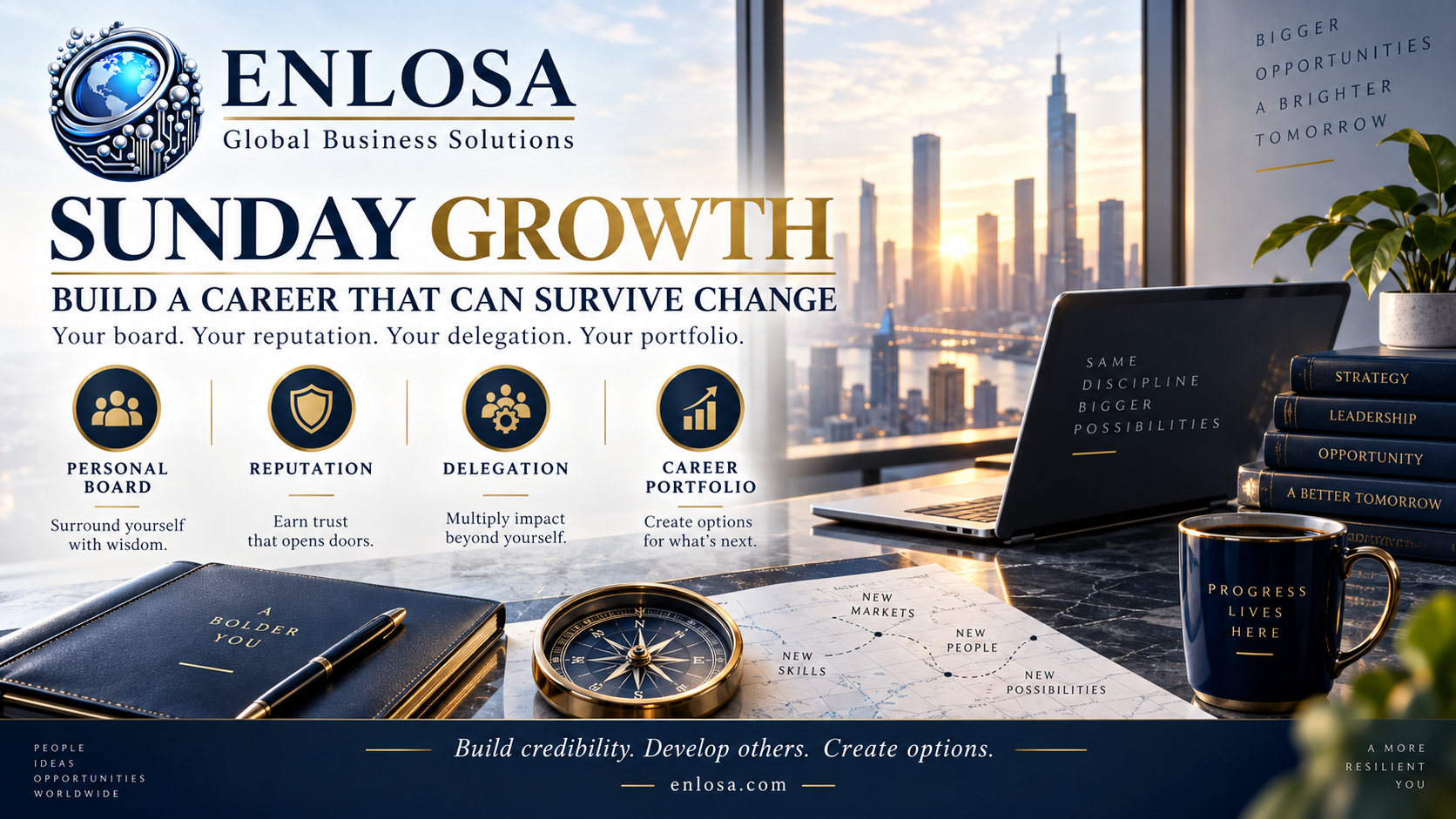
Sunday Growth — September 20, 2026
Career growth is often described as movement.
The next promotion. The next title. The next company. The next compensation level. The next leadership role.
But those milestones tell only part of the story.
A resilient career is built from assets that are much less visible.
People who will challenge your thinking. A reputation that opens doors before you enter the room. The ability to give away work and authority as your responsibilities increase. And a portfolio of experiences, capabilities and relationships that remains valuable even when a particular position disappears.
Those four assets matter because careers are becoming less linear.
Technology changes roles. Organizations restructure. Industries consolidate. Companies are acquired. Leadership teams change. Strategies shift. Personal priorities evolve. And sometimes the job you expected to hold for years simply stops existing.
That makes Sunday a useful time to ask a different career question.
Not:
“What is my next job?”
But:
“What am I building that will still have value regardless of what my next job happens to be?”
1. Build a Personal Board of Directors
One of the paradoxes of leadership is that the higher you rise, the easier it can become to receive less useful feedback.
Harvard Business Review recently described how senior executives can become increasingly insulated: direct reports filter their feedback, peers may hesitate to challenge them, and boards are often more focused on results than on the leader’s behavior. Source
That is dangerous.
Experience increases judgment.
But experience can also increase confidence in assumptions that nobody around you is willing to question.
A strong leader therefore needs more than a network.
A network gives you connections.
A personal board gives you perspective.
Harvard Business Review has long recommended the idea of a personal board of directors: a deliberate group of people who help uncover blind spots, provide feedback, challenge assumptions and, in some cases, advocate for your development. Source
You probably do not need one mentor who knows everything.
That person probably does not exist.
You may need several people who each see a different part of your professional life clearly.
Someone who understands your industry. Someone who understands finance. Someone who has already held the role you want. Someone who sees how you lead people. Someone who understands technology. Someone who knows your weaknesses. Someone who will tell you when your idea is wrong.
And ideally, someone who does not benefit from agreeing with you.
Your Board Should Not Be an Echo Chamber
Professional networks often become structurally biased.
We spend more time with people from our own industries, functions, professional histories and ways of seeing problems.
The 2026 Edelman Trust Barometer found that seven in ten respondents globally were hesitant or unwilling to trust people who differed from them in areas such as values, information sources, backgrounds or approaches to societal problems. The research covered 33,938 respondents across 28 markets. Source
That is broader societal research, but the leadership implication is worth considering.
If your trusted professional circle contains only people who think like you, it may reinforce your assumptions instead of testing them.
A useful personal board needs diversity of thought.
Not artificial disagreement.
Constructive disagreement.
You need people who support you enough to tell you something you may not want to hear.
Do Not Network Only Upward
There is another common career mistake.
Ambitious professionals frequently concentrate their networking efforts upward.
Senior executives. Board members. Important clients. Potential sponsors.
Those relationships matter.
But Harvard Business Review argued this year that aspiring leaders should not restrict relationship-building to people above them in the hierarchy. Strong professional networks also include peers and people across different functions and levels who provide information, collaboration and perspectives that senior-only networks cannot. Source
This matters because careers are built horizontally as well as vertically.
Today’s peer may become tomorrow’s CEO. Today’s supplier may become tomorrow’s customer. Today’s colleague may eventually recommend you for a position you did not know existed.
A powerful network therefore resembles an ecosystem.
Not a ladder.
The Sunday question:
Do the five people you call for difficult decisions give you five different perspectives—or the same perspective five times?
2. Treat Your Reputation as an Asset
The second career asset is harder to quantify.
Reputation.
Your reputation is not your résumé. It is not your LinkedIn profile. It is not your job title. It is not your personal brand statement.
Your reputation is the accumulated expectation other people have about how you will behave.
Will you deliver? Will you tell the truth? Will you remain calm under pressure? Will you solve the problem? Will you develop people? Will you take responsibility? Will you protect the organization? Will you treat people fairly? Will you disappear when the situation becomes difficult?
Those expectations accumulate slowly.
And they often begin working before you even enter the conversation.
Trust Is Accumulated
Korn Ferry CEO Gary Burnison described trust this year as something that rarely appears instantly. It builds through accumulated experiences: authenticity supports transparency, transparency supports honesty, and repeated honest behavior creates trust. Source
That is an important career principle.
Reputation is essentially compound interest on behavior.
One decision rarely defines a career.
Patterns do.
A person who delivers repeatedly becomes known for reliability. A leader who consistently develops people becomes known as someone talented employees want to work for. A manager who claims credit for everyone’s success eventually develops a different reputation.
Titles can be assigned.
Reputation has to be earned.
The Stakes Increase With Visibility
The higher your visibility, the more quickly an individual moment can affect professional perception.
Harvard Business Review noted this year that in a social-media environment, public interviews and statements can circulate rapidly and affect perceptions of a leader’s judgment, credibility and intent. Source
Executives therefore have another responsibility that earlier generations faced less intensely.
Your professional behavior is increasingly observable.
A comment. A video. An email. A public presentation. A LinkedIn post. A customer interaction recorded on a phone.
The environment remembers.
Reputation Is Not Popularity
A strong reputation does not require universal approval.
Good leaders make decisions some people dislike. They say no. They change organizations. They close facilities. They terminate projects. They hold difficult conversations. They challenge assumptions.
Reputation therefore should not be optimized for popularity.
It should be optimized for credibility.
Edelman describes trust as a strategic asset influencing behavior, reputation and outcomes. Source
The Sunday question:
If you were not in the room, what three words would the people who work with you use to describe you—and what evidence have you given them this month?
3. Growth Eventually Requires Giving Things Away
The third asset sounds counterintuitive.
Most careers begin by accumulating responsibility.
You prove yourself. You receive more work. Then more authority. Then more people. Then larger projects. Then larger budgets.
Eventually a dangerous pattern can emerge.
The behaviors that helped you advance become the behaviors preventing further growth.
You remain the expert. You remain the decision-maker. You remain the person everyone calls. You remain copied on everything. You remain the final approval. You remain indispensable.
That can feel like leadership.
Sometimes it is dependency.
The Next Leadership Skill Is Subtraction
As leaders rise, their responsibility changes.
Early in a career, value often comes from personally solving problems.
Later, value increasingly comes from creating an organization capable of solving problems without you.
That requires giving away decisions.
Harvard Business Review’s 2026 work on decision rights warns that simply assigning responsibility on a RACI chart is not enough. Organizations need clarity about what the decision actually is, who provides input and who ultimately has authority. Source
McKinsey similarly recommends pushing decision responsibility deeper into organizations where appropriate and creating clear escalation paths rather than allowing routine decisions to continuously travel upward. Source
That same principle applies personally.
A growing executive should periodically examine the decisions still sitting on their desk.
Does this genuinely require me?
Am I the only person capable of making it?
Would delegating it create unacceptable risk?
If the answers are no, no and no, why are you still making it?
Being Needed Can Become Addictive
This is rarely just an organizational-design problem.
It can become psychological.
Being needed feels important. People come to you for answers. You fix things quickly. Everyone knows you are the expert.
Delegating can initially feel slower.
The other person may make a different decision. They may not perform the task exactly as you would. They may even make mistakes.
But leaders who refuse to transfer meaningful responsibility eventually create organizations that cannot scale.
They become bottlenecks.
And they prevent other people from developing.
Your Successor Is Part of Your Career Portfolio
If nobody can replace you, moving to a larger role becomes harder.
Organizations need continuity. Boards need confidence. Executives need somebody ready to absorb responsibility.
Delegation therefore does more than improve today’s productivity.
It creates tomorrow’s succession capacity.
The more effectively your organization can operate without you, the more options you may create for yourself.
The Sunday question:
What are you still doing because you are good at it—even though someone else now needs the opportunity to become good at it?
4. Build a Career Portfolio, Not Only a Career Path
Finally, reconsider the career itself.
The traditional model resembles a ladder.
Analyst. Manager. Director. Vice president. Senior vice president. President. CEO.
Progress is measured vertically.
There is nothing wrong with that model.
But increasingly, it is only one possible model.
Harvard Business Review’s concept of a career portfolio offers a broader way to think about professional development: rather than defining a career only through a sequence of jobs, people can think about the collection of skills, experiences, roles, interests and contributions they accumulate over time. Source
What Is Inside Your Portfolio?
An experienced executive may possess operating leadership, industry expertise, M&A integration experience, transformation experience, supply-chain knowledge, board exposure, international experience, financial understanding, technology implementation experience, crisis leadership, coaching skills, negotiation capability, professional relationships, speaking ability, writing, teaching and entrepreneurial experience.
These are assets.
They can be recombined.
That creates optionality.
Someone may move from corporate executive to fractional executive to board advisor to consultant to entrepreneur to coach to investor to educator—or several simultaneously.
The career is no longer a single ladder.
It becomes a portfolio.
Do Not Confuse a Portfolio With Doing Everything
A career portfolio is not an argument for collecting random side projects.
It needs coherence.
Your experiences should gradually answer:
What problems am I exceptionally qualified to solve?
That becomes more important with experience.
For example, a manufacturing executive with experience in operations, procurement, SIOP, M&A integrations, nearshoring and leadership development does not simply possess six unrelated capabilities.
Combined, those experiences may create a distinctive ability to transform complex global operating organizations.
That is a portfolio becoming a proposition.
Your Reputation Connects the Portfolio
This is where the four Sunday topics connect.
Your career portfolio contains your capabilities.
Your reputation tells people whether they can trust you to use them.
Your personal board helps you determine where those capabilities should go next.
And delegation creates the capacity to leave your current responsibilities without destroying what you built.
Together, they create professional optionality.
Optionality Is a Form of Career Security
Traditional career security often depended on employer stability.
Stay with a strong company. Build tenure. Advance internally. Protect the position.
That model still exists.
But another form of security is increasingly important.
The ability to create value in multiple environments.
If your current organization restructures, you have options. If technology changes your function, you have options. If you want to leave corporate life, you have options. If an unexpected opportunity appears, you have options.
That may be one of the strongest forms of career resilience.
Not certainty.
Options.
The Sunday Career Asset Review
Instead of reviewing only your job goals, review four professional assets.
Your Advisory Capital: Who challenges your thinking? Who knows your blind spots? Who tells you the truth? Who sees opportunities you cannot see yourself?
Your Reputation Capital: What are you known for? What do people trust you to do? Where is your reputation stronger than your résumé? Where could one repeated behavior quietly be damaging your credibility?
Your Delegation Capital: Which responsibilities have you successfully transferred? Who is stronger because you developed them? Which decisions still depend unnecessarily on you? Could your organization operate effectively for 30 days without you?
Your Career Portfolio: Which capabilities have you accumulated? Which industries do you understand? Which problems can you solve repeatedly? Which relationships create access? Which experiences differentiate you?
The Personal Career Balance Sheet
Think about your career almost as you would examine a business.
Human capital: skills, judgment and experience.
Relationship capital: people who trust you and people you trust.
Reputation capital: credibility accumulated over time.
Intellectual capital: ideas, frameworks and specialized knowledge.
Leadership capital: the ability to mobilize people and organizations.
Opportunity capital: the number of credible paths available to you.
The objective is not to maximize every category.
The objective is to avoid becoming completely dependent on only one.
One company. One title. One skill. One sponsor. One industry. One source of professional identity.
Concentration risk exists in careers too.
Our Perspective
At EGBS — ENLOSA: Global Business Solutions, we believe personal development should eventually move beyond acquiring another skill or earning another credential.
Those things matter.
But experienced leaders must increasingly think about architecture.
How is your professional life constructed?
Who challenges you?
What do people trust you for?
What responsibilities can you transfer?
What capabilities remain yours regardless of where you work?
Because professional growth is not always about becoming more important inside one organization.
Sometimes it is about becoming more valuable across many possible environments.
Build people around you who sharpen your judgment.
Build a reputation that travels with you.
Build leaders who can succeed without you.
Build a portfolio of capabilities that gives you options.
Then the question “What comes next?” becomes less threatening.
You do not need to know the exact answer.
You have built enough professional assets to create several answers.
So this Sunday, instead of asking only:
“What position do I want next?”
Ask:
“What am I building now that will still matter ten years from today?”
That is a different kind of career planning.
And perhaps a much more durable one.
ENLOSA: Global Business Solutions
Strategy. Leadership. Execution.
enlosa@enlosa.com | +1 (877) 246-1109
References
- Harvard Business Review — “Aspiring Leaders, Don’t Just Network Up,” July 2026. Source
- Harvard Business Review — “How to Convince Your Boss They Need a Coach,” April 2026. Source
- Harvard Business Review — “Build Your Own Personal Board of Directors.” Source
- Korn Ferry — “The Trust in All of Us,” May 2026. Source
- Edelman — 2026 Trust Barometer. Source
- Harvard Business Review — “What Companies Get Wrong About Decision Rights,” July–August 2026. Source
- McKinsey & Company — “Untangling Your Organization’s Decision Making.” Source
- Harvard Business Review — “Why You Should Build a ‘Career Portfolio’ (Not a ‘Career Path’).” Source
#SundayGrowth, #LeadershipDevelopment, #CareerDevelopment, #ExecutiveLeadership, #PersonalBoardOfDirectors, #Reputation, #Trust, #Delegation, #DecisionRights, #CareerPortfolio, #ProfessionalDevelopment, #ExecutiveCoaching, #CareerStrategy, #Leadership, #EGBS
Leave a Reply