
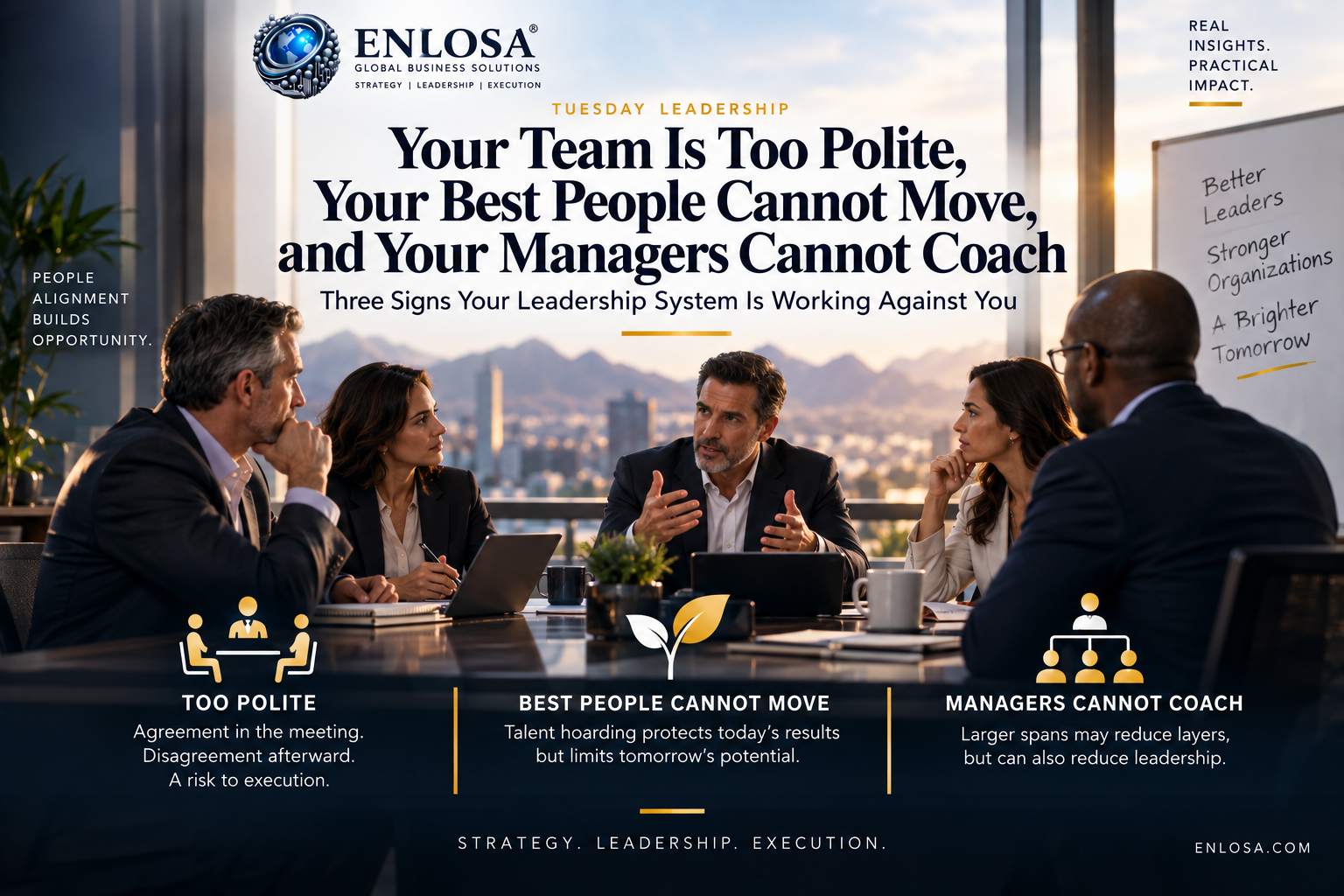
Tuesday Leadership — September 22, 2026
The executive meeting ends without conflict.
Everyone agrees.
The strategy is approved.
The priorities appear clear.
Then the real conversations begin after the meeting.
One executive questions the decision privately.
Another delays implementation.
A third quietly protects resources inside the function.
The CEO discovers two weeks later that the organization was never as aligned as the meeting suggested.
Elsewhere in the same company, one of the strongest employees asks about moving into a larger internal role.
The manager hesitates.
Not because the employee is unqualified.
Because the employee is too valuable to lose.
And one level down, another manager has 14 direct reports, operational responsibilities, customer escalations, budgets, projects and a calendar full of meetings.
One-on-ones are postponed.
Coaching becomes occasional.
Development becomes something discussed during the annual review.
These can look like three separate problems:
Weak executive-team dynamics.
Talent hoarding.
Excessive managerial span of control.
They may actually be symptoms of the same leadership-system problem.
The organization is protecting short-term functional performance at the expense of enterprise leadership capability.
That matters because leadership is not simply about having strong individuals.
It is about creating a system in which leaders can challenge one another, talent can move to where it creates the most value, and managers have enough capacity to actually lead.
Why This Matters Now
The leadership environment is changing in ways that make these problems increasingly visible.
Harvard Business Review reported in September 2026 on research involving more than 10,000 professionals showing a meaningful gap between how many senior leaders perceive their own collaboration and how people around them experience it. Leaders may believe they listen and empower while colleagues experience the interaction differently. Source
That is important.
Leadership effectiveness is not defined by what the executive intends.
It is partially defined by what the organization experiences.
At the same time, companies are changing their organizational structures.
Gallup reported in January 2026 that the average number of employees reporting to a manager increased from 10.9 in 2024 to 12.1 in 2025, nearly 50% higher than when Gallup first measured the figure in 2013. The median remains much lower—about five to six—but larger teams are becoming more common. Source
And organizations continue looking for better ways to deploy people internally. Harvard Business Review’s January–February 2026 examination of internal talent markets notes that organizations including Walmart and the U.S. Army use internal mechanisms that allow people to explore different roles, projects and assignments. Source
Three developments.
Collaboration.
Talent mobility.
Managerial capacity.
But they intersect.
Because the effectiveness of all three ultimately depends on what the leadership system rewards.
Problem One: Your Leadership Team May Be Too Polite
Executives do not need to fight.
But they do need to disagree.
A healthy leadership team should be capable of saying:
“I don’t think that assumption is correct.”
“I disagree with the investment.”
“Operations cannot support that promise.”
“We are underestimating the risk.”
“That decision improves your function but damages the enterprise.”
And then, after the discussion:
Make a decision.
Commit.
Execute.
The problem begins when harmony becomes more important than clarity.
False Alignment Can Look Like Strong Culture
Imagine a leadership meeting.
The CEO proposes an important strategic decision.
Nobody strongly objects.
The discussion lasts twenty minutes.
Everyone leaves.
It appears efficient.
But afterward:
Finance questions the economics.
Operations questions feasibility.
Sales questions timing.
Human Resources questions capacity.
Nobody raised those concerns forcefully enough while the decision was being made.
The result is not alignment.
It is deferred disagreement.
Harvard Business Review’s July–August 2026 coverage examined what it called false alignment—the organizational risk created when apparent agreement hides unresolved differences. Source
That distinction matters.
Because disagreement that occurs before the decision can improve the decision.
Disagreement that occurs after the decision often slows execution.
Productive Conflict Is Not Dysfunction
Another recent HBR examination of team friction makes the distinction clearly: strong teams do not succeed because they eliminate friction; they learn how people process information, communicate under pressure and approach decisions differently. Source
The objective is not conflict for its own sake.
It is productive challenge.
There is a significant difference between:
“I disagree with you.”
and:
“You don’t know what you’re doing.”
The first can improve a decision.
The second damages trust.
Strong executive teams learn to challenge the assumption, the economics, the timing, the risk, the evidence, the customer impact and the operational feasibility—without attacking the person.
Signs Your Executive Team May Be Too Polite
- Important proposals receive surprisingly little challenge.
- The CEO speaks first and everybody else’s opinion begins moving toward the CEO’s position.
- Executives raise objections privately rather than in the meeting.
- Decisions are repeatedly reopened.
- Teams comply slowly with decisions they publicly supported.
- Cross-functional disagreements escalate to the CEO rather than being resolved among peers.
- Meetings produce consensus but implementation produces resistance.
Those are not necessarily personality problems.
They may indicate that the leadership team has not created a strong enough operating discipline for disagreement.
Problem Two: Your Best People Cannot Move
Now consider another leadership problem.
A strong employee wants a new internal role.
The manager responds:
“You aren’t ready yet.”
Sometimes that is true.
But sometimes the real meaning is:
“I am not ready to lose you.”
That creates a difficult organizational contradiction.
Companies tell employees:
Develop.
Grow.
Take on new challenges.
Build your career here.
But the employee’s strongest contribution to the current team can become the very reason the organization makes movement difficult.
Talent Hoarding Often Looks Rational From the Manager’s Perspective
This is important.
Talent hoarding is not always caused by a selfish manager.
Imagine you lead an operation with aggressive performance commitments.
One of your best people asks to move.
If you release them:
Your capacity drops.
The position may remain open.
You must recruit or train a replacement.
Productivity may decline temporarily.
Your targets do not change.
Your manager still expects the same result.
Under that system, keeping the high performer can become the rational local decision.
The organization says:
Develop talent.
The management system says:
Protect your results.
Guess which incentive usually wins?
The Enterprise Pays for Local Talent Protection
The cost may not appear immediately.
Eventually it shows up elsewhere.
The employee stops seeing a future.
The organization recruits externally for skills it already possesses internally.
Succession pipelines weaken.
High-potential employees stop volunteering for opportunities.
Departments protect talent rather than sharing it.
People discover that the easiest way to get a promotion is to leave.
Harvard Business Review addressed this directly in 2026 through its examination of internal talent markets and the organizational challenge of balancing employee mobility with business performance. Source
HBR also highlighted the politics involved when one internal team wants to hire a standout performer from another—an issue that demonstrates how quickly enterprise talent decisions can become functional ownership disputes. Source
The question for leaders therefore becomes:
Does your company believe talent belongs to the manager—or to the enterprise?
Retention Is a System, Not a Policy
Another HBR analysis published in January 2026 reached a broader conclusion: organizations that retain talent effectively tend to operate hiring, advancement, compensation and retention as an integrated system rather than as disconnected policies. Source
That principle is important.
You can create a career-development policy.
An internal job board.
A succession process.
A mentoring program.
A leadership academy.
But if managers are penalized operationally when good people leave their teams, the informal system may overpower the formal policy.
Culture is often revealed by what the management system rewards when two priorities conflict.
Problem Three: Your Managers Have Too Many People to Actually Lead
Now consider the manager caught in the middle.
Thirteen direct reports.
Maybe fifteen.
Sometimes twenty or more.
A budget.
Customer issues.
Operational metrics.
Projects.
Hiring.
Performance reviews.
Administrative work.
Cross-functional meetings.
And perhaps significant individual-contributor responsibilities as well.
Then leadership tells the manager:
Coach more.
Develop people.
Give regular feedback.
Build succession.
Improve engagement.
Hold people accountable.
The request is reasonable.
The capacity may not be.
Flatter Is Not Automatically Better
Removing unnecessary hierarchy can improve speed.
Reducing bureaucracy can improve accountability.
But organizational flattening is not automatically organizational improvement.
Gallup’s 2026 span-of-control analysis found that average team size has increased significantly and that about 22% of managers lead 10 to 24 people while 13% oversee 25 or more. Gallup emphasizes that the appropriate span depends heavily on manager capability, work complexity, location and the amount of individual-contributor work the manager must still perform. Source
That last point deserves attention.
A manager responsible for highly standardized work may successfully lead a large team.
A manager leading complex professionals, developing future leaders, managing major customers and coordinating significant cross-functional work may not.
There is no universal magic number.
The correct span of control is the number of people a manager can lead effectively given the complexity of the work—not the number an organizational chart can physically fit beneath the box.
When Manager Capacity Disappears, Leadership Becomes Exception Management
The first thing overloaded managers often sacrifice is not today’s urgent task.
It is tomorrow’s capability.
One-on-ones get canceled.
Coaching gets delayed.
Development conversations disappear.
Succession planning becomes an annual exercise.
Feedback occurs mainly when something goes wrong.
Strong performers receive less attention because they are considered self-sufficient.
Weak performers remain unresolved because the manager lacks time for sustained intervention.
The manager gradually stops developing the team and starts responding to exceptions.
That creates another cycle.
Employees become less independent.
More problems escalate.
The manager becomes even busier.
The organization concludes that management is overloaded.
And sometimes responds by removing another management layer.
The Three Problems Reinforce One Another
Now connect them.
A leadership team avoids difficult disagreement.
So structural problems remain unresolved.
Managers continue protecting functional performance.
Those managers protect their strongest talent because delivery pressure is high.
Talent mobility slows.
The remaining managers receive broader responsibilities as the organization tries to become leaner.
Their spans increase.
Coaching decreases.
Leadership pipelines weaken.
More issues eventually escalate upward.
Senior leaders become increasingly involved in operational problems.
Executive capacity falls.
And the company responds by asking everybody to collaborate better.
The problem was never simply collaboration.
It was the system.
The Root Cause: Local Optimization of Leadership
Many organizations unintentionally optimize leadership locally.
The executive protects the function.
The manager protects the team’s strongest employee.
The organization removes layers to protect cost.
Each choice can appear rational independently.
Together, they may weaken enterprise capability.
This resembles an operating problem familiar to manufacturing and supply-chain leaders.
A plant can maximize utilization and create excess inventory.
Procurement can minimize purchase price and increase total landed cost.
Sales can maximize revenue and damage margin.
Finance can control spending and unintentionally starve a critical capability.
Leadership systems can suffer from the same local-optimization problem.
The leadership question should therefore move beyond:
“Is this manager performing?”
Toward:
“Is the leadership system producing the capability the enterprise will need next?”
What the CEO Should Be Asking
- Can my executives challenge one another without damaging trust?
- Do they behave as enterprise leaders or functional representatives?
- Are we developing talent across organizational boundaries?
- Can important people move without creating organizational resistance?
- Do managers have enough capacity to develop their teams?
- Are we eliminating bureaucracy—or simply transferring more work to fewer managers?
What the COO Should Be Asking
The COO should examine leadership as part of the operating model.
- Where do decisions repeatedly escalate?
- Where does cross-functional disagreement become execution delay?
- Which functions depend excessively on particular individuals?
- Where are managers spending their time?
- Which managerial roles have become too broad?
- Where does losing one strong employee materially threaten performance?
Those are not merely HR questions.
They are operating-risk questions.
What the CFO Should Be Asking
Leadership capacity has economic consequences.
- External recruiting cost created by weak internal mobility.
- Productivity loss caused by excessive managerial load.
- Turnover among high performers.
- Delayed decisions.
- Succession risk.
- The cost of repeatedly replacing organizational knowledge.
- The financial impact of underperformance that persists because managers lack time to address it.
Leadership development often appears as an expense line.
Leadership weakness frequently appears somewhere else entirely.
The Executive Diagnostic
- When was the last time somebody materially challenged the CEO’s position in an executive meeting? If you cannot remember, investigate why.
- How often are executive decisions reopened after the meeting? Repeated reopening may indicate that agreement was never real.
- Can one of your strongest employees apply for another internal role without their manager quietly blocking the move? If not, mobility may exist on paper more than in practice.
- Are managers rewarded when their people are promoted into other parts of the organization? If development produces pain for the releasing manager but no recognition, the incentives are misaligned.
- Which managers have more direct reports than the work realistically allows them to coach? Do not rely only on averages. Examine role complexity.
- How often do managers cancel one-on-ones because operational work takes priority? The calendar frequently reveals whether development is actually a priority.
- If a key employee left tomorrow, would the organization lose capability—or reveal that succession was never built? The answer separates talent strength from talent dependency.
What Leaders Can Do
Make disagreement part of the operating discipline
Before major decisions, deliberately ask:
- What are we missing?
- Who disagrees?
- What assumption deserves the strongest challenge?
- What would have to be true for this decision to be wrong?
Do not ask these questions ceremonially.
Create space for real answers.
Separate disagreement from commitment
Executives should have permission to disagree strongly before the decision.
After the decision, expectations change.
The team commits.
Unless significant new information emerges, the debate does not simply continue in the hallway.
That is the difference between productive conflict and organizational resistance.
Treat talent as an enterprise asset
A strong manager should not be punished for developing people who become valuable elsewhere in the company.
Measure leaders partly on successors developed, internal promotions, cross-functional assignments, talent exported to broader roles and bench strength.
An executive who continually produces future leaders is creating enterprise value.
Design the transition when talent moves
Internal mobility does not mean ignoring operating reality.
When a strong employee moves:
- Define the transition period.
- Identify knowledge-transfer requirements.
- Prepare a successor.
- Determine whether temporary capacity is needed.
- Clarify replacement authority.
- Share the operational burden.
Do not force the releasing manager to choose between developing people and delivering results.
Fix the system around the choice.
Redesign spans around work complexity
Do not start with:
“We want every manager to have 12 direct reports.”
Start with:
- What work does this manager perform?
- How experienced are the employees?
- How standardized is the work?
- How much coaching is required?
- How many functions or geographies are involved?
- How much individual-contributor work remains?
- How often do exceptions require managerial intervention?
Then design the span.
The ENLOSA Perspective
At EGBS — ENLOSA: Global Business Solutions, leadership development should not be separated from how the organization actually operates.
Training an executive to collaborate better helps.
But collaboration will remain difficult if incentives continue rewarding functional optimization.
Teaching managers to coach helps.
But coaching will disappear if the operating model gives them no time to do it.
Building career-development programs helps.
But internal mobility will remain weak if managers pay the operational price every time they develop someone successfully.
Leadership behavior and organizational design have to reinforce one another.
That is why effective leadership development should connect behavior, decision-making, executive-team dynamics, managerial capacity, talent development, succession, accountability and the operating system surrounding all of them.
Is This Happening in Your Organization?
You may have a broader leadership-system problem if:
- Executive meetings are polite but decisions are frequently revisited.
- Cross-functional disagreements are resolved mainly by the CEO.
- Strong employees have difficulty moving internally.
- Managers describe top performers as “too critical to lose.”
- One-on-ones are routinely postponed.
- Managers spend more time solving problems than developing people.
- Succession plans contain names but little demonstrated readiness.
- Leadership development exists, but daily management behavior changes very little.
If several of those symptoms are familiar, the issue may not be three separate problems.
It may be one:
Your leadership system may not be developing and deploying capability fast enough for the organization you are trying to build.
A useful next step is to examine leadership effectiveness not only at the individual level but across executive-team behavior, managerial capacity, talent mobility and succession.
The relevant ENLOSA path is Leadership Development, designed to help leaders strengthen the behaviors, operating disciplines and organizational capability required to convert leadership potential into measurable execution.
Explore ENLOSA Leadership Development
If the diagnostic reveals a material leadership constraint, the next conversation should focus on where the system is failing—not on selling another generic leadership program.
ENLOSA: Global Business Solutions
Strategy. Leadership. Execution.
enlosa@enlosa.com | +1 (877) 246-1109
References
- Harvard Business Review — “You Think You’re a Good Collaborator. Do the People You Manage Agree?” — September 15, 2026. Research examining differences between leaders’ perceptions of collaboration and the experiences of colleagues. Source
- Harvard Business Review — “Prevent Team Friction from Turning into Dysfunction” — June 17, 2026. Current perspective on handling differences in communication, decision-making and team friction. Source
- Harvard Business Review — “Are We All in Agreement?” — July–August 2026. Discussion of false alignment and the leadership risks created by superficial agreement. Source
- Harvard Business Review — “A Better Way to Manage Internal Talent Markets” — January–February 2026. Examination of internal mobility and balancing employee choice with organizational performance. Source
- Harvard Business Review — “The Delicate Politics of Hiring Someone from Another Team” — February 5, 2026. Current examination of the organizational tensions surrounding movement of high-performing internal talent. Source
- Harvard Business Review — “Policies Aren’t Enough to Retain Top Talent. You Need Systems.” — January 20, 2026. Research arguing that talent retention depends on integrated organizational systems rather than isolated policies. Source
- Gallup — “Span of Control: What’s the Optimal Team Size for Managers?” — January 13, 2026. Current data on expanding managerial spans and the importance of matching team size to managerial talent, work design and coaching requirements. Source
#TuesdayLeadership, #Leadership, #ExecutiveLeadership, #LeadershipDevelopment, #HighPerformanceTeams, #ExecutiveTeams, #TalentMobility, #TalentDevelopment, #SuccessionPlanning, #OrganizationalDevelopment, #SpanOfControl, #Management, #ProductiveConflict, #Collaboration, #HighPerformers, #CEO, #COO, #LeadershipStrategy, #OrganizationalEffectiveness, #EGBS
Leave a Reply