
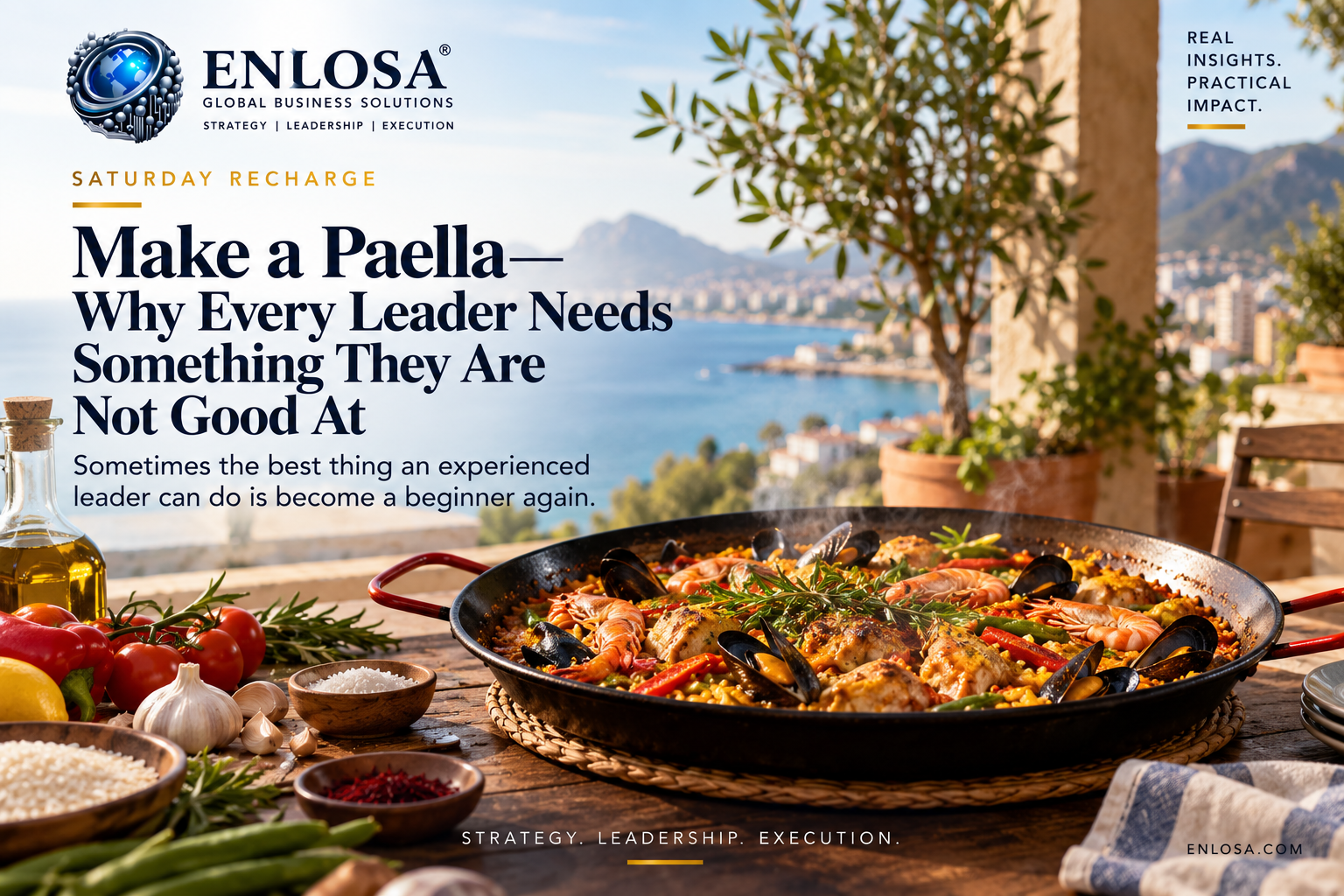
Saturday Recharge — September 26, 2026
There is something useful about standing in front of a paella pan and realizing that your title does not matter.
The rice does not care how many people report to you.
The fire does not care how many years of experience you have.
The broth does not care how successful your last quarter was.
And if you get the timing wrong, the paella will tell you immediately.
For leaders who spend most of the week operating in environments where they are expected to know the answer, that can be surprisingly healthy.
Sometimes the best thing an experienced leader can do is become a beginner again.
Not in another executive program.
Not in another strategy workshop.
In something completely different.
For me, paella is a perfect example.
It looks simple.
Rice.
Broth.
Protein.
Vegetables.
Heat.
A wide pan.
But simplicity is deceptive.
You quickly discover that there is technique, sequencing, judgment, patience and tradition behind the final dish.
And perhaps that is exactly why it is useful.
Paella Is More Than Rice With Things
Paella is deeply connected to Valencia and particularly to the agricultural landscape around L’Albufera, where Visit Valencia traces its origins to farm workers cooking rice with ingredients available locally. Traditional Valencian versions typically use ingredients such as chicken, rabbit, local beans and rice grown around the Albufera area. Source
Even the name tells part of the story.
“Paella” originally refers to the pan itself.
The dish evolved from something practical—people cooking what was locally available—into one of Spain’s most internationally recognized foods. Source
That history makes paella interesting.
It was not originally created to impress anyone.
It solved a problem.
Feed people.
Use what is available.
Cook it together.
And do it well.
There may be a leadership lesson hiding there before we even light the burner.
The Beginner’s Problem
Experienced leaders become accustomed to competence.
You walk into the operating review and understand the numbers.
You recognize the customer problem.
You know the industry.
You have seen the organizational pattern before.
Someone raises a supply-chain issue and you already have three possible solutions.
Experience creates speed.
That is valuable.
But there is a risk.
When you spend enough time being the expert, you can forget what it feels like not to know.
Then make a paella for the first time.
Suddenly you have questions.
How much liquid?
When do I add the rice?
Should I stir it?
Is the heat too high?
Is the rice cooking evenly?
Why is one side progressing faster than the other?
Is that smell the beginning of socarrat—or the beginning of disaster?
You start paying attention differently.
You ask questions.
You observe.
You make mistakes.
You adjust.
You become teachable again.
Learning Agility Begins Where Expertise Ends
The Center for Creative Leadership describes learning agility as the ability to learn from experience and apply those lessons in unfamiliar situations. Its research emphasizes behaviors such as seeking new experiences, making sense of them, reflecting on what happened and applying the lesson later. CCL’s 2026 work also emphasizes the value of leaders deliberately moving outside their comfort zones. Source
That is very different from simply accumulating knowledge.
You can read twenty articles about paella.
Watch ten videos.
Study every recipe.
Understand the chemistry of rice.
And still discover something when the pan is actually in front of you.
Leadership works the same way.
There is knowledge.
And then there is experience.
The development occurs when you connect the two.
Paella Lesson One: Preparation Matters More Than It Looks
Most of the work happens before the rice goes into the pan.
Ingredients need to be ready.
The broth needs thought.
The equipment matters.
The heat source matters.
The sequence matters.
You cannot wait until the rice is cooking to discover that something essential is still in the refrigerator.
The same thing happens in organizations.
Execution problems frequently begin before execution.
The objective was unclear.
Ownership was not defined.
Resources were never aligned.
The team began before dependencies were understood.
The deadline was announced before feasibility was examined.
Then leadership calls the resulting chaos an execution problem.
Sometimes it is.
Sometimes it was a preparation problem.
Paella makes the lesson visible.
Once the process reaches a certain point, your options narrow.
That is true in business too.
Paella Lesson Two: Sequencing Is a Form of Strategy
You cannot simply place every ingredient in the pan at the same time and expect the same result.
Some things need more time.
Some need less.
Some create the foundation for what follows.
There is an order.
Business leaders encounter the same issue.
Strategy may identify ten important actions.
But execution depends on sequence.
Which capability must exist first?
What decision unlocks the next one?
Which project depends on another?
When does the organization have enough capacity to absorb the change?
What needs to happen before the customer promise can be made?
A list of priorities is not necessarily a strategy.
Sequence matters because some actions change the conditions for everything that comes afterward.
Paella teaches this without PowerPoint.
Paella Lesson Three: Once the Rice Goes In, Stop Interfering With Everything
This may be one of the hardest lessons for an operator.
There is a moment when constantly touching the process makes it worse.
You have prepared.
You have made decisions.
Now the ingredients need time.
Leadership can struggle with the same thing.
A leader delegates a responsibility.
Then checks it.
Changes it.
Rechecks it.
Adds another instruction.
Corrects the person’s approach.
Takes part of the work back.
And eventually wonders why the team lacks ownership.
Sometimes leadership requires intervention.
Sometimes it requires restraint.
Knowing when not to interfere is also a leadership skill.
Paella Lesson Four: Heat Is Necessary—But Too Much Destroys the Result
Without heat, nothing happens.
Too much heat and you destroy what you are trying to create.
Organizations work similarly.
Pressure can create focus.
Deadlines can produce urgency.
Stretch goals can elevate performance.
But permanent pressure eventually changes behavior.
People shorten their thinking.
Protect themselves.
Hide problems.
Stop experimenting.
Prioritize today’s fire over tomorrow’s capability.
Leaders sometimes assume that if pressure produced a good result once, more pressure will produce a better one.
The pan offers a different lesson.
Intensity is useful only when it is controlled.
Paella Lesson Five: You Cannot Rush the Rice
Executives are trained to accelerate things.
Shorten lead time.
Reduce cycle time.
Remove waiting.
Improve throughput.
There is tremendous value in that mindset.
Until it reaches something that simply requires time.
Some processes can be accelerated.
Others can only be ruined faster.
Developing a leader takes time.
Building trust takes time.
Creating organizational capability takes time.
Changing culture takes time.
Learning a craft takes time.
You can create the right conditions.
But you cannot demand that every meaningful process obey the quarter.
A pan of rice is very clear about this.
Then Comes the Socarrat
For many paella lovers, one of the most prized parts is the thin layer of toasted rice that develops at the bottom of the pan.
The socarrat.
It sits very close to failure.
Not enough heat and it does not develop.
Too much heat and it burns.
There is judgment involved.
Experience helps.
Attention matters.
And there is no dashboard telling you the exact second to act.
Leadership contains moments like that too.
Data gets you close.
Experience gets you closer.
But eventually someone still has to make a judgment.
Should we enter the market?
Promote this person?
Close the facility?
Make the acquisition?
Stop the project?
Invest now?
Wait?
There are decisions where analysis reduces uncertainty but never eliminates it.
At some point, leadership becomes judgment.
Your First Paella May Not Be Very Good
That is part of the point.
Maybe the rice is slightly underdone.
Maybe too much broth remains.
Maybe the heat was uneven.
Maybe there is no socarrat at all.
Maybe you confidently tell everyone:
“This is how I wanted it.”
Nobody believes you.
Good.
You learned something.
The question is whether you try again.
CCL’s work on learning agility emphasizes reflection—extracting lessons from experience rather than simply accumulating experiences. Source
So after the meal:
What worked?
What didn’t?
What would you change?
What surprised you?
What did someone else know that you did not?
That sounds remarkably similar to a good operating review.
Except the consequences are usually more enjoyable.
Leaders Need Places Where They Are Not in Charge
There is another reason activities like cooking matter.
The executive role can gradually become part of your identity.
People ask you for answers.
They defer to you.
Your calendar is structured around importance.
Someone prepares the presentation before you arrive.
Someone asks for approval.
Someone wants the decision.
That can become normal very quickly.
Then Saturday arrives.
And the onion does not care.
The rice does not defer.
The person who has made fifty paellas knows more than you do.
Maybe your spouse does.
Maybe your friend does.
Maybe your child does.
Maybe the person standing beside you says:
“You’re doing that wrong.”
And they are right.
There is something useful about that.
Humility becomes easier to understand when it is practical rather than philosophical.
Share the Table
There is another side to paella that may matter even more than learning to cook it.
It is a dish meant to bring people together.
Recent work published through the University of Oxford’s Wellbeing Research Centre for the World Happiness Report 2025 examined the relationship between sharing meals, social connection and wellbeing. The research found strong associations between eating with others and positive social and life-evaluation outcomes. Source
That should not surprise us.
Some of life’s most important conversations happen around food.
Not in conference rooms.
Not during performance reviews.
Not while watching a presentation.
At a table.
Without an agenda.
Cooking something that takes time creates an excuse to slow everything else down.
And then share it.
The Saturday Diagnostic
This week’s diagnostic is personal.
- When was the last time I intentionally did something I was not good at?
- How do I behave when someone else clearly knows more than I do?
- Do I enjoy learning—or mainly enjoy being competent?
- When I make a mistake, do I become curious or defensive?
- Do I give developing people the same patience I expect when I am learning?
- Do I know when to intervene—and when to leave the process alone?
- How often do I sit around a table with people I care about without an agenda?
Those questions may tell you something that another leadership assessment cannot.
What Leaders Can Do This Weekend
Pick something you do not know how to do.
For this Saturday:
Make a paella.
Do not worry about being an expert.
Start by understanding the tradition.
Respect the ingredients.
Prepare carefully.
Follow the sequence.
Pay attention to the heat.
Resist the urge to constantly interfere.
Accept that the first attempt may not be perfect.
Then place the pan in the middle of the table.
Share it.
Listen.
Enjoy the conversation.
And decide what you will do differently next time.
That is learning.
The ENLOSA Perspective
At EGBS — ENLOSA: Global Business Solutions, we spend much of the week thinking about strategy, execution, operating systems, leadership and measurable results.
Those things matter.
But leadership development does not happen only at work.
Sometimes it happens when you deliberately put yourself somewhere that your experience cannot immediately rescue you.
Somewhere you have to ask.
Observe.
Listen.
Experiment.
Fail a little.
Reflect.
And try again.
That is one reason leaders need something they are not good at.
Not because they need another hobby on the résumé.
Because they need regular reminders that development begins when certainty ends.
If you are always the expert, you may eventually forget what learning feels like.
So this Saturday, consider a different leadership exercise.
Get a paella pan.
Invite some people you enjoy.
Cook.
Maybe it will be excellent.
Maybe it will be average.
Maybe everyone will politely eat it while planning where to order pizza afterward.
Either way, you will probably learn something.
And that might make it a very productive Saturday.
Is This Happening in Your Leadership?
If you find that experience has made it harder to receive feedback, experiment, relinquish control or enter situations where you are not the expert, the issue may be larger than learning a new hobby.
It may be a leadership-development question.
ENLOSA’s Leadership Development work helps executives examine how experience, behavior, adaptability, judgment and leadership habits affect the organizations they are trying to lead.
Explore ENLOSA Leadership Development
ENLOSA: Global Business Solutions
Strategy. Leadership. Execution.
enlosa@enlosa.com | +1 (877) 246-1109
References
- Visit Valencia — Authentic Valencian Paella. Overview of the dish’s roots in Valencia and L’Albufera, including traditional ingredients and preparation context. Source
- Center for Creative Leadership — Learning Agility. Research and guidance on learning from unfamiliar experiences, reflection and adaptability. Source
- Center for Creative Leadership — Leadership Models for Development. Additional material on reflection and learning from experience. Source
- University of Oxford Wellbeing Research Centre / World Happiness Report 2025. Research on shared meals, social connection and wellbeing. Source
#SaturdayRecharge, #Leadership, #LeadershipDevelopment, #LearningAgility, #Paella, #Valencia, #Cooking, #BeginnerMindset, #Humility, #ContinuousLearning, #ExecutiveLeadership, #PersonalDevelopment, #Reflection, #WorkLifeBalance, #EGBS
Leave a Reply