
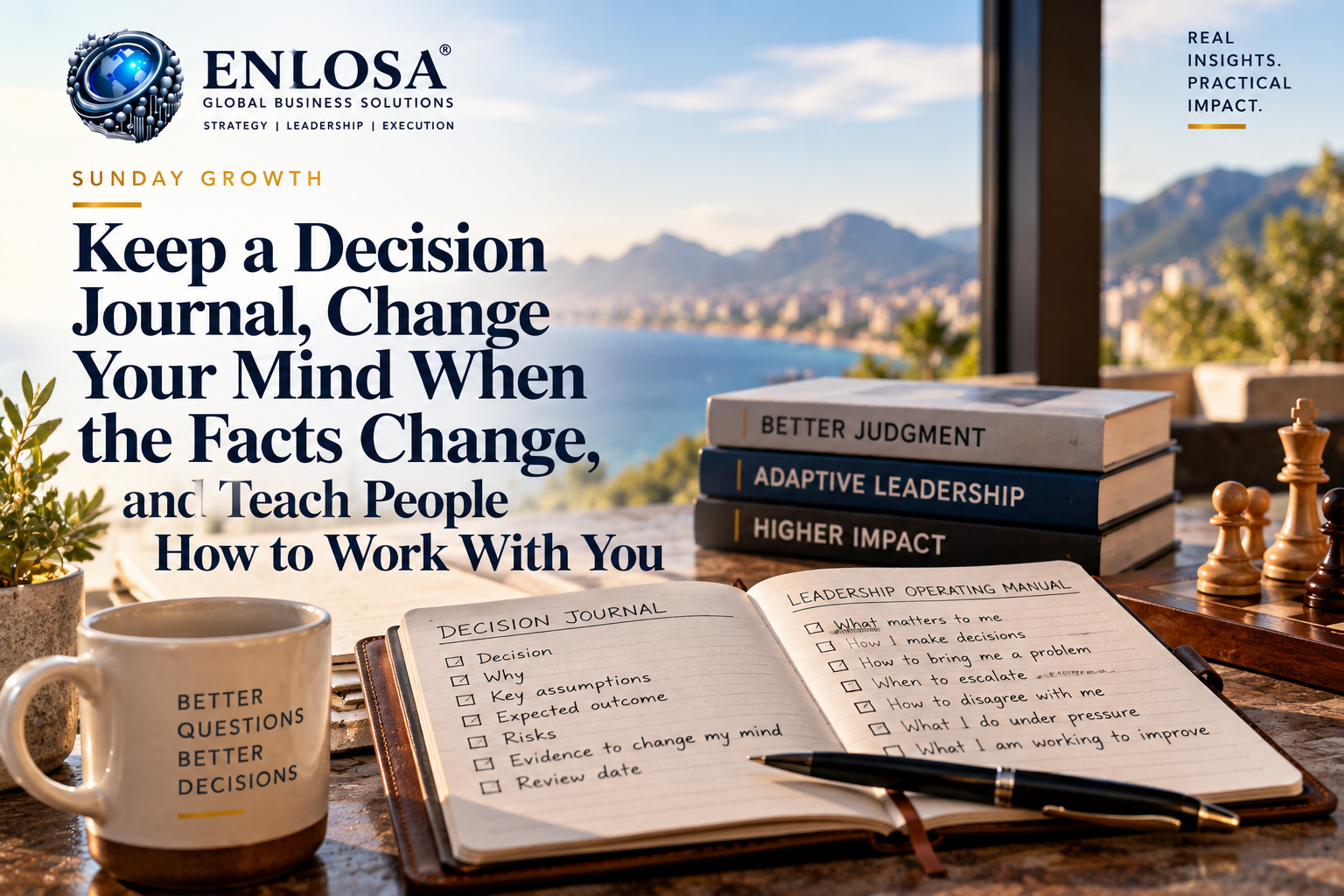
Sunday Growth — September 27, 2026
Senior leaders spend years accumulating experience.
Experience improves pattern recognition.
It helps you make faster decisions.
It gives you context younger leaders may not yet possess.
It teaches you which problems deserve attention and which ones usually disappear on their own.
But experience creates another risk.
You can become increasingly confident in your judgment without becoming equally disciplined about examining it.
You remember the acquisition that worked.
The turnaround you led.
The person you promoted who became exceptional.
The supplier you replaced before the problem became obvious.
The strategic decision everyone questioned that eventually proved correct.
Those experiences matter.
But memory has an uncomfortable limitation.
We tend to remember outcomes more clearly than the assumptions that produced our original decisions.
A successful result can make a questionable decision look brilliant.
A poor result can make a thoughtful decision look foolish.
And after enough time has passed, it becomes surprisingly easy to believe:
“I knew that was going to happen.”
Did you?
Or does it simply feel obvious now?
This Sunday, instead of asking what leadership skill you should add next, consider three disciplines that can make the experience you already possess more valuable:
Record your important decisions before you know the outcome.
Develop the courage to change your mind when evidence changes.
Make your leadership behavior more understandable to the people around you.
Together, they create something experienced leaders increasingly need:
A system for examining their own judgment.
The Problem With Experience
Experience is one of leadership’s greatest assets.
It can also become one of its greatest defenses.
A leader says:
“I’ve seen this before.”
Sometimes that insight saves months of analysis.
Sometimes it prevents the leader from noticing that this situation is actually different.
A leader says:
“I know how customers respond.”
Perhaps.
But what if customer behavior changed?
A leader says:
“That person isn’t ready.”
Maybe.
But what evidence supports the conclusion?
A leader says:
“We tried that five years ago.”
True.
Were the conditions the same?
A leader says:
“I know my team.”
Do they experience you the way you believe they do?
These are not arguments against experience.
They are arguments for examining it.
Good Outcome Does Not Automatically Mean Good Decision
One of the most important distinctions in executive judgment is the difference between decision quality and outcome quality.
Harvard Business Review has highlighted the tendency to judge decisions heavily by their outcomes rather than by the quality of the reasoning that existed when the decision was actually made. Source
That distinction is critical.
Imagine two executives.
The first approves a major investment after carefully examining customer demand, downside scenarios, cash requirements, competitive response, execution capacity, risk and alternative uses of capital.
Then an unexpected external event destroys demand.
The investment fails.
Was the original decision necessarily poor?
Now imagine another executive.
Very little analysis.
Weak assumptions.
No downside scenario.
A concentrated bet.
But the market unexpectedly moves in exactly the right direction.
The investment succeeds spectacularly.
Was that necessarily a great decision?
Results matter enormously. But results alone do not tell you whether your judgment process was good.
Leaders need to evaluate both.
Discipline One: Keep a Decision Journal
This does not need to become complicated.
You do not need a new software platform.
You do not need a 14-page approval template.
You need to capture what you believe before hindsight rewrites the story.
For significant decisions, write down:
- What am I deciding?
- Why am I making this decision?
- What assumptions am I relying on?
- What outcome do I expect?
- What could make me wrong?
- What evidence would cause me to reconsider?
- When should I review the decision?
That is enough to create an extraordinary leadership-development tool.
Write Before You Know the Answer
Consider an executive deciding whether to launch a new manufacturing location.
Before approval, the journal might say:
Decision: Establish production in Mexico.
Primary assumptions:
- Demand will grow 8–10%.
- Labor availability will remain adequate.
- Customer proximity will reduce lead time.
- USMCA treatment will remain advantageous.
- Supplier localization can reach the required level within 24 months.
Expected result:
- Lower total landed cost.
- Improved customer responsiveness.
- Reduced exposure to trans-Pacific logistics.
Primary risks:
- Execution capability.
- Supplier development.
- Labor turnover.
- Security.
- Regulatory changes.
Evidence that would change the decision:
- Demand deteriorates materially.
- Total-cost advantage falls below threshold.
- Customer commitments change.
- Critical supplier localization proves infeasible.
Now imagine reviewing that page 18 months later.
You can ask:
- Which assumptions were correct?
- Which were wrong?
- What did we underestimate?
- What did we overestimate?
- What signal appeared first?
- Did leadership recognize it?
- What would we do differently next time?
That is far more useful than:
“The project worked.”
or:
“The project failed.”
Experience Only Improves Judgment When You Learn Accurately From It
Organizations conduct project reviews.
Financial reviews.
Quality reviews.
Safety reviews.
Customer reviews.
But many executives do not systematically review their own judgment.
That is a missed opportunity.
A decision journal allows you to identify recurring patterns.
Perhaps you consistently underestimate implementation time.
Perhaps you overestimate organizational capacity.
Perhaps you are too optimistic about new hires.
Perhaps you become overly conservative after a failure.
Perhaps you rely too heavily on one trusted executive.
Perhaps you see market opportunities earlier than others but regularly underestimate the working capital they require.
Perhaps you delay difficult people decisions longer than you should.
Those patterns can remain invisible for years if every decision is considered independently.
The journal turns experience into data about yourself.
The Sunday Decision Review
Once a month, choose three meaningful decisions from your journal.
Do not ask only:
Was I right?
Ask:
- What did I believe?
- Why did I believe it?
- What information received too much weight?
- What information received too little?
- What surprised me?
- What happened that I could not reasonably have predicted?
- What happened that I should have seen?
- Did I revise my view quickly enough?
- Did ego become attached to the original decision?
That last question leads to the second discipline.
Discipline Two: Learn to Change Your Mind Without Feeling That You Lost
Leaders are rewarded for decisiveness.
Organizations want confidence.
Boards want clarity.
Employees want direction.
Customers want commitments.
Nobody wants the CEO to say:
“I have absolutely no idea. Ask me again next month.”
But confidence creates a subtle trap.
Once leaders state a position publicly, changing it can begin to feel expensive.
The executive who championed an acquisition becomes emotionally attached to proving the acquisition was correct.
The leader who recruited an executive becomes slower to acknowledge that the hire is failing.
The CEO who launched a strategic initiative continues funding it because stopping feels like admitting the original decision was wrong.
The organization that spent $20 million on a technology platform spends another $10 million because abandoning it would make the first $20 million difficult to explain.
The discussion quietly shifts from:
“What should we do now?”
to:
“How do I prove that what I said before was right?”
Those are very different questions.
Changing Your Mind Is Not the Same as Being Indecisive
Research published by Harvard Business Review found that people can interpret a willingness to change one’s mind as a signal of intelligence, even though the social perception can vary depending on how much a context prizes confidence. Source
That creates an important leadership distinction.
Indecision means avoiding commitment because you are unwilling to choose.
Updating your position means:
You chose.
You acted.
New evidence emerged.
You reassessed.
And you changed course.
That is not weakness.
That is adaptive judgment.
Changing your mind because the facts changed is not inconsistency. Refusing to change may be.
The Question Every Important Decision Needs
Before making a major decision, write:
“What evidence would cause me to change my mind?”
That question is powerful because it forces you to imagine being wrong before your reputation becomes attached to being right.
For example:
We should acquire this business.
What would change your mind?
- Customer concentration above X?
- Synergy assumptions below Y?
- Leadership retention risk?
- Unresolved regulatory exposure?
- A deterioration in cash generation?
Or:
This executive should lead the division.
What would change your mind?
- Failure to build the team?
- Inability to make decisions?
- Persistent cross-functional conflict?
- Failure to achieve agreed milestones?
Or:
We should continue funding this transformation.
What would change your mind?
- No measurable benefit after a defined period?
- Repeated missed milestones?
- Economics materially below the original case?
- A superior alternative?
If the answer is:
“Nothing would change my mind.”
you may no longer be evaluating the decision.
You may be defending an identity.
Strong Leaders Separate Conviction From Attachment
Leadership requires conviction.
You cannot change direction every time someone objects.
You cannot operate a business by constantly reopening decisions.
Once the team decides, execution needs commitment.
But conviction should remain connected to evidence.
A useful leadership posture is:
Strong opinion.
Clear rationale.
Full commitment.
Open to contrary evidence.
That combination is difficult.
It is also powerful.
Harvard Business Review Has Long Warned About Preventable Decision Errors
Research on decision architecture points out that even capable leaders can underestimate timelines, favor confirming information, and make other predictable errors. One response is not simply telling people to “think better,” but designing better environments and processes around important decisions. Source
That is why the journal matters.
It creates structure before memory and ego interfere.
But there is another blind spot a private journal cannot solve.
You cannot fully evaluate your leadership from inside your own head.
That leads to discipline three.
Discipline Three: Teach People How to Work With You
Most executives develop strong working preferences.
How much information they want.
How they prefer problems presented.
How quickly they make decisions.
How they handle disagreement.
What causes them frustration.
What they expect during escalation.
How they react when under pressure.
What quality means to them.
Which issues they want immediately.
Which issues should never reach them.
The problem is that many leaders never explicitly explain these things.
The team learns them experimentally.
Someone gives too much detail.
The leader interrupts.
Lesson learned.
Someone escalates too early.
The leader says:
“Why are you bringing this to me?”
Lesson learned.
Someone waits too long.
The leader says:
“Why didn’t I know about this?”
Another lesson.
Someone challenges the leader directly and receives a positive response.
Good.
Someone else watches and learns.
Over several years, people gradually construct an unofficial operating manual for the executive.
Why make them wait several years?
Build a Personal Leadership Operating Manual
This should not be a document declaring:
“Here are the rules everyone must follow because I am the boss.”
That defeats the purpose.
It should be an exercise in self-awareness and transparency.
What matters most to me
The principles I prioritize when tradeoffs occur.
How I make decisions
What information I usually need.
What can be decided quickly.
What deserves deeper analysis.
How to bring me a problem
Do I want the problem only?
Options?
A recommendation?
Financial implications?
When to escalate
What requires immediate notification?
What can wait?
How to disagree with me
Do it directly.
Bring evidence.
Challenge the assumption, not the person.
Tell me when you think I am wrong.
What I do under pressure
Maybe I become quieter.
Maybe faster.
Maybe more demanding.
Maybe overly involved.
Whatever it is, name it.
What I am working to improve
Perhaps listening.
Delegating.
Patience.
Communication.
Asking before answering.
Making fewer assumptions.
What you should never interpret incorrectly
For example:
“If I ask multiple questions, it does not automatically mean I disagree.”
Or:
“If I am quiet in a meeting, I may be processing rather than dissatisfied.”
Those details can eliminate enormous unnecessary friction.
Self-Awareness Is Not Simply Knowing Yourself
The Center for Creative Leadership identifies self-awareness as one of its core leadership capabilities and emphasizes that effectiveness depends partly on understanding both yourself and how others experience you. Source
That second component matters.
You may describe yourself as:
Direct.
The team may experience you as impatient.
You may describe yourself as:
Highly involved.
Others may experience micromanagement.
You may believe you invite disagreement.
Nobody may actually feel comfortable disagreeing.
You may think your expectations are clear.
Your direct reports may spend considerable energy interpreting what you really meant.
This is why multi-source feedback can be so valuable. CCL’s work on 360-degree feedback focuses specifically on reconciling self-perception with feedback from peers, direct reports and supervisors in order to expose strengths and blind spots. Source
Your leadership operating manual should therefore not be written entirely by you.
Ask Your Team to Edit It
Give trusted colleagues the draft.
Ask:
- Is this accurate?
- What is missing?
- Where do I behave differently from what I wrote?
- What do people struggle to understand about me?
- What do I do under pressure that I may not recognize?
- What should new team members know about working with me?
This is where the document becomes useful.
It moves from:
How I see myself
to:
How we can work together more effectively.
Now Connect the Three Practices
At first, these may look like separate development exercises.
A decision journal.
Changing your mind.
A leadership operating manual.
They are actually connected.
The decision journal asks:
What did I believe?
Changing your mind asks:
Am I willing to revise what I believe?
The operating manual asks:
Do the people around me understand how my beliefs become behavior?
Together they create a powerful cycle:
Decide. Record. Act. Observe. Receive feedback. Update. Explain. Improve.
That is personal leadership development as an operating system.
Your Personal Leadership System Needs Feedback Loops Too
Executives understand feedback loops in operations.
Forecast versus actual.
Budget versus actual.
Planned versus produced.
Target versus performance.
Expected yield versus actual yield.
Customer promise versus delivery.
Yet personal leadership often operates without equivalent feedback loops.
You decide.
Move on.
Decide again.
Move on.
After 20 years, you possess a tremendous amount of experience.
But perhaps surprisingly little structured evidence about how your judgment evolved.
Years of experience and years of deliberate learning are not necessarily the same thing.
The difference is reflection.
A Practical Sunday Leadership System
You can begin today.
Create three pages.
Page One — My Decision Journal
For important decisions, record:
- Decision
- Date
- Expected outcome
- Key assumptions
- Primary risks
- Evidence that would change my mind
- Review date
Then return later and add:
- Actual outcome
- What I learned
Page Two — What Have I Changed My Mind About?
Once a quarter, answer:
- What important belief have I revised?
- Why?
- What evidence changed it?
- How long did it take me to accept the evidence?
- Did I resist because the facts were weak—or because the conclusion was uncomfortable?
- What should I watch for next time?
Imagine the value of keeping that record for ten years.
Not simply:
What did I accomplish?
But:
How did my judgment evolve?
Page Three — How to Work With Me
Write:
- What matters to me.
- How I make decisions.
- How I want disagreement handled.
- When I want escalation.
- How I behave under pressure.
- What frustrates me.
- What people often misunderstand about me.
- What I am actively trying to improve.
Then ask three people who know you well to challenge it.
That last part is essential.
The Executive Diagnostic
This Sunday, answer these seven questions:
- Can I identify three major decisions from the last year and accurately describe what I believed before knowing the outcome?
- What important assumption have I changed my mind about during the last 12 months?
- What evidence would cause me to reconsider one of my strongest current positions?
- Do people around me believe they can tell me that my assumption is wrong?
- Can my direct reports explain how I make decisions and when I expect escalation?
- What leadership behavior do others experience differently from how I intend it?
- Am I becoming wiser from experience—or simply more confident because I have more of it?
Spend some time with the last question.
It may be uncomfortable.
That is useful.
A Warning About Confidence
Senior leadership naturally creates reinforcement.
People listen.
Your recommendations receive attention.
Others adapt to your preferences.
Success strengthens credibility.
Over time, fewer people may challenge you.
That can make confidence rise precisely when external correction is becoming harder to obtain.
This is one reason leadership development becomes more—not less—important with seniority.
The problem is no longer lack of knowledge.
It may be reduced exposure to contradiction.
Reduced feedback.
Reduced willingness to appear uncertain.
Reduced opportunities to discover that you were wrong.
The higher you rise, the more deliberately you may need to design mechanisms that challenge your own certainty.
Changing Your Mind Publicly Can Strengthen a Team
Imagine saying:
“When we made this decision six months ago, I believed three things. Two of those assumptions are no longer valid. Based on what we know today, I believe we should change direction.”
What does that communicate?
Not weakness.
It communicates:
Evidence matters.
Learning matters.
Updating matters.
Nobody needs to pretend the original plan is still perfect.
The organization receives permission to surface changing facts.
That can be enormously powerful.
Now compare it with:
“Stay the course.”
when everybody knows the assumptions changed.
Teams notice the difference.
Your Operating Manual Should Also Change
Do not write your personal leadership manual once and treat it as permanent.
You are not permanent.
Your role changes.
Your team changes.
Your strengths change.
Your weaknesses change.
Your context changes.
Your development priorities change.
Review it every six months.
Ask:
- What have I learned about myself?
- What feedback continues appearing?
- What behavior am I trying to change?
- What expectation has become clearer?
- What should I stop doing?
- What do people need from me now that they did not need two years ago?
A leadership operating manual should document development—not freeze personality.
The ENLOSA Perspective
At EGBS — ENLOSA: Global Business Solutions, we believe leadership development becomes most valuable when it changes behavior, judgment and execution.
Leadership development should not simply create more knowledge.
Experienced executives usually have plenty.
The challenge is helping leaders examine:
- How they make decisions.
- Which assumptions guide them.
- How they respond when evidence contradicts those assumptions.
- How their behavior affects the people around them.
- Where self-perception differs from organizational experience.
- How experience can be deliberately converted into better judgment.
That is why three simple disciplines can be so powerful:
Write down important decisions before you know the result.
Decide in advance what evidence would change your mind.
Help the people around you understand how to work with you—and ask them where your description is wrong.
None requires sophisticated technology.
All require humility.
Is This Happening in Your Leadership?
You may have a leadership-development gap if:
- You remember results but not the assumptions behind major decisions.
- You rarely document why you made important choices.
- You find it difficult to identify a significant issue on which you changed your mind recently.
- People challenge you less than they used to.
- Your team sometimes appears confused by your expectations.
- You regularly explain your intentions after your behavior has already been misunderstood.
- Your experience has made you increasingly certain but not necessarily increasingly reflective.
If several of those conditions are familiar, the next step does not need to be another course.
It may be a structured examination of your judgment, feedback patterns and leadership behavior.
ENLOSA’s Leadership Development work helps experienced executives convert self-awareness, feedback and operating experience into clearer leadership behavior and stronger organizational execution.
Explore ENLOSA Leadership Development
The objective is not to make leaders less confident.
It is to make confidence more evidence-based.
And judgment more deliberate.
ENLOSA: Global Business Solutions
Strategy. Leadership. Execution.
enlosa@enlosa.com | +1 (877) 246-1109
References
- Harvard Business Review — “What We Miss When We Judge a Decision by the Outcome.” Research on the tendency to evaluate decision quality through results rather than the original decision process. Source
- Harvard Business Review — “Research: Changing Your Mind Makes You Seem Intelligent.” Experimental research examining how people perceive leaders and others who revise their positions. Source
- Harvard Business Review — “Leaders as Decision Architects.” Research on designing environments and processes that reduce predictable decision errors. Source
- Center for Creative Leadership — “4 Sure-Fire Ways to Boost Your Self-Awareness.” Guidance on self-awareness and understanding how others experience your leadership. Source
- Center for Creative Leadership — “How to Get the Most From Your 360 Results.” Guidance on using feedback from direct reports, peers and leaders to identify strengths, development needs and perception gaps. Source
#SundayGrowth, #Leadership, #LeadershipDevelopment, #ExecutiveLeadership, #DecisionMaking, #ExecutiveCoaching, #SelfAwareness, #Judgment, #DecisionJournal, #Learning, #Feedback, #GrowthMindset, #LeadershipBehavior, #ContinuousImprovement, #CEO, #COO, #PersonalDevelopment, #EGBS
Leave a Reply