
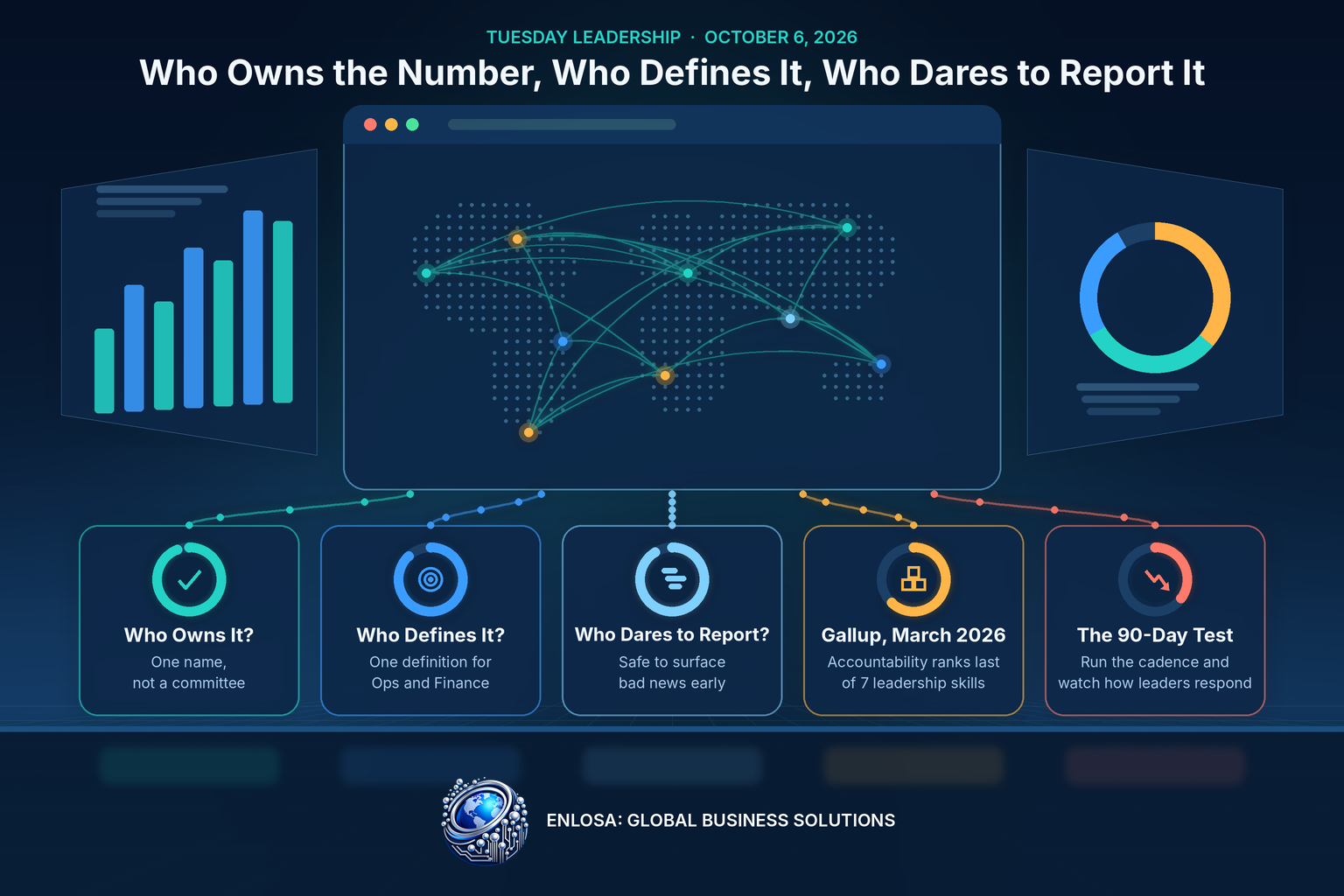
Tuesday Leadership — October 6, 2026
Yesterday we looked at five numbers that connect the factory floor to the P&L.
Today is about what happens next.
A dashboard does not create execution.
Leadership does.
Three leadership questions decide whether a set of operating metrics changes results or simply decorates a slide:
- Who owns the number when it moves?
- Who defines the number so operations and finance mean the same thing?
- Who dares to report the number when it turns red?
Why This Matters Now
Recent research shows that accountability is the weakest link in many leadership teams.
In a March 2026 Gallup study of more than 23,000 U.S. employed adults, “create accountability” ranked last among seven core leadership competencies for both leaders and managers. Only 30% of managers rated their leaders as exceptional or outstanding at holding people accountable. Leaders rated themselves higher, at 46%. Source
Roles are also converging. L.E.K. Consulting reported in October 2025 that nearly two-thirds of CFOs say their responsibilities overlap with the COO role, and that about 10% of companies have fully merged the two. Source
And the oldest finding of the three still holds. Amy Edmondson’s 1999 study of work teams found that team psychological safety, “a shared belief that the team is safe for interpersonal risk taking,” is associated with learning behavior, which in turn mediates team performance. Source
Ownership, shared definitions and candor are not soft topics.
They are the operating system underneath the numbers.
Question 1: Who Answers When the Number Moves?
Every operating review has a moment when a number is red and the room goes quiet.
If no one is named, the silence is the answer.
The Gallup finding is a useful warning. Leaders tend to believe accountability is stronger than their managers experience it. The gap between 46% and 30% is the distance between intention and the lived reality of the organization.
Real ownership has three parts:
- A name, not a committee. One leader per number.
- An explanation. Why did it move, in facts and not in excuses?
- A proposed response. What will be done, by whom and by when?
Kaplan and Norton argued in their 1992 Harvard Business Review article on the balanced scorecard that operating measures matter because they drive financial performance. Ownership is how a measure actually gets acted on: without a named leader, a number is only an observation.
The test: if the number moves tomorrow, can everyone in the room name the person who will explain it by Friday?
Question 2: Who Defines the Number?
Ownership fails quickly when two functions describe the same business with different definitions.
Operations reports on-time delivery against the date the plant planned.
The customer measures it against the date the company promised.
Finance counts scrap in one cost center, while the plant reports yield on a different basis.
The numbers may all be accurate. The conversation is still broken.
The L.E.K. data shows why this is becoming a leadership issue and not just a reporting one. As CFO and COO responsibilities overlap, the person who funds the plan and the person who runs it increasingly need to read the same scoreboard.
Four practices close the gap:
- Write one definition per metric and publish it.
- Name an owner of the definition, separate from the owner of the result.
- Agree how each number converts to dollars before the review, not during it.
- Reconcile operations and finance data on a fixed cadence so the operating review and the boardroom describe the same business.
The test: would finance and operations give the CEO the same number for last quarter’s cost of poor quality?
Question 3: Who Dares to Report It?
This is where a new operating cadence is truly tested.
A weekly review makes problems visible earlier.
Earlier visibility only helps if people are willing to show them.
Edmondson’s research gives the mechanism. Where people believe the team is safe for interpersonal risk taking, they ask questions, admit errors and raise concerns. Those learning behaviors are how teams improve their results.
Manufacturing has a well-known illustration. In Toyota’s andon system, team members can signal a problem by pulling a cord or pressing a button, and team leaders are expected to respond promptly. As Mark Graban of the Lean Blog describes it, team members trust they will not face repercussions for using the system. Source
The mechanism is a cord. The foundation is trust.
In your own weekly review, the leader’s response to the first red metric sets the culture for the next ninety days.
Three responses protect candor:
- Ask before judging. “What do we know, and what do we not know yet?”
- Separate the problem from the person. Work the cause, not the culprit.
- Reward early reporting. Thank the person who surfaced the issue weeks before it reached the P&L.
The test: when was the last time someone brought you bad news early, and what happened next?
The 90-Day Leadership Test
Put the three questions together and a new operating cadence becomes a diagnostic of leadership itself.
| Question | What strong leadership looks like | Early warning sign |
|---|---|---|
| Who owns it? | One named owner explains the move and proposes a response with a date | Silence, or “we are looking into it” |
| Who defines it? | One published definition, agreed by operations and finance | Two versions of the same number in the same meeting |
| Who dares to report it? | Problems surface early and are thanked | Numbers turn red only after the P&L does |
Run the cadence for 90 days with the smallest practical scope: one plant or product family and the five numbers from yesterday.
By day 90 you will know more than what the metrics say.
You will know how your leadership team behaves when the metrics say something uncomfortable.
The ENLOSA Perspective
At EGBS — ENLOSA: Global Business Solutions, we see the same pattern in organizations of every size.
The metrics are rarely the problem.
The gap is between the number and the leader who is accountable for it, the definition everyone trusts, and the culture that lets the truth travel fast.
This is where Stratactic™ — Strategy + Execution becomes practical.
Strategy sets the destination. Leadership behavior decides whether the organization gets there.
Is This Happening in Your Organization?
Your leadership team may need an operating cadence reset if:
- Red metrics are met with silence or explanations, not owners and actions.
- Operations and finance bring different numbers to the same meeting.
- Bad news reaches the CEO after it reaches the P&L.
- Reviews are reporting sessions, not decision sessions.
- Leaders believe accountability is strong, but managers describe something different.
- The same root causes appear in the review month after month.
Those are not merely reporting problems.
They may indicate that leadership, definitions and culture are not yet connected to the operating system.
A useful next step is the ENLOSA Initial Operational Value Creation Assessment, a focused 1–2 week executive review covering leadership, manufacturing, supply chain, working capital, systems and execution, with a 30/90/180-day roadmap.
Explore ENLOSA Operational Value Creation
ENLOSA: Global Business Solutions
Strategy. Leadership. Execution.
enlosa@enlosa.com | +1 (877) 246-1109
References
- Harter, J., and Tatel, C., March 19, 2026. “Accountability Is Leadership’s Greatest Weakness.” Gallup. Source
- Edmondson, A., 1999. “Psychological Safety and Learning Behavior in Work Teams.” Administrative Science Quarterly, 44(2), 350–383. Source
- Wong, G., Ko, D., and Li, S., October 14, 2025. “What CFO-COO Alignment Means for Leaders and Investors.” L.E.K. Consulting. Source
- Kaplan, R. S., and Norton, D. P., 1992. “The Balanced Scorecard—Measures That Drive Performance.” Harvard Business Review, January–February 1992, pp. 71–79.
- Graban, M. “Demystifying Toyota’s Andon System: How It Works and Common Misconceptions.” Lean Blog. Source
#TuesdayLeadership, #Leadership, #ExecutiveLeadership, #Accountability, #PsychologicalSafety, #LeadershipBehavior, #Execution, #OperationalExcellence, #PerformanceManagement, #KPIs, #Operations, #COO, #CEO, #CFO, #FractionalCOO, #OperationalValueCreation, #Stratactic, #EGBS, #OrganizationalCulture, #BusinessStrategy
Leave a Reply