
Wednesday Environment Scan — October 7, 2026
Most operating plans are built on internal numbers.
Most surprises arrive from outside.
This Wednesday, three external signals deserve to be read together: what the PMI is saying, what tariffs are doing to cost, and how fast AI is entering operations.
Signal 1: What the PMI Is Saying
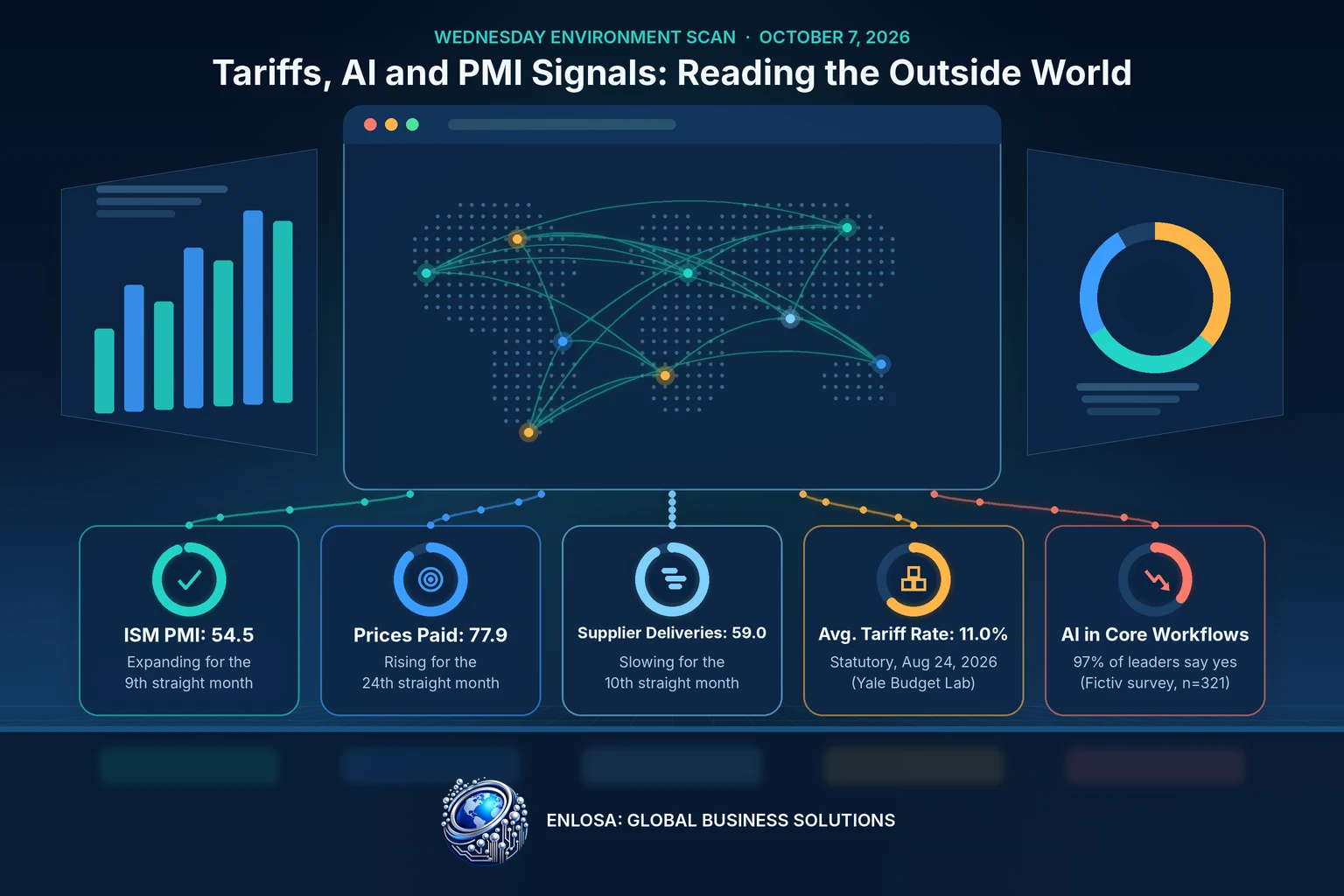
The September 2026 ISM Manufacturing PMI came in at 54.5%, down 0.1 point from August. It has now been in expansion for nine consecutive months.
The sub-indices tell the more useful story for an operations leader:
- Prices: 77.9%, up 6.8 points, and increasing for the 24th consecutive month.
- Supplier Deliveries: 59.0%, slowing for the 10th consecutive month.
- New Orders: 55.3%, up 1.6 points.
- Backlog of Orders: 56.4%, up 4.6 points.
- Inventories: 48.6%, down 2.0 points, in contraction.
- Customers’ Inventories: 41.6%, rated too low.
Demand is firm, suppliers are slower, and prices are climbing. Inventories are being drawn down on both sides of the relationship.
ISM survey respondents also cited tariffs directly. One said, “The U.S. tariff schedule is providing challenges,” and others flagged Canada tariffs as a source of cost increases and supply chain disruption. Source
Signal 2: Tariffs, Planning for Volatility You Cannot Forecast
The Yale Budget Lab estimated the average statutory U.S. tariff rate at 11.0% as of August 24, 2026, rising to 11.8% by year-end under current law. Section 122 tariffs expired on July 24 and were replaced with new tariffs under Section 301. The Lab estimates the ultimate consumer price impact of current-law policy at about 0.7%. Source
Deloitte’s 2026 Manufacturing Industry Outlook found that 78% of manufacturers cite trade uncertainty as their top concern, and that manufacturers expect input costs to rise by an average of 5.4% over the next year. Source
The lesson is not to predict the next tariff schedule.
It is to make the plan able to absorb the next one.
That means three things:
- Know your exposure. Map spend by supplier, country of origin and tariff basis.
- Know your cost-to-serve. Calculate landed cost by lane, product and customer, not by average.
- Set triggers in advance. Decide which cost, lead-time or policy changes will prompt a pricing, sourcing or inventory decision.
Signal 3: AI, From Pilot to Production
AI is no longer a side project in operations.
Deloitte found that 22% of manufacturers plan to use physical AI within two years, more than double today’s 9%, and that 80% of 600 surveyed executives plan to put at least 20% of their improvement budgets into smart manufacturing. Source
A 2026 survey of 321 director-level and above manufacturing and supply chain leaders by Fictiv, a manufacturing platform, reported that 95% say AI is vital to their company’s future success and 97% say it is already embedded in core workflows. The same survey found 81% say supplier sourcing and management is too time-consuming and costly. Treat it as a vendor survey, but the direction is consistent with Deloitte. Source
Adoption is moving faster than governance.
The question is no longer whether to use AI. It is who owns the result.
What the Three Signals Say Together
| Signal | What the data says | Operating response |
|---|---|---|
| PMI | Firm demand, slower suppliers, prices up 24 months running | Review lead-time buffers, safety stock and price-adjustment terms |
| Tariffs | 11.0% average statutory rate, shifting legal basis, 78% cite trade uncertainty | Map exposure, compute landed cost, set decision triggers |
| AI | Adoption rising quickly across planning, sourcing and quality | Start with one use case that has an owner, a metric and a baseline |
Each signal is manageable on its own.
Together they raise the cost of running an operation on monthly reports.
Three Moves for This Week
1. Build a one-page external dashboard.
Track supplier deliveries, prices paid and your own supplier lead times side by side, with a named owner for each line.
2. Run a tariff exposure drill.
Pick your top ten supplier-product combinations and calculate landed cost under two scenarios. Agree in advance what changes at each threshold.
3. Choose one AI use case and give it an owner.
Define the metric, record the baseline, and review it in the weekly operating cadence. This is the same discipline from Monday and Tuesday: one owner, one definition, early reporting.
The ENLOSA Perspective
At EGBS — ENLOSA: Global Business Solutions, we treat the external environment as an operating input, not background noise.
This is where Stratactic™ — Strategy + Execution becomes practical.
Strategy sets the destination.
Environment scanning keeps the route current.
The objective is not to predict the outside world. It is to shorten the time between a signal and a decision.
Is This Happening in Your Organization?
Your business may need an environment-scan discipline if:
- Pricing and sourcing decisions follow cost increases by months.
- No one owns the link between external indicators and internal triggers.
- Tariff exposure is known in aggregate but not by supplier and product.
- Safety stock and lead-time assumptions have not been updated this year.
- AI tools are being adopted without a named owner, metric or baseline.
- The operating review looks backward more than outward.
Those are not merely planning problems.
They may indicate that the operating system is not yet connected to the world it operates in.
A useful next step is the ENLOSA Initial Operational Value Creation Assessment, a focused 1–2 week executive review covering leadership, manufacturing, supply chain, working capital, systems and execution, with a 30/90/180-day roadmap.
Explore ENLOSA Operational Value Creation
ENLOSA: Global Business Solutions
Strategy. Leadership. Execution.
enlosa@enlosa.com | +1 (877) 246-1109
References
- Institute for Supply Management (ISM), October 1, 2026. “Manufacturing PMI at 54.5%; September 2026 ISM Manufacturing PMI Report.” Source | ISM report page
- Yale Budget Lab, updated August 24, 2026. “The State of U.S. Tariffs.” Source
- Deloitte, November 13, 2025. “2026 Manufacturing Industry Outlook.” Source
- Fictiv, 2026. “2026 State of Manufacturing AI and Supply Chain Report” (survey of 321 leaders), as reported by Supply Chain 24/7. Source
#WednesdayEnvironment, #EnvironmentScan, #SupplyChain, #Manufacturing, #Tariffs, #TradePolicy, #PMI, #ISM, #AI, #AgenticAI, #SmartManufacturing, #OperationalExcellence, #Operations, #Execution, #PerformanceManagement, #COO, #CEO, #CFO, #FractionalCOO, #OperationalValueCreation, #Stratactic, #EGBS, #BusinessStrategy
Leave a Reply