
Thursday Research — October 8, 2026
Operations leaders hear two claims constantly.
Good management raises productivity.
Tying up less cash raises profit.
Both sound plausible. This Thursday, here is what the research says about each, and how they connect.
Finding 1: Management Practices Vary Widely, and the Differences Matter
The World Management Survey, led by Nicholas Bloom, Raffaella Sadun and John Van Reenen, scored organizations on 18 practices grouped into three areas: targets, incentives and monitoring. It covers more than 8,000 manufacturers in 20 countries.
Two results stand out:
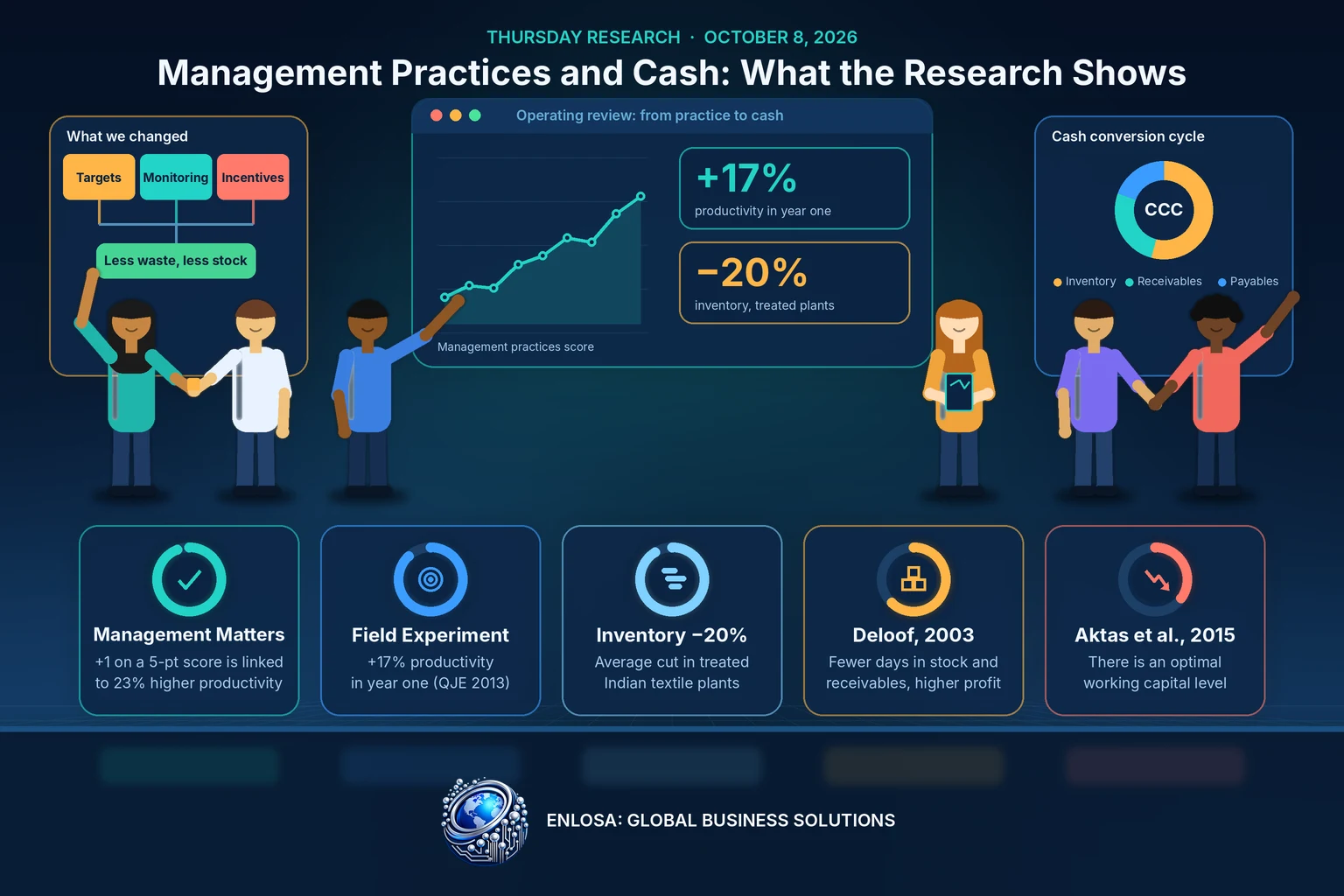
- A one-point higher score on the five-point scale was associated with 23% greater productivity in manufacturing. The authors describe this as roughly the gap between the bottom third and top third of firms.
- 79% of organizations rated their own management as above average, but their scores showed no correlation with that self-assessment.
Both are in the authors’ 2012 Harvard Business Review article. Source
The second finding matters most for executives. Many leadership teams believe their practices are strong. The data says that belief is a poor guide.
Finding 2: A Field Experiment Moved the Numbers
Correlation is not proof. So the same group of researchers ran a randomized experiment.
In the Indian textile industry, 14 of 28 plants at 17 firms received about five months of on-site consulting on targets, incentives and monitoring. On average, treated plants cut defects by more than 50%, reduced inventory by 20% and raised output by 10%. Source
The peer-reviewed version, by Bloom, Eifert, Mahajan, McKenzie and Roberts, reports that the adopted practices raised productivity by 17% in the first year, through better quality, greater efficiency and lower inventory. Within three years, treated firms had also opened more production plants. Source
Note where one of those gains landed: inventory.
Finding 3: Where the Cash Sits
Inventory is where cash goes to wait, as we discussed on Monday. Two academic studies look at what that waiting costs.
Marc Deloof studied 1,009 large Belgian non-financial firms from 1992 to 1996. He found that shorter periods in receivables and inventories were associated with higher profitability, and that less profitable firms took longer to pay their suppliers. Source
Nihat Aktas, Ettore Croci and Dimitris Petmezas studied US firms from 1982 to 2011. They found there is an optimal level of working capital. Firms that moved toward that level, whether by raising or lowering their working-capital investment, improved both stock and operating performance. The channel was investment: efficient working capital frees up underused resources that firms can redeploy. Source
The practical message is not “minimize inventory”. It is “find the right level, and manage toward it.”
Connecting the Two
Read together, the studies suggest a chain:
Clear targets, monitoring and incentives improve quality and efficiency.
Better quality and efficiency reduce rework and the inventory buffers that hide it.
Lower, better-managed inventory shortens the cash conversion cycle.
A better-positioned cash cycle is associated with stronger financial performance.
| Study | Setting | What it found | Limit to keep in mind |
|---|---|---|---|
| World Management Survey (Bloom, Sadun, Van Reenen, 2012) | 8,000+ manufacturers, 20 countries | +1 point on the practice score associated with 23% greater productivity | Association, not proof of cause |
| Bloom et al. (QJE, 2013) | Randomized experiment, Indian textile plants | +17% productivity in year one; defects, inventory and output improved | One industry and region; small sample of plants |
| Deloof (2003) | 1,009 large Belgian firms, 1992–1996 | Shorter days in receivables and inventories associated with higher profitability | Observational; large firms in one country |
| Aktas, Croci and Petmezas (2015) | US firms, 1982–2011 | An optimal working-capital level exists; moving toward it improves performance | Optimum varies by firm and industry |
What the Research Does Not Say
Good research has limits, and good leaders respect them.
- The 23% figure is an association across firms. It does not mean any one plant will gain 23%.
- The Indian experiment is rigorous but narrow: textile plants, a specific region, a small number of sites.
- The working-capital studies are observational. They show a link, not a guaranteed result.
- The optimum is not zero inventory. Moving past it can hurt performance.
The right reading is not “do this and get that.” It is “this is where the evidence points, so test it in your own plant.”
Four Questions for Your Team This Week
- Targets: Does every line and function have a clear, current target, and does everyone know it?
- Monitoring: How quickly do we see a miss? Daily, weekly or at month end?
- Incentives: Do our incentives reward the behavior that reduces rework and excess stock?
- Working capital: Do we know our target level of inventory days by product family, and why?
The ENLOSA Perspective
At EGBS — ENLOSA: Global Business Solutions, we use research as a starting point and the plant floor as the test.
This is where Stratactic™ — Strategy + Execution becomes practical.
Strategy sets the destination.
Disciplined practices and visible measures turn it into cash and margin.
The evidence supports a simple discipline: set targets, monitor early, align incentives, and manage working capital to a deliberate level.
Is This Happening in Your Organization?
Your business may need an operating-practices review if:
- Leaders rate management practices as strong, but results say otherwise.
- Targets exist, but monitoring is monthly and corrective action is slow.
- Rework and scrap are absorbed by extra inventory.
- Inventory days have drifted up and no one can explain why.
- Incentives reward volume over first-pass quality.
- Finance and operations use different working-capital targets.
Those are not merely performance problems.
They may indicate that practices and cash are not yet managed as one system.
A useful next step is the ENLOSA Initial Operational Value Creation Assessment, a focused 1–2 week executive review covering leadership, manufacturing, supply chain, working capital, systems and execution, with a 30/90/180-day roadmap.
Explore ENLOSA Operational Value Creation
ENLOSA: Global Business Solutions
Strategy. Leadership. Execution.
enlosa@enlosa.com | +1 (877) 246-1109
References
- Bloom, N., Sadun, R., and Van Reenen, J., November 2012. “Does Management Really Work?” Harvard Business Review. Source
- Bloom, N., Eifert, B., Mahajan, A., McKenzie, D., and Roberts, J., 2013. “Does Management Matter? Evidence from India.” The Quarterly Journal of Economics, 128(1), 1–51. Source
- Deloof, M., 2003. “Does Working Capital Management Affect Profitability of Belgian Firms?” Journal of Business Finance & Accounting, 30(3–4), 573–588. Source
- Aktas, N., Croci, E., and Petmezas, D., 2015. “Is Working Capital Management Value-Enhancing? Evidence from Firm Performance and Investments.” Journal of Corporate Finance, 30, 98–113. Source
#ThursdayResearch, #Research, #ManagementPractices, #OperationalExcellence, #Productivity, #WorkingCapital, #CashConversionCycle, #InventoryManagement, #CashFlow, #Manufacturing, #Operations, #Execution, #PerformanceManagement, #Leadership, #COO, #CEO, #CFO, #FractionalCOO, #OperationalValueCreation, #Stratactic, #EGBS, #BusinessStrategy
Leave a Reply