
Friday, October 9, 2026 | Operations & Leadership Perspectives
Most leadership teams do not have an accountability problem.
They have an accountability system problem.
Three failures show up again and again:
- Actions leave the meeting without a clear owner, date or definition of done.
- Status reports show green on the outside and red on the inside.
- There is no fixed rhythm for closing the loop.
Fix all three and accountability stops being a personality trait. It becomes how the business runs.
The Execution Gap Is Real
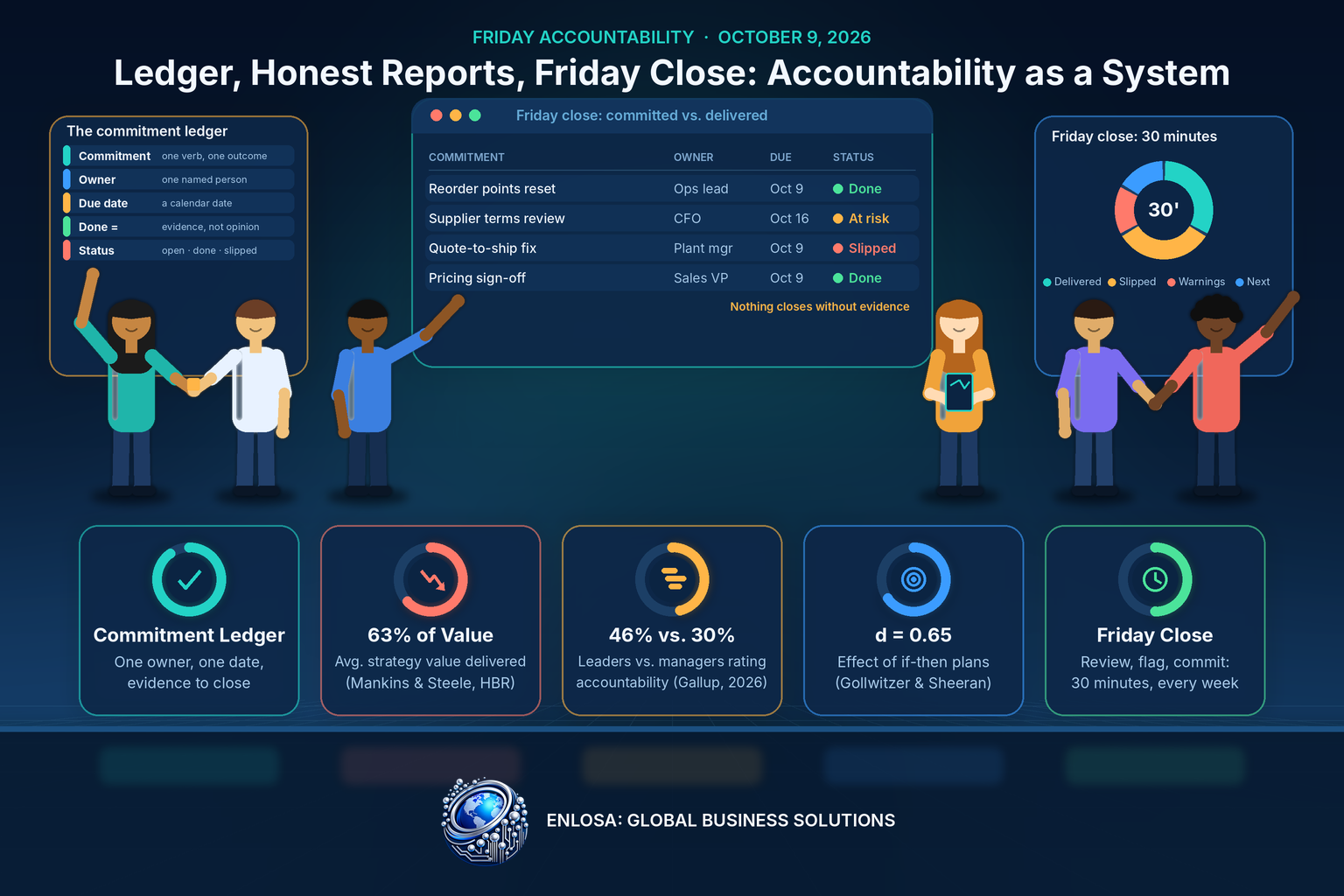
Mankins and Steele, writing in Harvard Business Review, found that most companies’ strategies deliver only 63% of their promised financial value.
The gap is rarely strategy. It is the follow-through between the plan and the result.
Gallup’s March 2026 leadership research points the same way. Only 46% of leaders rate themselves exceptional or outstanding at creating accountability, the lowest of the seven leadership competencies it measured. Only 30% of managers say their own leaders are.
Managers who rate their leader highly on accountability are three times as likely to be engaged: 51% versus 17%.
Accountability is a leadership weakness. It is also an engagement lever.
Part 1: The Commitment Ledger
Meetings produce discussion. Ledgers produce results.
A commitment ledger is one shared page. Every action goes on it with five fields:
| Field | The rule |
|---|---|
| Commitment | One verb, one outcome |
| Owner | One named person, never a team |
| Due date | A calendar date, not “soon” |
| Definition of done | What evidence will show it is finished |
| Status | Open, done with evidence, or slipped with reason |
Two rules make it work:
- Nothing is closed without evidence. “I think it’s done” is not done.
- Slipped items stay on the ledger with a reason until they are done or deliberately dropped.
The psychology supports specificity. Gollwitzer and Sheeran’s meta-analysis of 94 tests found that specifying in advance when, where and how you will act has a medium-to-large positive effect on goal attainment (d = 0.65).
A named owner with a date is an implementation intention in business form.
FranklinCovey’s 4 Disciplines of Execution builds on a similar idea. Each team member answers one question each week: what are the one or two most important things I can do this week that will have the biggest impact on the scoreboard?
Part 2: The Watermelon Report
Project managers have a name for a status report that is green outside and red inside: a watermelon.
It happens when:
- Reporting a problem feels riskier than hiding it.
- Colors measure effort, not outcomes.
- Bad news is received badly.
By the time the red shows, the options are fewer and the cost is higher.
Edmondson’s field study of 51 work teams at a manufacturing company found that psychological safety, a shared belief that the team is safe for interpersonal risk-taking, was linked to learning behavior, and learning behavior was linked to team performance.
Toyota’s andon system shows the operating version of this. Toyota describes every team member as permitted to stop the production line if they see a threat to quality. The alert is a signal that shows where action is needed, so a solution can be found when the problem happens, not after it ships.
Three practical changes
- Report the trend, not just the status. “Green, but slipping for three weeks” is more honest than “green.”
- Define red in advance. Agree the thresholds that trigger escalation before anyone is under pressure.
- Reward early flags. Thank the person who raises a problem first. That is the behavior you want repeated.
Part 3: The 30-Minute Friday Close
A fixed weekly rhythm keeps the ledger alive.
FranklinCovey describes a weekly session of no more than 20 minutes, where each person reports whether last week’s commitments were met, whether they moved the scoreboard, and what they commit to next.
A Friday close adapts that idea for a leadership team:
| Minutes | Agenda |
|---|---|
| 0 to 10 | Committed vs. delivered. Walk the ledger. Done with evidence, or not. |
| 10 to 20 | What slipped and why. Cause, not blame. Is it capacity, clarity, a dependency or a decision? |
| 20 to 25 | Early warnings. Anything trending toward red next week. |
| 25 to 30 | Next week’s commitments. Owner, date and definition of done, written down before leaving. |
Three questions replace blame with learning:
- What did we say would happen?
- What actually happened?
- What do we change next week?
The ENLOSA Perspective
Accountability does not come from pressure. It comes from clarity, visibility and rhythm.
A ledger makes the commitment clear. An honest report makes the status visible. A Friday close makes the rhythm repeatable.
Together they turn plans into results and surface problems while they are still cheap to fix.
What the Evidence Does Not Say
- The 63% figure describes the average of the companies Mankins and Steele studied, not every business.
- Gollwitzer and Sheeran’s results come mostly from individual goal pursuit. Applying them to teams is a reasonable extension, not a proven result.
- Edmondson’s study covered one manufacturing company. It shows a link, not a guarantee.
- The Friday close is a practitioner design built on these ideas. It is not a tested protocol.
Is This Happening in Your Organization?
- Do your meetings end with owners and dates, or with “let’s follow up”?
- When did a project last go from green to red in a single week?
- Would your team report a miss on Monday, or hide it until Friday?
If the answers are uncomfortable, let’s talk about operational value creation.
Enrique Lopez Salido | ENLOSA: Global Business Solutions
enlosa@enlosa.com | +1 (877) 246-1109
References
- Mankins, M. C. & Steele, R. (2005). Turning Great Strategy into Great Performance. Harvard Business Review. Source (Bain-hosted page)
- Gallup (March 19, 2026). Accountability Is Leadership’s Greatest Weakness. Source
- Gollwitzer, P. M. & Sheeran, P. (2006). Implementation intentions and goal achievement: a meta-analysis of effects and processes. Advances in Experimental Social Psychology, 38, 69-119. Source
- Edmondson, A. (1999). Psychological Safety and Learning Behavior in Work Teams. Administrative Science Quarterly, 44(2), 350-383. Source
- Toyota UK. Andon: Toyota Production System guide. Source
- FranklinCovey. Discipline 4: Create a Cadence of Accountability. Source
#FridayAccountability #Accountability #ExecutiveLeadership #LeadershipBehavior #Execution #PerformanceManagement #OperationalExcellence #PsychologicalSafety #ContinuousImprovement #LeanManagement #ProjectManagement #Operations #COO #CEO #CFO #FractionalCOO #OperationalValueCreation #Stratactic #EGBS #BusinessStrategy
Leave a Reply