
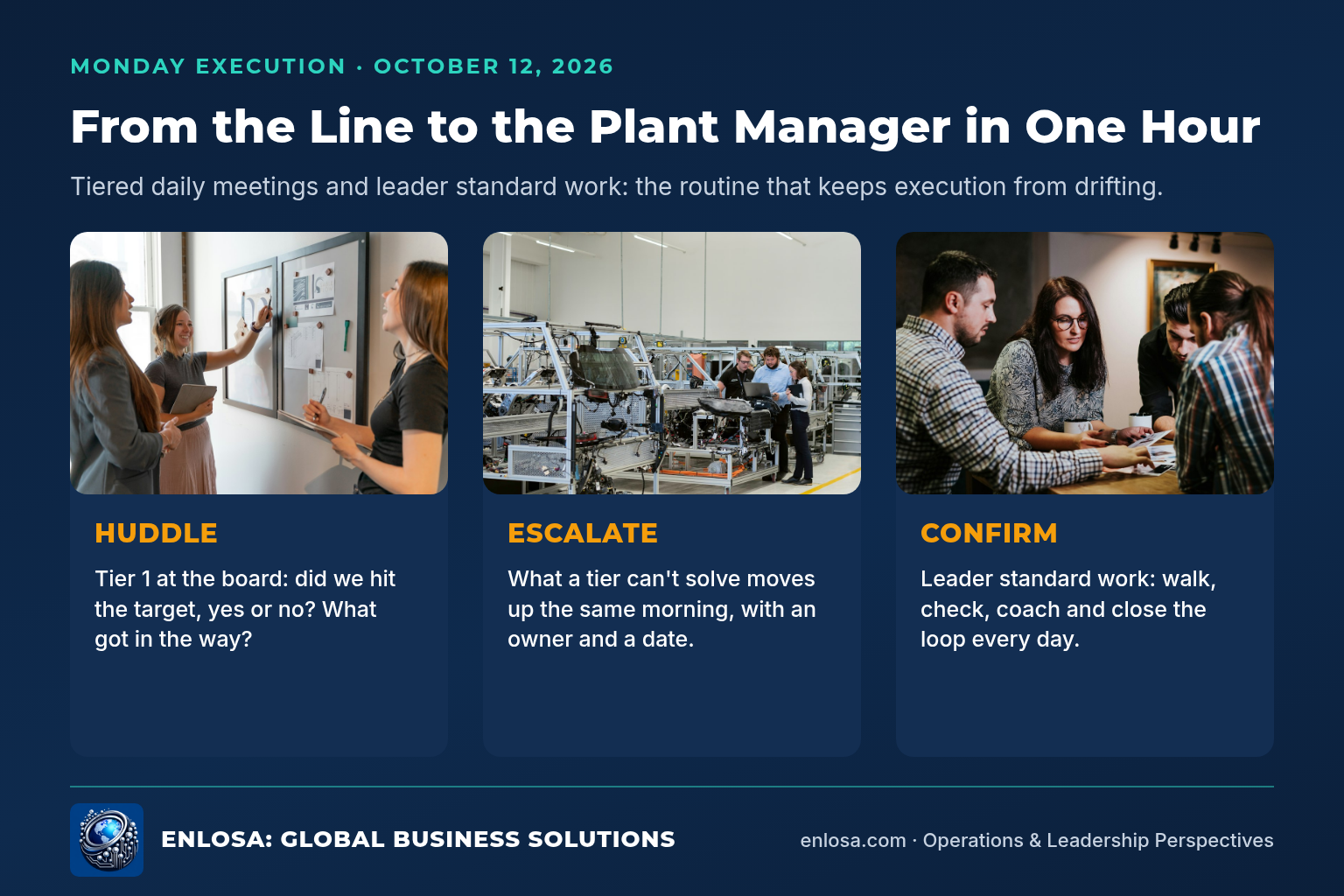
Monday, October 12, 2026 | Operations & Leadership Perspectives
Last week ended with one question:
Is your operating system surfacing the truth early enough to act?
This Monday, we turn that question into a routine.
Two practices, used together, do most of the work:
- Tiered daily meetings, which move a problem from the line to the plant manager in about an hour.
- Leader standard work, the daily routine that makes sure the meetings, the boards and the follow-ups actually happen.
One without the other fails. Meetings without leader routines become a reporting ritual. Leader routines without a meeting structure leave each leader solving problems alone.
Why Problems Surface Late
In most plants, the information exists. An operator knows the machine has been slow since 6 a.m. A supervisor knows the material is short for second shift. A planner knows the customer order will ship late.
What is missing is a path that carries that information upward the same day, to the person who can remove the barrier.
The cost of slow, unclear decision-making is measurable. In a McKinsey survey of more than 1,200 managers, 61% said at least half the time they spend on decisions is ineffective, and fewer than half said their organizations make decisions in a timely way. For a typical Fortune 500 company, the authors estimate the wasted time at about 530,000 manager-days a year (McKinsey, 2019).
Tiered meetings are a direct answer: short, daily, structured conversations that decide what happens next instead of reviewing what already happened.
Part 1: Tiered Daily Meetings
A tiered system is a cascade of short stand-up meetings held early in the day, each one feeding the next.
| Tier | Who | When and how long | The question it answers |
|---|---|---|---|
| Tier 1 | Operators and team leader, at the line board | Start of shift, 10 minutes | Did we hit yesterday’s target, yes or no? What is in the way today? |
| Tier 2 | Supervisors and support functions (maintenance, quality, materials) | 30 to 45 minutes after Tier 1, 15 minutes | Which Tier 1 problems need help from another function? |
| Tier 3 | Plant manager and department heads | About one hour after Tier 1, 15 to 20 minutes | Which problems need plant-level resources, priorities or decisions? |
| Tier 4 (weekly) | Plant or business leadership | Weekly, 30 to 45 minutes | What patterns are repeating, and which need investment or a project? |
The times above are a common pattern, not a fixed rule. What matters is that each tier meets after the one below it, so the escalation path is measured in minutes, not days.
As Catalyst Connection describes the rhythm, teams start at a visual board with safety, quality, delivery and abnormalities, and issues a level cannot resolve move up to the next one. Its key warning: if escalations do not lead to action, people stop raising problems (Catalyst Connection).
Five rules that make tiered meetings work
- Stand at the board, not in a conference room. The board shows the same five numbers every day. Last week’s Monday Execution post suggested OTIF, first-pass yield, schedule adherence, inventory days and cost of poor quality.
- Red or green, then the reason. Did we hit the target, yes or no? Explanations come only for misses.
- Every escalation leaves with an owner and a date. No owner means no escalation.
- Answer down the same day. Every item raised gets a response back to the tier that raised it, even if the answer is “not yet, and here is why.”
- Keep to time. Problem solving happens after the meeting, with the right people, not in front of everyone.
Part 2: Leader Standard Work
Tiered meetings create the path. Leader standard work makes sure leaders walk it every day.
David Mann, in Creating a Lean Culture, describes leader standard work as the routine that protects the integrity of the production system. For executives, he says, it is a way “to go test for the integrity of the system” (Lean Blog interview with David Mann).
In practice, it is a short written checklist of what each leader does every day, every week and every month: which boards they check, which areas they walk, which meetings they lead, and which follow-ups they close.
A common guideline in lean practice is that the share of time on standard routines shrinks as the role gets more senior: about 80% for team leaders, about 50% for middle managers, and about 10% for executives (Tervene). The rest of the time goes to improvement, development and strategy.
| Role | Daily standard work examples |
|---|---|
| Team leader | Run Tier 1. Check hour-by-hour production board. Respond to andon calls. Confirm one standardized work step with an operator. |
| Supervisor | Attend Tier 1 for one line, run Tier 2. Walk every line once per shift. Close yesterday’s escalations. Review the commitment ledger. |
| Plant manager | Run Tier 3. Walk one area with its supervisor and ask about one red item. Remove one barrier raised from below. Coach one leader. |
Span of control matters. At Toyota, a team leader typically supports four to six team members, and a group leader oversees four or five team leaders. Toyota Supplier Support Center president Jamie Bonini warns that where team leader roles are missing, lean transformations are likely to struggle (Lean Enterprise Institute).
There is also a people reason. Gallup estimates that managers account for at least 70% of the variance in employee engagement across business units (Gallup). The daily behavior of supervisors and managers is the culture people experience.
How the Two Fit Together
Think of it as one loop that runs every day:
- Surface: Tier 1 makes the problem visible within hours.
- Escalate: Tiers 2 and 3 assign an owner, a date and the help needed.
- Confirm: Leader standard work checks that the fix happened, on the floor, not in a report.
- Close: The answer goes back down to the team that raised it.
This is the daily version of the weekly Friday close and commitment ledger. It also answers Tuesday’s question about who dares to report the number: people report problems when they see leaders act on them.
Common Failure Modes
- The meeting becomes a status report. Fix: only red items get discussion time.
- Escalations disappear. Fix: an action list on the Tier 3 board, reviewed every day until closed.
- Leaders skip the walk when they are busy. Fix: make it the first item on the calendar and audit it weekly.
- The checklist becomes a checkbox. Fix: each walk ends with one question asked and one barrier removed.
- Too many metrics on the board. Fix: five numbers, the same every day.
A 30-Day Start Plan
| Week | Action |
|---|---|
| Week 1 | Pick one value stream. Build a Tier 1 board with five numbers. Start a 10-minute daily huddle. |
| Week 2 | Add Tier 2 with maintenance, quality and materials. Start an escalation list with owners and dates. |
| Week 3 | Add Tier 3 with the plant manager. Write a one-page leader standard work checklist for each role. |
| Week 4 | Audit: How many escalations closed within 24 hours? How many leader walks happened? Adjust and extend to the next area. |
Questions for Your Leadership Team This Week
- How long does it take for a problem on the line to reach someone who can fix it?
- What percentage of escalations last month got an answer back to the team that raised it?
- Does every leader in operations have a written daily routine, and do they follow it?
- When did the plant manager last walk the floor and remove a barrier raised by a team?
- If we stopped the daily meetings for a week, would anyone notice the difference in results?
The ENLOSA Perspective
At ENLOSA, we call this Stratactic™: Strategy + Execution.
Strategy sets the targets. Execution is what happens every morning between 7:00 and 8:00, when a team decides whether yesterday was good enough and leaders decide what they will remove from the team’s way.
Tiered meetings and leader standard work are not paperwork. They are the operating rhythm that turns a strategy into daily results.
Is This Happening in Your Organization?
If problems reach leadership days late, meetings report instead of decide, or leaders spend the day firefighting instead of walking the floor, ENLOSA can help design and launch a daily management system that sticks.
Learn more about our Operational Value Creation approach.
ENLOSA: Global Business Solutions
enlosa@enlosa.com | +1 (877) 246-1109
Sources
- De Smet, Jost and Weiss, “Three keys to faster, better decisions,” McKinsey Quarterly, May 2019
- Catalyst Connection, “Tiered Meetings in Manufacturing: The Operating Rhythm That Protects Execution”
- Lean Blog, interview with David Mann on Creating a Lean Culture, 3rd edition
- Tervene, “Leader Standard Work (LSW)”
- George Taninecz, “The Role of Lean Team Leader,” Lean Enterprise Institute, January 2026
- Beck and Harter, “Managers Account for 70% of Variance in Employee Engagement,” Gallup, April 2015
#MondayExecution #OperationalExcellence #Execution #LeaderStandardWork #TieredMeetings #DailyManagement #LeanManufacturing #Accountability #COO #Manufacturing #PerformanceManagement #Stratactic #EGBS
Visual photos via Unsplash: Sable Flow, ThisisEngineering, Andreea Avramescu.
Leave a Reply