
Tuesday, October 20, 2026 | Operations & Leadership Perspectives
Yesterday’s Monday Execution post examined four bottlenecks slowing execution: judgment, planning cadence, capacity, and technical talent.
Today we move one level deeper.
Because AI is not only changing how quickly work gets done.
It is changing who does the work, who makes the decision, what managers are responsible for, and what employees consider acceptable behavior.
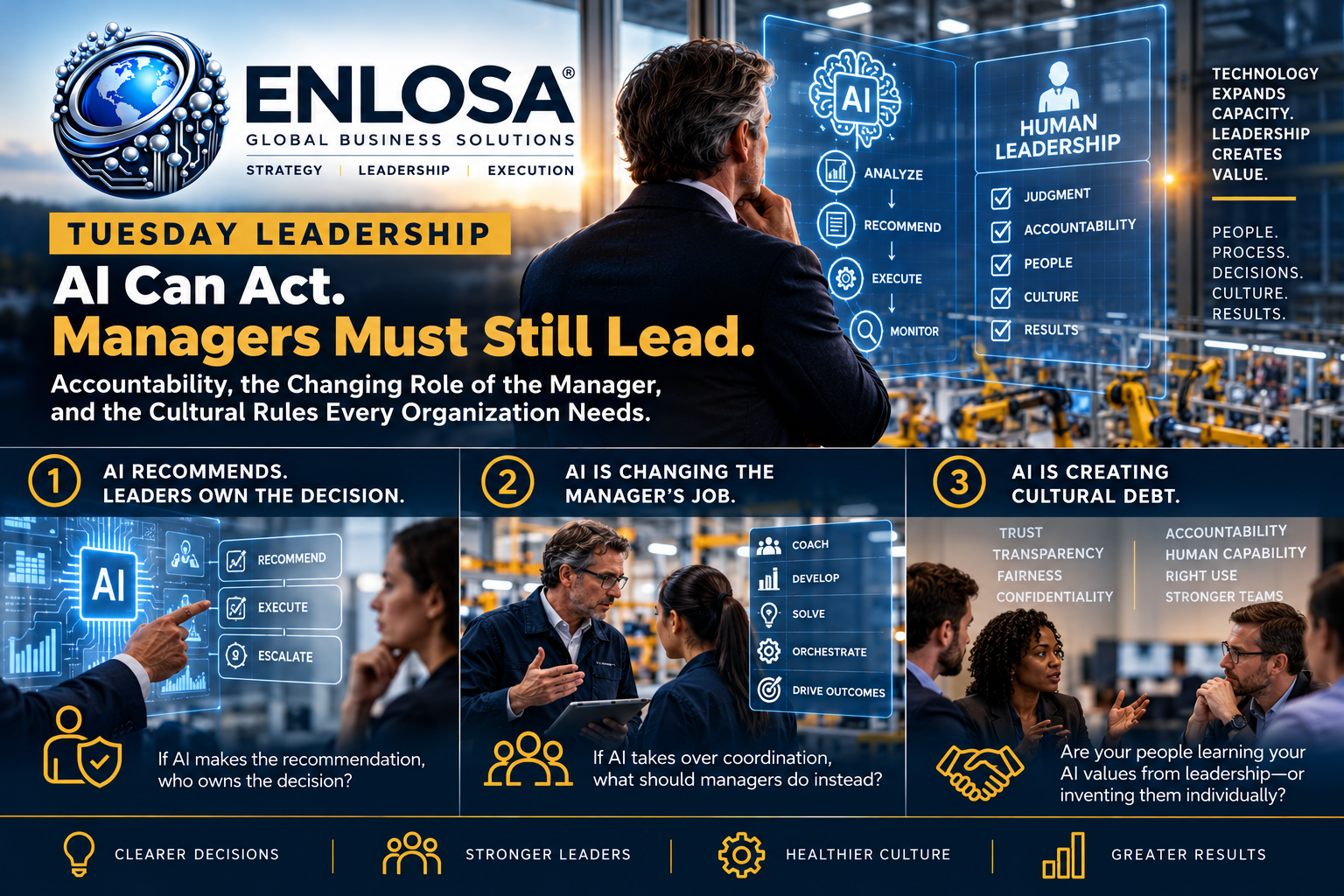
That creates three leadership questions every executive team should be asking:
If AI makes the recommendation, who owns the decision?
If AI performs much of the coordination and administrative work managers used to perform, what should managers do instead?
And if leadership does not establish clear rules for using AI, what happens to trust?
These are not technology questions.
They are leadership-system questions.
1. AI Can Make the Recommendation. Accountability Still Needs a Name.
Organizations are rapidly moving beyond copilots that help people write, search, or summarize.
AI agents can increasingly monitor information, analyze conditions, recommend actions, route work, trigger processes, access systems, and, within defined permissions, take action.
Deloitte reports that 80% of automation leaders plan to accelerate investment in AI agents, while only 21% of organizations say they have mature agentic-AI governance capabilities. Deloitte
That gap matters.
Technology is gaining autonomy faster than many organizations are establishing accountability.
A human employee makes a mistake and the organization usually knows who was responsible.
But consider an AI-enabled process.
An agent recommends changing the production sequence. Another system executes the change. The recommendation depends on demand data from one system, inventory from another, and operating assumptions created months earlier. Customer service deteriorates.
Who owns the result?
The AI developer? IT? The business-process owner? The manager who approved the workflow? The person who accepted the recommendation? The executive sponsoring AI?
Shared responsibility cannot become ambiguous accountability.
Deloitte makes the same point in its discussion of AI governance: AI risk increasingly crosses cybersecurity, operations, compliance, data, vendors, finance, and the business itself. No single function can manage everything, but distributed responsibility cannot mean nobody clearly owns the outcome.
Start With the Decision, Not the Technology
Before deploying an AI agent, leadership should answer five questions.
1. What outcome does the system influence?
Do not begin with: “What can this agent automate?”
Begin with:
“What business outcome could change because this agent acts?”
Customer promise? Production sequence? Supplier order? Price? Inventory? Hiring decision? Quality release? Capital allocation?
The more material the outcome, the clearer the governance must be.
2. What authority does AI actually have?
There should be a visible boundary between:
- Recommend.
- Prepare.
- Execute within guardrails.
- Execute and notify.
- Escalate for approval.
AI autonomy should not be defined by what the technology can technically do.
It should be defined by what the organization is prepared to govern.
3. Who owns the outcome?
Every consequential AI-enabled process should have a human business owner.
Not merely a system owner. Not merely IT. Not merely the vendor.
One leader should be able to say: “I own the business outcome produced by this process.”
4. What triggers human intervention?
Examples might include a financial threshold, customer-service risk, a confidence score below an agreed level, a regulatory exception, a quality concern, an action outside historical operating boundaries, a conflicting recommendation from another system, or a material change from the approved plan.
The trigger should be designed before the exception occurs.
5. Who reviews what the AI got wrong?
Every significant AI-enabled operating process should produce learning.
What recommendation was wrong? Why? Was the data wrong? Were the guardrails wrong? Was the model wrong? Was the human judgment wrong? Did the organization fail to escalate?
AI governance should include operational learning, not only compliance.
2. AI Is Changing the Manager’s Job
The second leadership issue is potentially even larger.
McKinsey argues that agentic AI is changing three constraints that helped shape the traditional organization: human capacity, expertise, and coordination. McKinsey
For decades, organizations built managerial structures partly because information and coordination were expensive.
Managers collected information, prepared reports, coordinated departments, assigned work, reviewed status, escalated issues, and connected one organizational layer with another.
AI can increasingly perform pieces of that work.
That does not necessarily eliminate the manager.
It changes what justifies the manager.
Productivity Is Rising Faster Than Enterprise Value
McKinsey’s 2026 State of AI findings illustrate the problem.
80% of respondents say AI improved their individual productivity.
But only 37% report positive EBIT impact.
And only 6% qualify as AI high performers.
That gap matters enormously.
Individuals can become faster without the enterprise becoming better.
Why?
Because producing the same work faster is not the same as redesigning how value gets created.
McKinsey reports that nearly three-quarters of AI high performers have substantially redesigned workflows, versus roughly one-quarter of other organizations.
The advantage is not simply using AI. It is redesigning the organization around what AI makes possible.
If AI Removes Managerial Work, Do Not Fill the Space With More Managerial Work
Imagine AI takes over much of a manager’s status reporting, meeting preparation, data gathering, routine analysis, scheduling, follow-up reminders, documentation, and basic workflow coordination.
What happens to the recovered capacity?
One possibility is predictable.
The manager gets more direct reports, more dashboards, more meetings, more projects, and more administrative responsibilities.
That would capture some efficiency.
But it may miss the bigger opportunity.
Use the productivity dividend to make managers better leaders.
Shift the manager’s role:
- From information collector → to judgment provider.
- From task allocator → to capability builder.
- From approval layer → to exception manager.
- From status reporter → to problem-solving coach.
- From knowledge gatekeeper → to orchestrator of human and AI capabilities.
- From checking activity → to owning outcomes.
McKinsey argues that AI should push organizations away from simply adding AI to existing workflows and toward redesigning roles, workflows, accountability, and operating models together.
The Manager’s Most Valuable Product May Become Judgment
AI can produce an analysis.
A good manager still needs to ask:
- Does this make sense?
- What assumption matters most?
- What is missing?
- What would have to be true for this recommendation to be wrong?
- What are the unintended consequences?
- How does this affect the customer?
- What does the team know that the system does not?
- What should we do now?
That is judgment.
And judgment develops through experience.
Which introduces another leadership risk.
If AI begins performing the work through which younger employees historically developed expertise, where will future judgment come from?
McKinsey explicitly raises this issue: as AI removes tasks that traditionally helped people build expertise, organizations need new approaches to apprenticeship, coaching, development, and progression.
We cannot automate the apprenticeship ladder and then wonder ten years later why nobody has enough judgment to lead.
A New Manager Standard Work
Yesterday we discussed leader standard work in an operating system.
For the AI-enabled manager, standard work may increasingly include:
- Review one consequential AI recommendation. Ask what assumptions produced it.
- Coach one employee through a decision instead of giving the answer. Build judgment.
- Inspect one human-AI workflow. Look for duplication and unnecessary handoffs.
- Review one exception. Understand why automation stopped or should have stopped.
- Develop one capability. Ensure employees are learning more than prompt techniques.
- Clarify one decision right. Make clear where AI, employee, manager, and executive authority begin and end.
This is not less management.
It is higher-value management.
3. AI Is Also Creating Cultural Debt
There is a third dimension that may be less visible than productivity or organizational structure.
Trust.
Deloitte’s 2026 Global Human Capital Trends research reports that 42% of workers say their organizations rarely evaluate AI’s impact on people. Deloitte
The same research found that 80% of leaders, managers, and workers are concerned that coworkers or teams may use AI to appear more productive than they actually are.
Deloitte describes the resulting accumulation of unresolved norms and behaviors as cultural debt.
That phrase deserves executive attention.
Technical debt develops when organizations make short-term technology choices that create future complexity.
Cultural debt develops when leaders leave important behavioral questions unanswered and employees create their own rules.
Employees Are Already Answering Questions Leadership Has Not Addressed
Consider some of the questions appearing inside organizations:
- Is it acceptable to submit AI-generated work without saying so?
- If AI produces 80% of the analysis, who deserves credit?
- Is an employee more productive—or merely better at presenting AI output?
- Who is accountable when AI produces incorrect information?
- Can confidential company information be entered into an external AI system?
- Should managers use AI to write performance feedback?
- Can AI evaluate employees?
- Should employees be required to disclose when AI substantially produced their work?
- If AI saves an employee four hours, is that time theirs to reinvest in better work—or should leadership immediately add more work?
- What human capabilities must employees still demonstrate independently?
These questions are not waiting for HR policies.
Employees are answering them every day through behavior.
If leadership does not establish the norms, informal norms will establish themselves.
Trust Becomes an Operating Requirement
This is not merely about employee sentiment.
McKinsey’s recent organizational-readiness research found a substantial gap between personal and organizational readiness for AI: 70% of respondents said they were personally ready for AI, while only 27% of leaders said their organizations were ready for the shifts required by an agentic future.
People may be willing to use the technology.
They are less certain the organization knows how to manage what comes next.
McKinsey also reports that trust in the organization’s handling of AI-related changes is associated with greater enterprise value across stages of AI maturity.
Trust, therefore, is not separate from execution.
Trust is part of the infrastructure required for execution.
Establish an AI Leadership Compact
Organizations do not need a 70-page policy before leaders can establish useful behavioral expectations.
Start with five principles.
1. Transparency
People should understand when AI materially contributes to consequential work.
Not every grammar correction requires disclosure.
But important analysis, recommendations, decisions, customer communications, performance evaluations, or externally published work may require greater transparency.
2. Accountability
AI assistance does not transfer accountability to the AI.
If you submit it, approve it, or use it to make a decision, you remain accountable for the result.
“The AI said so” cannot become an acceptable management explanation.
3. Verification
AI output should be verified in proportion to the consequence of being wrong.
An internal brainstorming note requires one standard.
A quality release, customer commitment, financial forecast, employment decision, or regulatory submission requires another.
4. Confidentiality
Employees need specific guidance on which systems are approved, which data may be entered, which information is restricted, what customer or employee information is prohibited, and what intellectual property protections apply.
Ambiguity creates risk.
5. Capability Development
AI should increase human capability, not quietly replace the experiences required to develop it.
Ask:
- What should employees still know how to do without AI?
- Which judgment skills must remain human?
- What must managers continue to teach?
- Where does apprenticeship now happen?
Technology changes.
The organization still needs future leaders.
The Three Issues Are Really One Leadership Problem
Now connect the three.
An AI agent makes a recommendation.
The manager accepts it without deeply reviewing it because the system has been right before.
The recommendation creates a customer problem.
Nobody is certain who owned the decision.
The employee who prepared the analysis says the AI produced it.
The manager says the technology team approved the system.
IT says the business defined the workflow.
Meanwhile, other employees watch what happens.
They learn something about accountability.
They learn something about disclosure.
They learn something about what management actually values.
And a cultural rule has just been created.
Every AI workflow is also a leadership workflow.
It defines authority, responsibility, judgment, learning, trust, and eventually culture.
A Better Human–AI Leadership Model
The organization of the future should not be built around the idea that AI works and humans approve.
That will create overwhelmed reviewers.
Nor should it assume AI acts while humans merely handle exceptions.
That risks eroding capability and judgment.
A better model is:
AI processes information. Humans own outcomes.
AI handles repeatability. Humans manage ambiguity.
AI expands capacity. Managers develop capability.
AI identifies patterns. Leaders exercise judgment.
AI accelerates execution. Culture determines whether people trust the system.
A 30-Day Leadership Reset for AI
Week 1 — Map Accountability
Select the ten most consequential AI-enabled workflows already in use or being developed.
For each one, identify the business outcome, the human owner, the AI authority level, human approval requirements, escalation conditions, and review frequency.
If no human owner exists, do not call it governance.
Week 2 — Redesign the Manager Role
Choose one management layer.
List the administrative and coordination work AI can reduce.
Then ask:
What higher-value leadership activity should replace that work?
Examples: coaching, talent development, problem solving, customer interaction, continuous improvement, decision quality, cross-functional coordination, and capability building.
Do not simply increase span of control without deciding what kind of leader the organization needs.
Week 3 — Establish the AI Leadership Compact
Agree on five organization-wide rules: transparency, accountability, verification, confidentiality, and capability development.
Write them in plain language. Discuss them with teams. Use real scenarios.
Week 4 — Review the Cultural Signals
Ask employees and managers:
- Where are the AI rules unclear?
- What behaviors feel unfair?
- Where are people hiding AI use?
- Where are people afraid to use AI?
- Where has AI created duplicated work?
- Which capabilities appear to be weakening?
- Which manager behaviors should change?
Do not measure only adoption.
Measure what AI is teaching people about your organization.
Questions for Your Leadership Team This Week
- For every consequential AI-enabled decision, can we identify one human leader who owns the outcome?
- What can AI decide independently, and what must remain explicitly human?
- If AI removed half of our managers’ reporting and coordination work tomorrow, what higher-value leadership work would replace it?
- Which experiences currently develop judgment in our future leaders—and is AI beginning to remove them?
- Do employees know when AI use should be disclosed?
- Can every employee explain what company information may and may not be entered into AI tools?
- Are people being rewarded for better outcomes—or simply for appearing more productive?
- Is AI strengthening trust between leaders and employees—or quietly weakening it?
- Where are employees creating informal AI rules because leadership has not established formal ones?
- What kind of manager will our organization need five years from now, and are we developing that manager today?
The ENLOSA Perspective
At ENLOSA: Global Business Solutions, we call the connection between strategy and execution Stratactic™.
AI makes that connection even more important.
A technology strategy may authorize AI.
But execution determines who owns the outcome, how decisions are governed, what managers do differently, how employees develop, what gets disclosed, what gets verified, how trust is protected, and whether the organization actually becomes more capable.
AI should not eliminate leadership. It should expose which parts of management were administrative—and make the real work of leadership more important.
The opportunity is not to create an organization where machines do more and people do less.
It is to build an organization where machines handle more of what is repeatable so people can become better at what remains distinctly human:
- Judgment.
- Leadership.
- Relationships.
- Creativity.
- Coaching.
- Accountability.
- Purpose.
- And the responsibility for outcomes.
That is how AI becomes more than a productivity tool.
It becomes an operating advantage.
References
- McKinsey & Company — “AI Is Changing Work. Now It Has to Change the Organization,” October 5, 2026. The research examines how agentic AI changes capacity, expertise, coordination, workflows, talent systems, and organizational structures; it also reports the gap between individual productivity gains and enterprise economic impact. Source
- Deloitte — “Rethinking the CISO Role for an AI-Saturated Enterprise,” September 3, 2026. Deloitte reports rapid planned growth in AI-agent investment alongside much lower maturity in agentic-AI governance, illustrating the accountability gap created as autonomous systems spread. Source
- Deloitte — 2026 Global Human Capital Trends, “Dealing With AI’s Cultural Debt.” Deloitte examines how unresolved AI norms can affect human-to-human trust, including employee concerns about undisclosed AI use and organizations failing to evaluate AI’s impact on people. Source
- Deloitte — State of AI in the Enterprise 2026. The report highlights fast-growing agentic-AI adoption alongside limited mature governance and continuing gaps in talent and operating-model redesign. Source
ENLOSA: Global Business Solutions
Strategy. Leadership. Execution.
enlosa@enlosa.com | +1 (877) 246-1109
#TuesdayLeadership #Leadership #AILeadership #AgenticAI #FutureOfWork #Managers #AIGovernance #Accountability #DecisionRights #OrganizationalDesign #LeadershipDevelopment #OrganizationalCulture #Trust #ResponsibleAI #TalentDevelopment #ExecutiveLeadership #DigitalTransformation #OperationalExcellence #CEO #COO #CHRO #Stratactic #EGBS
Leave a Reply