
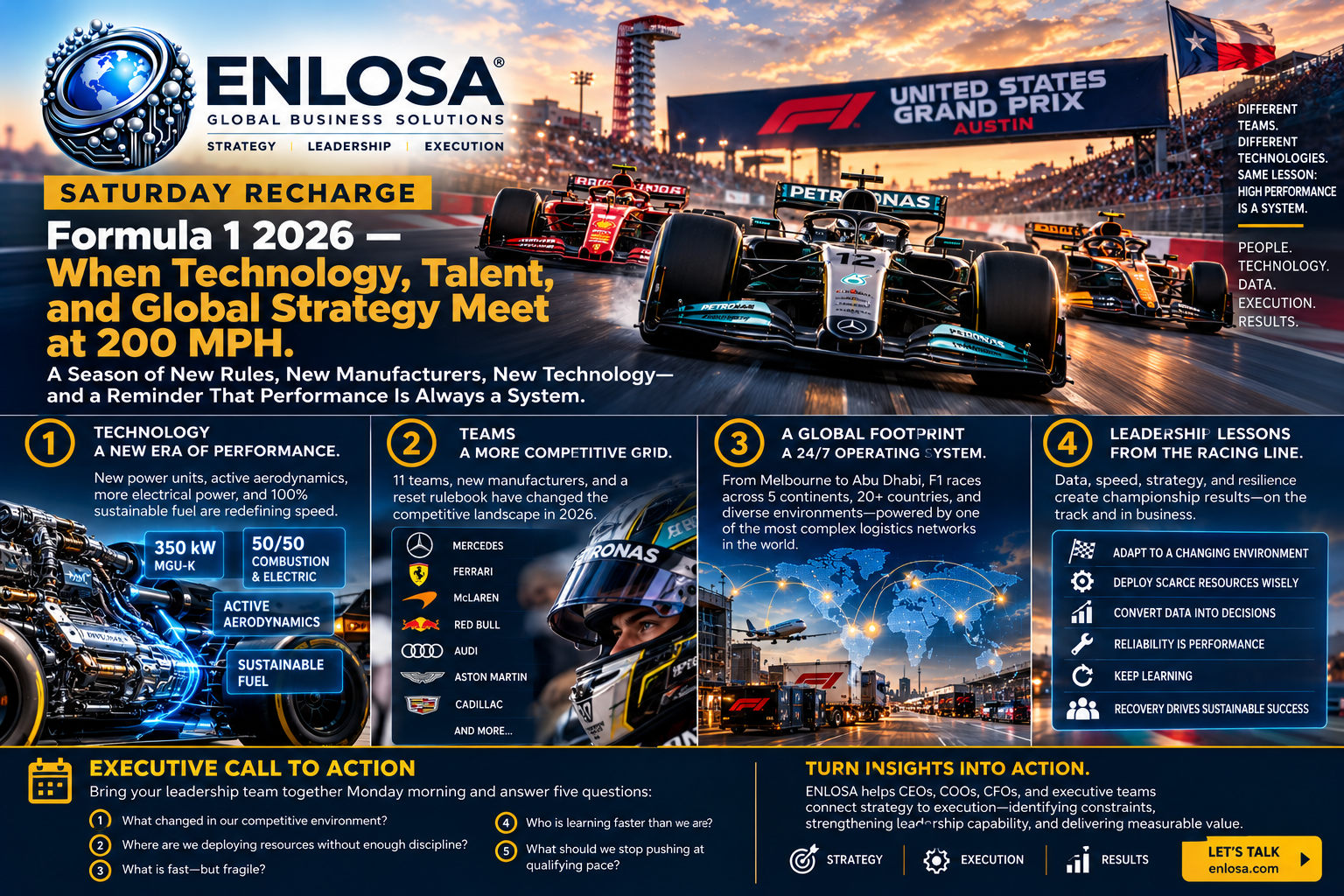
Saturday, October 24, 2026 | Operations & Leadership Perspectives
This weekend, Formula 1 arrives in Austin for the United States Grand Prix.
Seventeen Grands Prix are complete.
Six remain.
And the 2026 championship has become a fascinating experiment in something business leaders understand very well:
What happens when the rules of competition change almost overnight?
New cars. New engines. New aerodynamic concepts. More electrical power. Sustainable fuel. New manufacturers. A new team. Different energy-management strategies.
And an engineering rulebook that forced every organization on the grid to reconsider assumptions built over the previous decade.
Formula 1 may be entertainment.
But behind the spectacle is a remarkable global operating system combining:
- Technology.
- Manufacturing.
- Supply chain.
- Capital allocation.
- Data.
- Talent.
- Risk.
- Strategy.
- And relentless execution.
That makes the 2026 season worth examining beyond the lap times.
The Championship: Mercedes Started the New Era Best
Heading into Austin, Kimi Antonelli leads the Drivers’ Championship with 340 points, followed by Mercedes teammate George Russell with 238.
Lewis Hamilton sits third for Ferrari with 229, followed by Max Verstappen on 221, Charles Leclerc on 215, and Lando Norris on 201.
The gap at the top is substantial.
Antonelli enters Austin 102 points ahead of Russell and has a mathematical possibility of securing his first World Championship this weekend, although doing so would require a very favorable combination of results.
The Teams’ Championship paints an equally clear picture:
- Mercedes — 578 points
- Ferrari — 444
- McLaren — 339
- Red Bull Racing — 332
- Racing Bulls — 100
Mercedes therefore enters the closing phase with a 134-point advantage over Ferrari.
But that does not mean the competitive order has stopped changing.
Quite the opposite.
Seventeen Races, Four Winning Teams
The first 17 Grands Prix produced winners from four teams.
Mercedes won 11 of them.
Antonelli accounted for eight victories, while Russell won three.
Ferrari won with Lewis Hamilton in Barcelona and Charles Leclerc at Silverstone.
McLaren responded with consecutive victories for Lando Norris in Hungary and the Netherlands.
And Red Bull has arrived late in the season with renewed momentum: Max Verstappen won the last two Grands Prix, in Malaysia and Singapore.
That progression matters.
Mercedes understood the new regulations fastest.
Ferrari and McLaren found periods where they could challenge.
Red Bull has continued developing and recently converted upgrades into victories.
The first organization to understand a new environment gets an advantage.
The organization that keeps learning determines how long that advantage lasts.
That is true in racing.
And in business.
This Is Not Simply Another Formula 1 Season
The 2026 regulations represent one of the largest technical resets in modern Formula 1.
For the first time in years, teams simultaneously faced major changes to both the power unit and the aerodynamic platform.
Formula 1 described the change as essentially a ground-up reboot.
That matters because competitive knowledge accumulated under the previous rules suddenly became less valuable.
Engineering assumptions changed. Simulation models changed. Energy strategies changed. Car architecture changed. Driver techniques changed. And organizational learning started again.
Major rule changes compress the value of yesterday’s expertise.
The companies that adapt quickest build tomorrow’s expertise first.
The Biggest Technology Change Is Under the Bodywork
Formula 1 still uses a 1.6-liter turbocharged V6 internal-combustion engine.
But the hybrid architecture changed dramatically.
Approximately half of the car’s power is now designed to come from the internal-combustion side and roughly half from the electrical system.
The MGU-H—the complicated system that harvested energy from exhaust gases—has disappeared.
The MGU-K has become dramatically more powerful.
Its electrical output increased from 120 kW to as much as 350 kW.
That means electrical energy is no longer a supporting technology.
It is central to performance.
Drivers and engineers must continuously manage energy recovery, battery state, deployment, recharge, acceleration, overtaking opportunities, and where electrical power creates the greatest competitive advantage.
The car therefore becomes not simply a mechanical machine.
It becomes an energy-management system traveling at extraordinary speed.
Technology Creates Capability. Judgment Determines Where to Use It.
This is one of the more interesting leadership parallels.
A Formula 1 driver cannot simply demand maximum electrical deployment everywhere.
Energy is finite.
It must be recovered, stored, managed, and deployed where it creates the greatest advantage.
The driver and engineering team are constantly deciding:
Where does the next unit of energy create the most value?
Executives should recognize the question.
Time is finite. Capital is finite. Management attention is finite. Engineering talent is finite. Organizational energy is finite.
The objective is not maximum effort everywhere.
High performance is intelligent deployment of limited resources.
That may be one of the best Saturday Recharge lessons Formula 1 can offer.
Even the Aerodynamics Can Change While the Car Is Moving
The 2026 cars introduced active aerodynamics.
Movable front and rear wing elements allow the car to operate differently depending on the part of the circuit.
One configuration prioritizes aerodynamic performance through corners.
Another reduces drag on straights.
The FIA’s objective was to create lighter, more agile cars while improving racing and making the energy demands of the new hybrid system workable.
The cars also became smaller.
The FIA targeted a 30-kilogram reduction, with a target minimum of 724 kg including tyres.
Wheelbase was reduced by 200 mm to 3,400 mm, while overall width was reduced by 100 mm.
The concept has an appropriate name:
The Nimble Car.
There is an organizational lesson hidden there too.
Companies often respond to complexity by becoming bigger, more layered, more controlled, more procedural, and more centralized.
Formula 1 went in the opposite direction.
Faced with a more sophisticated energy system, the sport simultaneously tried to make the vehicle:
Smaller. Lighter. More agile.
Technology should not automatically make an organization more complicated.
Ideally:
Better technology should allow the operating system to become more responsive.
The Fuel May Be One of the Most Important Technologies of All
Every 2026 Formula 1 car runs on Advanced Sustainable Fuel.
The fuel can be produced from sources including carbon captured from the atmosphere or industrial processes, municipal waste, and non-food biomass.
It is designed as a “drop-in” fuel rather than something requiring an entirely different engine architecture.
Formula 1 sees this as part of its broader commitment toward net zero by 2030.
But the technological significance goes beyond Formula 1.
The championship is using extreme competition to accelerate development of technologies that manufacturers and energy companies hope can ultimately operate at much greater scale.
That is part of what has made the new engine regulations attractive to manufacturers.
Look at Who Has Entered the Technology Race
The 2026 grid contains 11 teams, with Cadillac becoming Formula 1’s first entirely new entrant since Haas joined in 2016.
More important than the number of teams is the industrial participation behind them.
Mercedes
Mercedes has adapted best so far.
Antonelli and Russell occupy the top two positions in the Drivers’ Championship, and Mercedes leads the Teams’ standings by 134 points.
The new technology reset has effectively returned Mercedes to the benchmark position it occupied during much of the previous hybrid era.
Ferrari
Ferrari combines perhaps Formula 1’s most recognizable brand with one of its most formidable driver pairings: Lewis Hamilton and Charles Leclerc.
Ferrari sits second in the Teams’ Championship and has already won with both drivers this season.
Its challenge now is converting competitive speed into repeatable victories.
McLaren
McLaren entered 2026 as the reigning Teams’ Champion, with reigning Drivers’ Champion Lando Norris alongside Oscar Piastri.
Yet a technical reset changed the competitive equation.
McLaren currently sits third with 339 points.
Yesterday’s championship does not guarantee tomorrow’s advantage when the operating environment changes.
Red Bull Racing
Red Bull pairs Max Verstappen with Isack Hadjar and is now developing its own power-unit capability with Ford through Red Bull Powertrains.
The early season was difficult compared with Mercedes.
But Verstappen has now won two consecutive races, while Red Bull has reduced the performance gap substantially.
That is what adaptation looks like.
Not denying that the first solution was insufficient.
Learning faster.
Changing the system.
And continuing.
Audi
Audi transformed the former Sauber operation into a full works team for 2026, with Nico Hülkenberg and Gabriel Bortoleto driving.
Audi entered Formula 1 specifically as the sport moved into this new power-unit generation.
That makes its participation more than sponsorship.
It is a long-term technology investment.
Aston Martin and Honda
Aston Martin continues with Fernando Alonso and Lance Stroll, while the new era also marks Honda’s return as a power-unit supplier.
The team has struggled for points so far, illustrating another reality of major transformations:
Having world-class people and technology does not guarantee immediate integration.
Cadillac
Cadillac represents perhaps the most interesting long-term expansion story.
The American team debuted this year with experienced drivers Sergio Perez and Valtteri Bottas.
For 2026 it uses Ferrari engines and gearboxes while General Motors develops its own future power-unit capability.
Cadillac has not yet scored a championship point.
But that does not necessarily tell us whether the strategic investment will succeed.
New operating systems take time.
Formula 1 Is Also a Global Supply Chain
Consider where this championship operates.
Melbourne. Shanghai. Suzuka. Miami. Montreal. Monaco. Barcelona. Silverstone. Monza. Madrid. Baku. Singapore. Austin. Mexico City. São Paulo. Las Vegas. Qatar. Abu Dhabi.
The championship spans multiple continents, regulatory environments, climates, cultures, time zones, and logistics networks.
Formula 1 has deliberately worked to improve the geographic flow of its calendar to reduce unnecessary freight movement, including placing Canada closer to Miami and consolidating the European portion of the season.
Behind every television image is a huge execution challenge.
Cars. Replacement parts. Tools. IT infrastructure. Hospitality. Broadcast equipment. People. Engineering systems.
And highly time-sensitive freight all have to arrive at the next location.
There is no option to tell the customer: “We are two weeks late.”
The race starts Sunday whether your supply chain is ready or not.
That is operational accountability at its most visible.
The Final Six-Race Run Is Global Strategy in Motion
Austin begins the final phase of the championship.
After Texas comes Mexico City, São Paulo, Las Vegas, Qatar, and finally Abu Dhabi.
Different altitude. Different temperatures. Different surfaces. Different corner profiles. Different energy requirements. Different tyre behavior. Different travel conditions.
The car that works perfectly in one environment may not dominate the next.
Performance therefore depends on adaptability—not simply optimization.
An organization optimized for only one environment may be incredibly efficient.
Until the environment changes.
What to Watch in Austin
Circuit of The Americas is 5.513 kilometers long and Sunday’s Grand Prix runs for 56 laps.
Its mixture of high-speed direction changes, slower technical sections, elevation change, and overtaking opportunities makes it a demanding test of both driver and machine.
The championship question is obvious.
Can Antonelli move close enough to securing the title—or even mathematically finish the job?
But another question may be more interesting.
Has Mercedes built a lasting advantage, or are Ferrari, McLaren, and especially Red Bull learning quickly enough to change the competitive order before Abu Dhabi?
That is what makes the final races worth watching.
Not simply who is fastest.
But:
Who is learning fastest?
The Saturday Recharge Lesson: You Cannot Drive Every Lap in Qualifying Mode
Formula 1 provides a useful metaphor for executive performance.
A race driver cannot operate every lap as though it were the final qualifying lap.
Tyres degrade. Energy must be recovered. Fuel must be managed. Equipment must survive. Weather changes. Competitors move. Strategy evolves.
There are moments to attack.
Moments to defend.
Moments to conserve.
And moments to wait.
Executives sometimes forget this.
Every issue becomes urgent. Every deadline becomes critical. Every week becomes “the most important week.” Every meeting demands maximum energy.
That is not sustainable high performance.
High performance requires knowing when to push.
And knowing when to recharge.
Seven Lessons From Formula 1 for Leaders
1. A rule change can erase yesterday’s advantage.
McLaren entered the year as champion.
Mercedes understood the new formula better.
Never assume historical success guarantees future relevance.
2. Technology alone does not win.
Every team has sophisticated technology.
The differences come from how technology, people, process, decisions, reliability, and execution work together.
3. Data still requires judgment.
Thousands of data points arrive from the car.
Someone still has to decide: Pit now? Stay out? Attack? Conserve? Change setup?
Technology improves information.
Leadership converts information into decisions.
4. Reliability is performance.
The fastest car parked beside the track scores nothing.
Businesses make the same mistake when they optimize only for theoretical output.
A system that cannot reliably deliver is not truly high-performing.
5. The environment always matters.
The same car behaves differently in Singapore than at Monza.
The same strategy does not work everywhere.
Leadership must distinguish principles that remain constant from tactics that must adapt.
6. Improvement never stops because you are leading.
Mercedes leads both championships.
Yet competitors continue learning and closing gaps.
The moment a leader believes the current advantage is permanent, the decline has usually already started.
7. Recharge is part of performance.
Tyres need management.
Energy needs recovery.
Machines need maintenance.
People do too.
Recovery is not time away from performance.
It is part of the system that makes performance repeatable.
The ENLOSA Perspective
At ENLOSA: Global Business Solutions, we call the connection between strategy and execution Stratactic™.
Formula 1 may be one of the clearest demonstrations of that connection anywhere.
Strategy determines the technical architecture, where capital is invested, which driver is hired, what technology is developed, and how the global operation is designed.
Execution determines whether the car starts, whether the parts arrive, whether the pit stop works, whether the energy is deployed correctly, whether the driver makes the decision, whether the team adapts, and ultimately whether the car crosses the finish line first.
Technology creates possibilities.
Talent creates potential.
Systems create repeatability.
Execution converts all three into results.
Executive Call to Action: Put Your Operating System on the Grid Monday Morning
Do not leave the Formula 1 lesson on the television Sunday night.
Use it Monday morning.
Bring your executive team together for 30 minutes and answer five questions.
1. What changed in our competitive environment this year?
A regulation? AI? Customer expectations? Tariffs? Technology? A new competitor? A new cost structure? A shift in demand?
Then ask:
Are we still operating with assumptions built for the previous rules?
2. Where are we deploying scarce resources without enough strategic discipline?
Look at capital, management attention, engineering talent, inventory, technology investment, commercial resources, and executive time.
Ask:
Where does the next dollar—or the next hour of leadership attention—create the greatest value?
If everything is a priority, resource allocation is already failing.
3. What part of our operating system is fast—but fragile?
Maybe it is a single-source supplier, one critical technician, a plant operating near its true constraint, an AI workflow without governance, a high-growth customer with weak margin, a transformation dependent on one executive, or a supply chain optimized for cost but not recovery.
Speed without reliability is not sustainable performance.
4. Who is learning faster than we are?
Do not only compare revenue or market share.
Look at learning velocity.
Which competitor is introducing products faster, automating faster, developing people faster, reconfiguring its footprint, using AI more effectively, improving customer experience, reducing decision time, or learning from failures?
The most dangerous competitor may not be the company ahead of you today.
It may be the organization improving faster than you.
5. What should we stop pushing at qualifying pace?
Identify one area where the organization is consuming disproportionate executive energy without equivalent value creation.
Then decide: delegate it, redesign it, automate it, stop it, or move it to a different operating cadence.
Leadership capacity is finite.
Protect it for the laps that matter.
The Executive Challenge
Before Monday ends, your leadership team should be able to complete this sentence:
“The competitive rule that changed most for our business is ________, and the operating-system change we will make in response is ________.”
If the second blank is difficult to answer, the strategy has not yet reached execution.
That is where leadership work begins.
When ENLOSA Can Help
If your company is facing a major transformation, a new operating model, nearshoring or footprint decisions, AI-enabled process redesign, a capacity constraint, supply-chain risk, post-acquisition integration, weak cross-functional execution, rapid growth that is not converting into cash, or an organization still dependent on executive heroics—do not solve each issue as another isolated project.
Rebuild the operating system that connects strategy to execution.
ENLOSA works with CEOs, COOs, CFOs, private-equity leaders, and executive teams to identify the constraint, establish ownership, redesign the operating cadence, strengthen leadership capability, and convert strategic priorities into measurable value.
A practical first step is a focused executive diagnostic:
- Where is value getting stuck?
- Which operating assumption is no longer valid?
- What decision is waiting too long?
- What dependency creates the greatest risk?
- What should leadership change first?
If those questions matter to your organization, start the conversation.
ENLOSA: Global Business Solutions
enlosa@enlosa.com
+1 (877) 246-1109
Do not wait for the next competitive reset to discover whether your operating system is ready.
Build the system before the race changes again.
References
- Formula 1 — 2026 Drivers’ and Teams’ Standings. Current championship positions and points entering the United States Grand Prix.
- Formula 1 — 2026 Race Results. Winners and race results through the Singapore Grand Prix.
- Formula 1 — United States Grand Prix Preview, October 22, 2026. Current championship situation and Circuit of The Americas information.
- FIA — Formula 1’s New Era and 2026 Technical Regulations. Lighter cars, active aerodynamics, revised dimensions, hybrid architecture, and sustainability objectives.
- Formula 1 — 2026 Power Unit Regulations Explained. Approximately 50/50 combustion and electrical power, 350 kW MGU-K, removal of the MGU-H, and increased energy recovery.
- Formula 1 — Advanced Sustainable Fuels. Explanation of the fully sustainable fuels introduced in 2026.
- Formula 1 — 2026 Teams. Team structures, drivers, Audi’s works entry, Cadillac’s debut, Alpine’s Mercedes switch, and other organizational changes.
ENLOSA: Global Business Solutions
Strategy. Leadership. Execution.
enlosa@enlosa.com | +1 (877) 246-1109
#SaturdayRecharge #Formula1 #F1 #USGrandPrix #AustinGP #Leadership #Technology #Innovation #HighPerformance #Teamwork #Engineering #Manufacturing #SupplyChain #SustainableTechnology #EnergyManagement #GlobalBusiness #Strategy #Execution #OperationalExcellence #LeadershipLessons #Performance #Resilience #ExecutiveLeadership #ValueCreation #Stratactic #ENLOSA #EGBS
Leave a Reply