
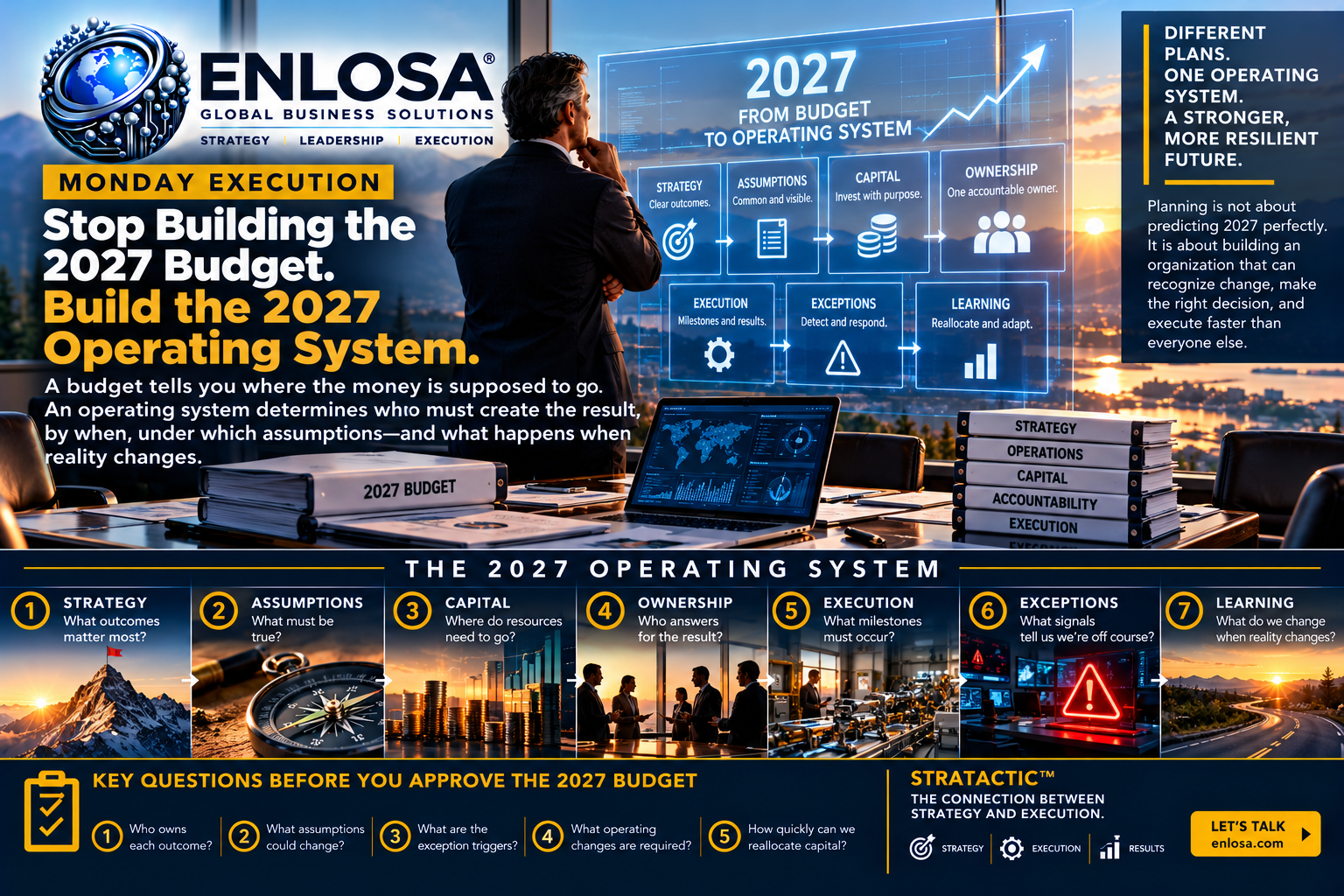
A budget tells you where the money is supposed to go. An operating system determines who must create the result, by when, under which assumptions—and what happens when reality changes.
Monday, October 26, 2026 | Execution & Operational Value Creation
Across many organizations, this is planning season.
Finance teams are consolidating spreadsheets.
Business leaders are defending assumptions.
Functions are negotiating headcount.
Capital requests are competing for approval.
Revenue forecasts are being challenged.
Cost targets are being negotiated.
And leadership teams are trying to convert strategy into a 2027 financial plan.
That work matters.
But there is a danger.
The organization can finish the budget without finishing the operating plan.
You can approve revenue, margin, headcount, CapEx, inventory, technology investment, cost reduction, and cash targets.
Yet still enter January without clear answers to several more important questions:
- Who owns each result?
- What operating assumptions must be true?
- Which milestones should appear before the financial outcome?
- What decisions are already required?
- Which resources need to move?
- What happens if demand is 10% below plan?
- What happens if a supplier fails?
- What happens if tariffs change?
- What happens if AI changes the economics of a process?
- What happens if a strategic initiative misses its first milestone?
- And how quickly can leadership respond without waiting for the next monthly or quarterly review?
Those questions are not primarily budgeting questions.
They are operating-system questions.
Finance Is Already Moving Beyond the Budget
Deloitte’s Finance Trends 2027 research surveyed 1,434 CFOs and senior finance leaders across 26 countries.
Their priorities for fiscal 2027 tell us something important about where finance leadership is heading.
- 43% identified embedding AI and advanced technology to automate operations as a leading priority.
- 34% prioritized enterprise cost efficiency.
- 33% prioritized optimizing capital allocation and investment decisions.
- 32% identified strengthening finance’s strategic influence across the enterprise.
These are not traditional accounting priorities.
They are enterprise operating priorities.
Deloitte also found that finance leaders increasingly need greater responsiveness in three areas:
- 48% identified providing real-time financial data and insights.
- 36% identified responding to external market shifts.
- 34% identified rapidly reallocating capital and funding.
Notice the pattern.
The modern finance problem is increasingly not:
Can we produce the budget?
It is:
Can we continuously connect strategy, financial performance, operating reality, risk, and resource allocation quickly enough to change the outcome?
That requires more than an annual planning process.
It requires an operating system.
A Budget Is a Necessary Artifact. It Is Not the Management System.
The annual budget typically answers:
- How much revenue?
- How much expense?
- How much capital?
- How many people?
- What margin?
- What cash?
Those questions are necessary.
But consider a business that approves the following 2027 targets:
- Revenue: $500 million.
- EBITDA: $75 million.
- Inventory reduction: $15 million.
- CapEx: $30 million.
- Productivity improvement: 6%.
- New-product revenue: $40 million.
- AI-enabled savings: $5 million.
The spreadsheet may balance perfectly.
But who owns the $15 million inventory reduction?
Finance? Operations? Supply Chain? Sales? All four?
What specifically must change operationally to generate the 6% productivity improvement?
Which AI initiatives create the $5 million savings?
When should the first savings appear?
What assumptions support the $40 million of new-product revenue?
What customer commitments exist?
What capacity is required?
What happens if the product launch slips 60 days?
What does leadership stop funding if the expected return does not appear?
The numbers may be precise.
The execution architecture may still be vague.
Precision in the spreadsheet can create an illusion of precision in the business.
Budgeting Often Starts With Money. Execution Starts With Outcomes.
There is an important difference.
Traditional budgeting may begin:
“What did we spend this year?”
Then:
“What do we expect next year?”
Then:
“What can we afford?”
An operating-system approach begins somewhere else.
What outcomes must the enterprise produce to execute the strategy?
Then:
- What capabilities are required?
- What resources are required?
- What assumptions support the plan?
- What decisions must be made?
- Who owns each outcome?
- What signals indicate the plan is failing?
And only then:
How should capital be allocated?
This is why the budgeting discussion should not be dominated by percentages.
“Reduce SG&A 5%.” “Hold headcount flat.” “Increase revenue 8%.” “Reduce inventory 10%.”
Those may be financially desirable.
But percentages do not execute themselves.
Someone must redesign the work.
The 2027 Planning Problem: Sequential Planning in an Interconnected Business
Many organizations still plan sequentially.
Sales creates the forecast.
Operations develops capacity requirements.
Supply Chain develops inventory requirements.
Procurement builds purchasing plans.
HR produces workforce assumptions.
IT builds the technology roadmap.
Finance consolidates everything.
Then leadership attempts to reconcile the conflicts.
The problem is obvious.
Every function may optimize its own plan using different assumptions.
Sales assumes demand growth.
Operations assumes a particular product mix.
Procurement assumes supplier availability.
Finance assumes a working-capital target.
HR assumes hiring timing.
Technology assumes implementation capacity.
By the time the plans meet, significant contradictions may already be embedded.
Deloitte’s Enterprise Business Planning framework advocates a different model: concurrent planning across the enterprise, using common data, shared assumptions, aligned performance routines, scenario planning, and tighter integration between planning and execution.
The enterprise does not operate sequentially. Why should it plan sequentially?
Build One Set of Enterprise Assumptions
Start the 2027 operating system with assumptions.
Not financial targets.
Assumptions.
For example:
- Market growth.
- Pricing.
- Volume.
- Product mix.
- Inflation.
- Labor availability.
- Labor cost.
- Interest rates.
- Tariffs.
- Energy.
- Supplier capacity.
- Transportation cost.
- Lead times.
- Customer concentration.
- Currency.
- New-product timing.
- Technology deployment.
- Productivity.
- Acquisition integration.
Every major operating plan should reference the same baseline assumptions.
Then designate an owner for each assumption.
Why?
Because assumptions change.
And when they change, the business plan should change.
Every Important Assumption Needs a Trigger
Imagine the 2027 plan assumes a 5% demand increase, stable tariffs, a key supplier operating normally, a major product launched in March, energy costs within a defined range, and a new automation system live by Q2.
Those assumptions should not disappear into the budget workbook.
Turn them into visible operating variables.
- Baseline assumption — What did we plan?
- Owner — Who watches it?
- Trigger — What amount of change requires leadership attention?
- Financial consequence — What happens to revenue, margin, cash, or capital?
- Response — What decision must be reconsidered?
Now planning becomes dynamic.
Instead of asking every quarter:
“Why did actual differ from budget?”
leadership can ask earlier:
“Which assumption changed, and what are we changing because of it?”
That is a much more powerful management question.
Move From Variance Reporting to Decision Management
Traditional management reviews often spend significant time explaining variances.
Revenue is below plan. Labor is above plan. Freight increased. Inventory increased. Margin declined.
The explanation may be excellent.
But by the time the variance appears in the financial statement, the operating event may have occurred weeks earlier.
Leadership needs to move closer to the cause.
Consider this chain:
Assumption → Signal → Exception → Decision → Action → Financial Result
Financial reporting usually captures the last element.
A strong operating system manages the earlier ones.
Example: Inventory
Suppose the 2027 budget requires a $12 million inventory reduction.
The budget records the number.
But the operating system should identify the drivers.
Inventory may depend on:
- Forecast accuracy.
- MOQ.
- Supplier lead time.
- Schedule adherence.
- Production lot size.
- Safety-stock policy.
- Customer variability.
- Slow-moving inventory.
- New-product introductions.
- Obsolescence.
- Service-level targets.
If leadership waits until monthly working-capital results show the miss, it is managing the outcome too late.
Instead establish leading indicators.
For example:
- Forecast error.
- Inventory days by category.
- Past-due purchase orders.
- Production schedule adherence.
- Excess and obsolete inventory.
- Supplier lead-time changes.
- Customer order volatility.
Then assign decision rights.
The operating system manages the causes before Finance reports the consequences.
Every Strategic Priority Needs an Execution Contract
For every material 2027 strategic priority, create a one-page execution contract.
It should contain eight items.
1. Outcome
What must actually change?
Not: “Implement AI.”
Instead: “Reduce order-entry processing time from four hours to 45 minutes while maintaining accuracy above the agreed threshold.”
2. Accountable Owner
One executive.
Not IT and Operations. Not Finance and Procurement. Not “The transformation team.”
One person answers for the outcome.
Other functions contribute.
3. Financial Value
Why are we doing this?
Revenue? Margin? Cash? Capacity? Risk reduction? Customer retention? Working capital? Cost avoidance?
Make the economic connection visible.
4. Operating Assumptions
What must be true?
Supplier available? Hiring completed? System delivered? Customer adoption? Volume achieved? Technology functioning?
If the assumptions fail, the investment case may change.
5. Milestones
Do not wait until December 2027 to discover whether the result exists.
Identify intermediate proof points.
30 days. 60 days. 90 days. Quarter 1. Quarter 2.
6. Decision Rights
What can the owner decide without another executive meeting?
Budget transfer? Supplier selection? Staffing? Process changes? Technology configuration? Timeline adjustments?
Accountability without authority produces escalation, not execution.
7. Exception Triggers
What conditions require reconsideration?
Cost +10%? Implementation 30 days late? Return below threshold? Demand below assumption? Service deterioration? Milestone missed?
Define them now.
8. Review Cadence
Weekly? Monthly? Quarterly?
The cadence should match how quickly the situation can change.
Stop Funding Projects. Fund Outcomes.
Budgets often become a list of funded projects.
ERP implementation. Automation project. AI initiative. New production line. Warehouse expansion. Nearshoring project. CRM rollout.
But a project can be completed without creating the expected value.
The system goes live. The line gets installed. The warehouse opens. The software gets deployed.
Leadership celebrates completion.
But productivity does not improve. Inventory does not decline. Revenue does not increase. Working capital does not improve. Decision time does not decrease.
That is project completion.
Not value creation.
The 2027 operating system should track value realization after implementation.
Every Investment Needs a Value Owner
Separate two roles.
Project Owner
Responsible for completing the project.
Value Owner
Responsible for ensuring the expected business benefit appears.
Sometimes they are the same person.
Often they should not be.
An IT leader may successfully deliver the system.
Operations may own the productivity improvement.
Finance may verify the economic result.
That creates a stronger governance chain:
Investment → Implementation → Adoption → Operating Change → Financial Value
If one link disappears, ROI can disappear with it.
Capital Allocation Is Becoming More Strategic
Deloitte’s research shows just how much the CFO role is expanding.
- 54% of surveyed finance leaders are involved in enterprise AI and technology capital-allocation decisions.
- 48% oversee AI and technology spending and cost controls.
- Another 48% have responsibility connected to AI trust, including reliability, accuracy, and explainability.
This is important beyond AI.
The modern CFO increasingly connects strategy, capital, risk, technology, performance, and value realization.
But the COO must connect the other half: processes, capacity, people, execution, customer delivery, and operating capability.
2027 planning should therefore become a CFO–COO operating process, not simply a finance exercise.
Finance asks:
Does the investment create acceptable value?
Operations asks:
Can the organization actually produce that value?
Leadership needs both answers.
The CEO’s Role: Force Trade-Offs
A budget becomes weak when every strategic priority survives.
Growth. Margin. Digital transformation. AI. New products. Resilience. Nearshoring. M&A. Customer experience. Capability building. Working capital. Cost reduction.
Everything receives funding.
Nothing truly receives priority.
The CEO’s role is not simply approving the final financial plan.
It is forcing choices.
Ask:
If we could execute only three priorities exceptionally well in 2027, which three would create the greatest enterprise value?
Then ask:
What will we stop funding, stop measuring, stop meeting about, or stop asking people to do?
Strategy requires subtraction.
The CFO’s Role: Connect Resources to Outcomes
The CFO should make capital visible as a strategic resource.
Not simply: Department A gets $10 million. Department B gets $6 million. Department C gets $4 million.
Instead:
- What business outcome is being purchased?
- What return is expected?
- What assumption supports the return?
- When should evidence appear?
- When will we reconsider funding?
Deloitte found that finance leaders increasingly recognize the need to rapidly reallocate capital as conditions change.
That is the important word:
Reallocate.
An annual budget should not become a one-year commitment to assumptions made in October.
The COO’s Role: Turn Financial Commitments Into Operating Commitments
The COO should translate the budget into operating reality.
If the plan requires 6% productivity improvement—where? How? Through which processes?
If it requires $15 million less inventory—which inventory? Which policies? Which suppliers? Which schedules?
If it requires 20% faster growth—does capacity exist? Does leadership capacity exist? Does technical talent exist?
If it requires $10 million of procurement savings—what changes operationally? Supplier consolidation? Design changes? Specification changes? Localization? Volume commitments?
A financial commitment without an operating mechanism is a wish.
The 2027 Operating System
I would build the annual management architecture around seven connected layers.
- Strategy — What are the few outcomes that matter most?
- Assumptions — What must be true for the strategy to work?
- Capital — Where do money, people, technology, and management attention need to go?
- Ownership — Who answers for each outcome?
- Execution — What milestones and operating changes must occur?
- Exception Management — What signals tell us the plan is moving off course?
- Learning and Reallocation — What do we change when reality contradicts the plan?
Then repeat.
Strategy → Assumptions → Capital → Ownership → Execution → Exceptions → Reallocation
That is far more powerful than:
Budget → Actual → Variance → Explanation
Replace the Static Budget Review With Three Management Horizons
Horizon 1 — Real-Time Exceptions
Manage what can damage the plan now.
Safety. Quality. Customer disruptions. Supplier failures. Critical capacity. Major cost excursions. Cash events.
Horizon 2 — Weekly Operating Execution
Review priority milestones, capacity, customer commitments, working capital, cross-functional constraints, resource conflicts, and corrective actions.
Horizon 3 — Monthly Enterprise Planning
Reassess demand, supply, financial outlook, capital, scenario assumptions, strategic priorities, risk, and resource allocation.
The monthly meeting should not simply report the past.
It should determine what the enterprise changes next.
Scenario Planning Must Become Normal Management
Deloitte’s Enterprise Business Planning framework places scenario capability at the center of planning because operating decisions must remain linked to their financial consequences.
That means leadership should have several 2027 scenarios ready before they are needed.
Demand downside
Revenue 10% below plan.
What happens to capacity, labor, inventory, CapEx, and cash?
Demand upside
Revenue 15% above plan.
Where is the constraint? Capacity? Technical talent? Supplier availability? Working capital?
Trade disruption
Tariffs increase significantly.
Which suppliers or products become uneconomic?
Technology delay
A major AI or ERP implementation slips six months.
Which benefits disappear? What alternative exists?
Supply disruption
A critical supplier becomes unavailable for eight weeks.
What revenue is exposed?
Acquisition opportunity
An unexpected target becomes available.
What capital can be reallocated? What investment should be delayed?
Scenario planning does not mean predicting which event will happen.
It means reducing the decision time when something does happen.
The Budget Should Contain Kill Criteria
Organizations are usually good at starting initiatives.
They are less disciplined about stopping them.
That wastes capital.
For every major investment, ask before approval:
Under what conditions would we stop?
Examples:
- Adoption below threshold.
- Cost above 125% of plan.
- Milestone more than 90 days late.
- ROI deteriorates below hurdle.
- Technology no longer provides competitive differentiation.
- Customer assumption fails.
- Strategic priority changes.
- An alternative produces better economics.
Defining kill criteria early reduces emotional attachment later.
A disciplined organization does not defend yesterday’s decision simply because yesterday’s decision consumed money.
Build a Capital Reallocation Reserve
One practical recommendation for 2027:
Do not allocate every available dollar during budgeting.
Maintain a leadership-controlled investment reserve.
Why?
Because opportunity and risk rarely arrive according to the budget calendar.
You may need capital for unexpected automation, supplier relocation, acquisition, capacity, cybersecurity, customer opportunity, restructuring, or accelerated technology adoption.
If every dollar is permanently assigned in October, any new priority requires political negotiation.
Strategic agility requires financial optionality.
Measure the Speed of the Operating System
For 2027, consider adding metrics leadership rarely measures.
- Decision Cycle Time — How long from material signal to decision?
- Resource Reallocation Time — How long from decision to money or people moving?
- Exception Closure Time — How long from problem detection to verified closure?
- Benefit Realization — How much approved investment is producing the expected return?
- Assumption Accuracy — Which assumptions repeatedly miss?
- Forecast Responsiveness — How quickly is the plan updated when reality changes?
These metrics expose something financial statements cannot:
How quickly the organization can adapt.
A 30-Day 2027 Operating-System Build
Week 1 — Identify the Outcomes
Take the 2027 budget and identify the 10–15 outcomes that create most of the enterprise value.
Not every line item.
The material outcomes.
Week 2 — Expose the Assumptions
For each outcome identify critical assumptions, owner, threshold, downside consequence, and alternative response.
Week 3 — Assign Ownership and Decision Rights
One accountable executive per outcome.
Define what that executive can decide without additional escalation.
Week 4 — Build the Management Cadence
Define real-time exception reviews, weekly operating reviews, monthly enterprise planning, quarterly capital reallocation, and board-level strategic review.
Now the budget has become part of the management system.
Questions for Your Leadership Team
- Which five assumptions create the greatest risk to our plan?
- Who owns each assumption?
- Which strategic priority currently has multiple contributors but no single accountable owner?
- What 2027 financial target lacks a clearly defined operating mechanism?
- Which CapEx request assumes capacity is the problem without proving why current capacity is unavailable?
- What investment would we stop if we had to free 10% of capital tomorrow?
- How quickly can we move capital from an underperforming priority to a better opportunity?
- Which initiatives have project owners but no value owners?
- What milestone will tell us by March that a December target is already at risk?
- What happens to the plan when one of our major assumptions changes?
If those questions cannot be answered, the budget may be complete.
The operating system is not.
The ENLOSA Perspective
At ENLOSA: Global Business Solutions, we call the connection between strategy and execution Stratactic™.
The annual planning process is one of the most important places where that connection either becomes real—or disappears.
Strategy establishes direction.
The budget allocates resources.
But neither produces value by itself.
Value requires clear outcomes, explicit assumptions, disciplined capital allocation, one accountable owner, decision authority, execution milestones, exception management, learning, and rapid reallocation when conditions change.
The goal is not to predict 2027 perfectly in October 2026.
That is impossible.
The goal is to build an operating system capable of recognizing when the prediction is wrong—and responding faster than competitors.
That is a very different definition of planning.
Monday Executive Call to Action
Before approving another round of budget revisions this week, choose one major 2027 priority.
Take it out of the spreadsheet.
Put it on one page.
Write:
- Outcome
- Financial value
- Accountable owner
- Critical assumptions
- Required resources
- 90-day milestone
- Decision rights
- Exception triggers
- Review cadence
- Kill criteria
Then ask the executive team:
If reality changes in February, will this one-page management system help us act faster—or will we wait until Finance reports the variance in March?
That answer tells you whether you have built a budget—or an operating system.
Do both.
Because the 2027 winners will not be the companies whose October forecasts happen to be most accurate.
They will be the organizations that can see reality changing, make the right decision, move resources, and execute before everyone else catches up.
References
- Deloitte — Finance Trends 2027: Shaping the Next Era of Stakeholder Value, September 8, 2026. Based on a survey of 1,434 finance leaders across 26 countries. Finance leaders identified AI and advanced technology automation (43%), enterprise cost efficiency (34%), capital allocation optimization (33%), and stronger strategic influence (32%) among their leading fiscal 2027 priorities. Source
- Deloitte — Finance Trends 2027: Finance Leaders Balance AI Ambition With Enterprise Accountability, September 9, 2026. Finance leaders increasingly have responsibility for enterprise technology investment, AI governance, cost management, and capital allocation. Source
- Deloitte — Enterprise Business Planning. Deloitte describes an enterprise planning model based on concurrent planning, shared assumptions and data, scenario capability, integrated execution, and continuous visibility between operating decisions and financial outcomes. Source
- Deloitte — CFO Signals, First Quarter 2026. CFOs identified automation and technology upgrades as a leading cost-management lever, while cloud-based planning, budgeting, and forecasting was the most frequently selected technology for enabling cost management. Source
ENLOSA: Global Business Solutions
Strategy. Leadership. Execution.
enlosa@enlosa.com | +1 (877) 246-1109
#MondayExecution #Budget2027 #StrategicPlanning #EnterprisePlanning #BusinessPlanning #CapitalAllocation #CFO #COO #CEO #Operations #Finance #Execution #SIOP #ScenarioPlanning #WorkingCapital #CapEx #OperationalExcellence #DecisionMaking #ResourceAllocation #BusinessTransformation #ValueCreation #OperationalValueCreation #Strategy #Stratactic #ENLOSA #EGBS
Leave a Reply