
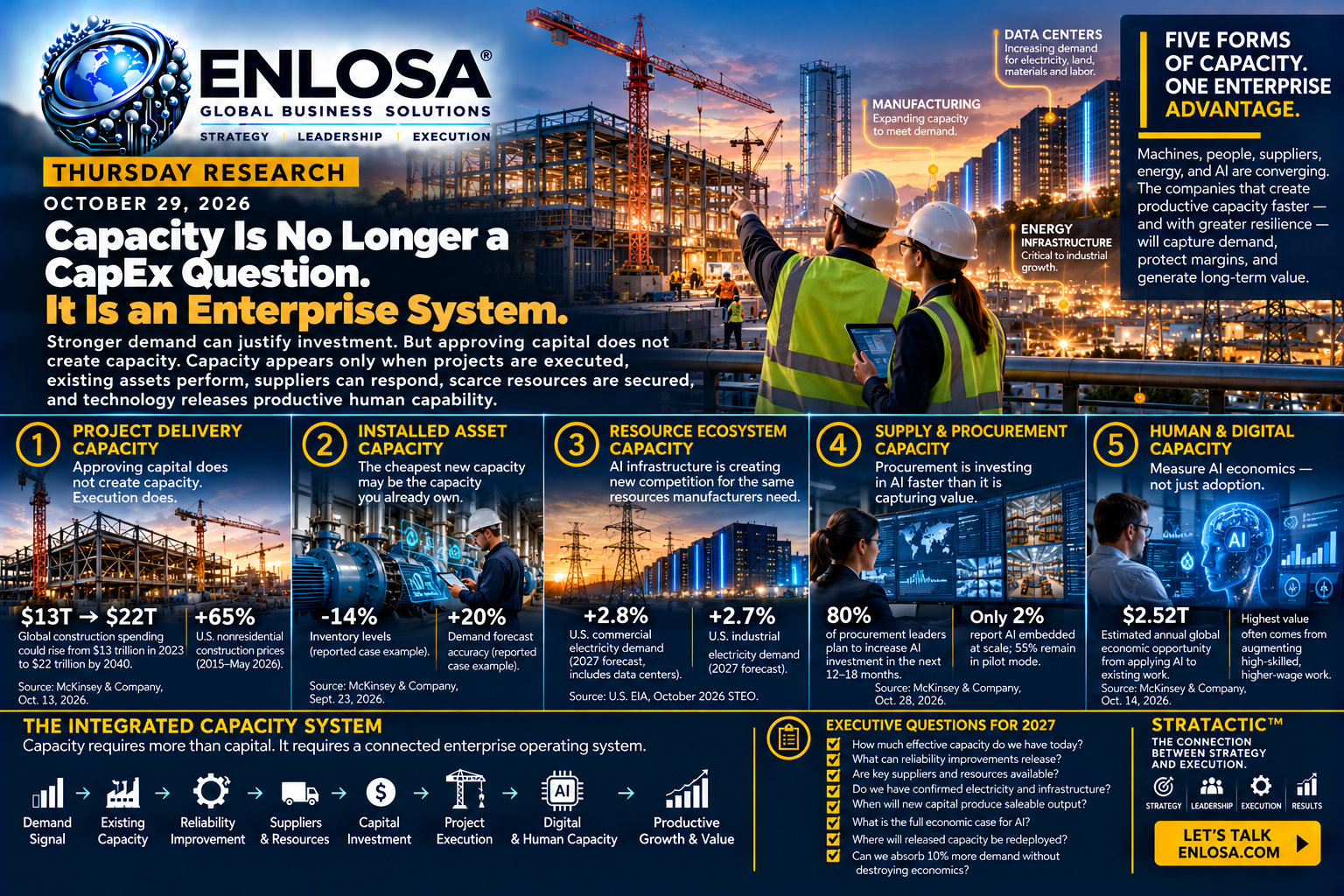
Stronger demand can justify investment. But approving capital does not create capacity. Capacity appears only when projects are executed, existing assets perform, suppliers can respond, scarce resources are secured, and technology releases productive human capability.
Thursday, October 29, 2026 | Research & Operational Value Creation
Monday we argued that the 2027 budget should become an operating system.
Tuesday we examined the decision architecture required to run that system.
Wednesday we stress-tested what happens if demand arrives 10% above plan.
Today we need to take the next step.
Suppose the upside scenario happens.
Customers want more.
Backlog increases.
Commercial teams see opportunity.
The business case for additional capacity becomes attractive.
What happens next?
The traditional answer has often been:
Approve CapEx.
But current research suggests something more complicated.
The next capacity constraint may not be money.
It may be project execution, engineering, equipment availability, maintenance, supplier capability, electricity, construction resources, technical labor, procurement effectiveness, management bandwidth, or the economics of the technology intended to make the organization more productive.
Capacity is becoming an enterprise system—not a capital-budget line.
Five Forms of Capacity Leaders Should Manage
Organizations often define capacity too narrowly.
They think: machines, square footage, production lines, warehouses, headcount.
Those matter.
But the emerging operating environment requires leaders to manage at least five different forms of capacity.
1. Project Delivery Capacity
Can we convert approved capital into productive assets quickly enough?
2. Installed Asset Capacity
Can we extract more reliable output from what we already own?
3. Resource Ecosystem Capacity
Can we secure the electricity, equipment, materials, contractors, engineers, and skilled labor needed for expansion?
4. Supply and Procurement Capacity
Can our sourcing organization identify, negotiate, secure, and continuously manage the external capacity the enterprise depends on?
5. Human and Digital Capacity
Can technology release scarce expertise for higher-value work at economics that genuinely improve enterprise performance?
Those five questions connect what might otherwise appear to be unrelated research.
Together they describe the capacity challenge companies are likely to face in 2027.
1. Approving CapEx Does Not Create Capacity
One of the strongest warnings comes from current research on capital projects.
McKinsey estimates that global construction spending could rise from approximately $13 trillion in 2023 to $22 trillion by 2040.
Outside China, meeting that demand would require construction growth to accelerate materially above its historical rate.
But the delivery system is struggling to keep pace.
McKinsey estimates that long-term construction productivity has improved only about 10% since 2000, compared with roughly 50% for the broader economy and 90% for manufacturing.
Meanwhile, U.S. nonresidential construction prices increased approximately 65% between 2015 and May 2026. McKinsey & Company
That creates an uncomfortable equation:
- More projects.
- Higher cost.
- Scarcer experienced talent.
- Longer supply chains.
- Greater competition for equipment.
- More pressure to reach market faster.
The implication for manufacturing, infrastructure, energy, logistics, and other capital-intensive businesses is straightforward.
Capital availability and capital-execution capability are not the same thing.
A board can approve $100 million today.
That does not tell you when the first saleable unit comes off the new line.
Measure Time to Productive Capacity
Traditional project governance often emphasizes approved budget, engineering completion, construction progress, schedule status, and spend versus plan.
Those metrics are necessary.
But the economic question is larger:
How long from investment approval until the asset produces sustainable output at target economics?
Think of the chain:
Demand Signal → Business Case → Capital Approval → Engineering → Procurement → Construction → Commissioning → Qualification → Ramp-Up → Stable Output → Cash Generation
Every delay between those stages postpones value.
A project that finishes construction “on time” but requires another nine months to reach stable throughput has not created capacity on the original economic timeline.
Project completion is not the same as value realization.
The Capital Project Should Have Two Clocks
Clock 1 — Project Delivery
When will construction and installation finish?
Clock 2 — Economic Ramp
When will the asset reach target throughput, target yield, target labor productivity, target customer quality, target margin, and target cash generation?
A plant expansion is not complete when the contractors leave.
It is complete when the economics assumed in the investment case become repeatable.
Digital and AI May Improve Project Execution—but Only Through Workflow Redesign
McKinsey argues that digital and AI tools can improve capital-project performance across strategy, engineering, procurement, construction, and project steering.
Potential applications include generative scheduling, design assistance, risk detection, procurement intelligence, and faster integration of signals across project stages.
But there is an important lesson.
A dashboard placed on top of a fragmented project-management process does not create a digital operating model.
The work itself must change.
Decision rights. Information flow. Contractor interfaces. Project controls. Risk escalation. Engineering change. Procurement coordination. And executive governance.
Technology creates value when it shortens the path from signal to decision to action.
Capital Execution Readiness Test
Before approving a major 2027 project, leadership should ask:
- What capability are we actually buying?
- What demand assumption justifies it?
- What is the true project constraint?
- Which engineering capability is scarce?
- Which equipment has the longest lead time?
- Which supplier could delay commissioning?
- Which trade or contractor becomes critical?
- What qualification requirements extend the ramp?
- Who owns the transition from project completion to operational performance?
- When does the investment begin producing cash?
The critical measure:
Approval-to-Productive-Capacity Time
Not simply approval-to-construction-complete.
2. Before Buying Capacity, Recover the Capacity You Already Own
There is another side to the capacity discussion.
Companies frequently respond to rising demand by asking:
“What equipment should we buy?”
A better first question may be:
“How much of the equipment we already own is actually available?”
McKinsey’s September research on asset-heavy industries describes maintenance as one of the largest controllable cost categories in manufacturing and other capital-intensive businesses.
It identifies five areas where AI and digital tools can improve maintenance economics: reliability, maintenance planning and execution, shutdowns and turnarounds, spare-parts management, and contractor management. McKinsey & Company
That matters because maintenance is not simply a cost-control function.
Maintenance determines how much purchased capacity is actually usable.
Nameplate Capacity Is Not Effective Capacity
A machine may theoretically produce 1,000 units per shift.
But subtract breakdowns, microstops, changeovers, preventive maintenance, unplanned maintenance, scrap, rework, unavailable operators, missing spare parts, poor scheduling, and process instability.
The economically useful number may be significantly lower.
Think of capacity this way:
Nameplate Capacity − Reliability Loss − Changeover Loss − Quality Loss − Labor Loss − Planning Loss = Effective Capacity
The cheapest additional capacity may be hidden inside those losses.
Reliability Can Become a Capital-Allocation Tool
Suppose an organization believes it needs a $20 million expansion.
Before approving it, determine whether better reliability could release 5% more output, changeover reduction another 3%, improved scheduling 2%, quality improvement 2%, or cross-training another shift.
Suddenly, part of the growth requirement may be met without new bricks and equipment.
That does not mean CapEx is unnecessary.
It means:
Reliability improvement should compete for capital against expansion.
Maintenance AI Is Showing Practical Economics
McKinsey cites several examples demonstrating how asset and maintenance data can change economics.
A global airline using AI-driven spare-parts planning reduced inventory levels by 14%, improved demand-projection accuracy by 20%, and raised service levels by 4%.
Other examples include industrial companies using digital contractor-management approaches to improve on-tool time by approximately 10%, and AI-supported invoice analysis producing reported spend reductions of roughly 3% to 6% in relevant applications.
These are organization-specific examples, not universal guarantees.
But the principle is important.
Maintenance technology can influence throughput, inventory, labor utilization, working capital, and external spend simultaneously.
That makes reliability an enterprise-value issue.
Ask for the Economic Value of Uptime
Instead of asking Maintenance only:
“What is our maintenance cost?”
Ask:
What is one additional point of availability worth?
If an asset produces $50 million of annual contribution margin at full utilization, an additional point of usable capacity may have significant economic value.
That changes the maintenance conversation.
From cost to value protected, throughput released, CapEx deferred, working capital reduced, and customer commitments protected.
3. Your Next Competitor for Capacity May Be a Data Center
This may be one of the most important external developments for industrial leaders.
Artificial intelligence is increasingly becoming a physical infrastructure story.
AI requires data centers, electricity, transmission, transformers, cooling, copper, steel, electronics, construction equipment, land, engineers, skilled trades, and capital.
S&P Global’s October commodity outlook identifies AI-related data-center investment as one of the strongest sources of demand growth for industrial inputs, including energy, labor, metals, building materials, and equipment.
It also expects lead times and pricing pressure for several data-center-related inputs to remain elevated through 2027. S&P Global Market Intelligence
This means manufacturers may increasingly find themselves competing indirectly with technology infrastructure.
Not for customers.
For resources.
Electricity Is Becoming a Strategic Capacity Variable
The U.S. Energy Information Administration forecasts that commercial-sector electricity demand—which includes data centers—will increase approximately 2.8% in 2027.
Industrial demand is forecast to rise approximately 2.7%.
EIA explicitly identifies data-center development and increased manufacturing activity as drivers of U.S. electricity-demand growth. U.S. Energy Information Administration
That changes the site-selection conversation.
Historically, companies evaluating a new plant might prioritize labor, transportation, customer proximity, taxes, land, and supplier access.
Those still matter.
But increasingly leadership may also need to ask:
- How much power is available?
- When can we connect?
- What transmission constraints exist?
- What is the expected power price?
- Can capacity be expanded?
- Who else is requesting that capacity?
- What is the reliability profile?
A site without sufficient energy is not a capacity solution.
The Industrial Resource Competition Is Broader Than Electricity
S&P Global expects manufacturing costs to remain elevated through 2027 due to a combination of geopolitical disruption, trade barriers, supply constraints, and concentrated demand from AI infrastructure, electrification, and defense.
Its outlook specifically identifies continuing competition for copper, electrical equipment, electronics, energy, construction materials, and skilled labor.
That should influence capital budgeting, supplier agreements, site selection, expansion sequencing, strategic sourcing, inventory policy, and project schedules.
The AI boom is not only changing software budgets.
It is changing competition for physical resources.
Resource Reservation May Become Part of Strategy
If a critical expansion depends on transformers, switchgear, specialized electrical equipment, construction labor, copper, power, or long-lead industrial equipment, leadership may need to secure those resources earlier than traditional project governance would suggest.
That means procurement may become involved before final investment approval.
Supplier capacity may need reservation.
Engineering specifications may need earlier stabilization.
Alternative equipment architectures may need evaluation.
The sequence changes.
Instead of:
Approve → Design → Source.
Some projects may increasingly require:
Signal → Prequalify → Reserve → Approve → Execute
That is a different capital-project operating system.
4. Procurement Is Investing in AI Faster Than It Is Capturing AI Value
This brings us to the fourth form of capacity:
Sourcing capacity.
If external resources become scarcer, Procurement becomes much more than a transaction function.
It becomes a strategic capacity-management function.
But procurement itself is undergoing rapid AI adoption.
McKinsey’s October 28 research found that approximately 80% of surveyed CPOs and senior procurement leaders plan to increase procurement technology and AI investment over the next 12–18 months.
Yet only 2% reported AI embedded at scale.
Approximately 55% remained in pilot mode. McKinsey & Company
That gap is striking.
Investment is accelerating faster than scaled value realization.
Automating Procurement Activity Is Not the Same as Improving Sourcing
AI can already help with spend classification, RFQ development, supplier research, document review, data gathering, market analysis, contract preparation, reporting, and routine communication.
Those applications may save time.
But the larger opportunity lies elsewhere.
Could AI improve supplier-capacity visibility, cost modeling, alternative-source identification, negotiation preparation, should-cost analysis, commodity exposure, supplier-risk detection, supplier innovation, scenario analysis, network design, or capacity reservation?
Those questions create enterprise value.
The objective should not be a faster RFQ.
It should be a better sourcing decision.
Procurement Must Move From Price to Capacity Economics
A traditional sourcing comparison might ask:
Supplier A: $9.70.
Supplier B: $9.45.
Select B.
But the real economic comparison might include unit price, freight, tariffs, lead time, quality, capacity, inventory requirement, working capital, tooling, supplier financial health, recovery capability, geographic concentration, energy exposure, and speed of expansion.
That produces a different equation:
Total Sourcing Value = Price + Capacity + Risk + Cash + Flexibility + Strategic Option Value
Procurement AI should help leaders understand that equation.
Not simply process transactions faster.
AI Should Improve Supplier Intelligence
Imagine a sourcing system continuously monitoring lead-time movement, commodity trends, supplier financial indicators, capacity commitments, shipment performance, quality trends, geopolitical developments, tariff changes, energy exposure, contract obligations, and internal demand forecasts.
The objective is not another dashboard.
The objective is earlier intervention.
Signal → Risk → Scenario → Decision → Supplier Action → Capacity Protected
That is where procurement becomes part of the operating system.
5. Stop Measuring AI Adoption. Measure AI Economics.
The fifth capacity question concerns the technology itself.
AI can potentially expand organizational capacity without adding equivalent headcount.
But only if the economics work.
McKinsey’s October research estimates an approximately $2.52 trillion annual global opportunity from economically applying AI to suitable tasks across occupations, industries, and regions.
One of its most important findings is counterintuitive:
Some of the strongest economics come from augmenting high-skilled, higher-wage work, rather than simply automating the largest volumes of lower-cost labor. McKinsey & Company
That should change how executives evaluate AI projects.
The Best AI Business Case May Be Scarce Expertise
Imagine an organization has five experienced project managers, three world-class process engineers, two senior procurement experts, and one highly experienced reliability engineer.
Their constraint is not salary.
Their constraint is time.
If AI can reduce the hours those people spend searching, formatting, drafting, summarizing, comparing, preparing reports, and reviewing routine documentation, then their scarce expertise can move toward judgment, negotiation, problem solving, engineering decisions, supplier development, leadership, and project execution.
The value is not the hour saved.
The value is what the scarce expert does with that hour.
Hours Saved Are Not Automatically Value Created
This distinction is critical.
Imagine AI saves 500 hours.
The business case says: 500 hours × $75/hour = $37,500.
That arithmetic may be technically correct.
But economically incomplete.
What happens to the 500 hours?
If people simply become less busy, there may be little measurable enterprise value.
If those hours instead enable another capital project, additional supplier development, more customer engagement, faster engineering, higher throughput, or reduced downtime, then the economics may be far more attractive.
Capacity released must be redeployed to create value.
McKinsey: Plan Redeployment Before Deployment
McKinsey specifically argues that leaders should determine how capacity freed by AI will be redeployed before scaling technology.
Otherwise, productivity can disappear into lower utilization and unmeasured organizational slack.
That principle should become part of every AI business case.
Before implementation answer:
- What work disappears?
- How many hours are released?
- Which people gain capacity?
- What higher-value work will they perform?
- What new capability is required?
- What measurable economic result should follow?
If the answer is unclear, the AI project may have an adoption case—but not yet a value case.
Include the Full Cost of AI
The AI economics are also more complex than license price.
McKinsey’s value-curve methodology incorporates costs such as model usage, tokens, human review, validation, correction, and rework.
It also warns that AI economics can change significantly as underlying technology costs move.
The enterprise business case should therefore include technology, integration, infrastructure, security, governance, training, change management, human review, rework, ongoing support, and model economics.
Then compare that total with the current workflow.
AI adoption is not the metric.
Economic advantage is.
The Five Capacity Systems Are Connected
Now combine the research.
A stronger demand environment may justify expansion.
But:
- Project capacity determines whether you can build it.
- Maintenance capacity determines whether existing assets can release more output first.
- Resource capacity determines whether electricity, equipment, labor, and materials are available.
- Procurement capacity determines whether those resources can be secured at acceptable economics.
- Human and digital capacity determines whether scarce expertise can manage a more complex enterprise.
This is why capacity can no longer be owned by one function.
Operations cannot solve it alone.
Finance cannot solve it alone.
Engineering cannot solve it alone.
Procurement cannot solve it alone.
IT cannot solve it alone.
Capacity has become an enterprise design problem.
The 2027 Capacity Architecture
A useful executive framework is:
Demand → Existing Capacity → Reliability → External Capacity → Capital → Project Execution → Digital Capacity → Value
Demand: What volume and mix might the market require?
Existing Capacity: What can the current system sustainably produce?
Reliability: What unavailable capacity can be recovered?
External Capacity: What suppliers, labor, energy, equipment, and infrastructure are required?
Capital: What new productive assets are economically justified?
Project Execution: How quickly can approved investments become stable output?
Digital Capacity: Where can AI release scarce expertise?
Value: What margin, cash, resilience, and return does the additional capacity create?
That is a fundamentally different way to think about expansion.
Capacity Should Be Evaluated in Dollars, Not Units Alone
Operations often measures capacity in units, tons, hours, machines, lines, and people.
Finance thinks in revenue, EBITDA, cash, ROIC, and NPV.
The operating system must connect them.
For every additional unit of capacity, determine revenue potential, contribution margin, required working capital, capital requirement, ramp time, supplier requirement, labor requirement, risk, and cash return.
The goal is not maximum capacity.
The goal is economically productive capacity.
Build a Capacity Waterfall Before Approving Expansion
For the critical value stream, create a simple waterfall.
Current theoretical capacity
Minus reliability loss, quality loss, changeover loss, labor loss, planning loss, and supplier constraint.
Current effective capacity
Add maintenance improvement, OEE improvement, scheduling improvement, automation, cross-training, and supplier improvement.
Optimized existing capacity
Only after that calculate:
Required new capacity
This prevents the company from buying assets to compensate for weak execution.
Then Build a Capital Execution Waterfall
For new capacity, model board approval, engineering duration, permitting, long-lead procurement, construction, installation, commissioning, customer qualification, ramp, and stable production.
Do not present only the project completion date.
Present:
The date economic capacity becomes available.
That is what the 2027–2029 financial model should use.
Build a Resource Competition Map
For every critical expansion, identify resources that may also be under pressure from AI infrastructure, energy development, defense, electrification, infrastructure spending, and other manufacturers.
Ask which resources are shared, which have long lead times, which suppliers serve multiple growth industries, which resources should be reserved early, and which alternatives should be qualified.
That turns the environment scan into capital action.
Procurement Needs a Capacity Mandate
Give Procurement visibility into strategic growth scenarios, capital plans, engineering roadmaps, supplier-capacity requirements, critical equipment, commodity exposure, and infrastructure constraints.
Do not wait until the project team submits a requisition.
By then, the strategic sourcing window may already be closing.
Early sourcing can become a strategic option.
Every AI Project Needs a Redeployment Line
Add one line to every AI investment proposal:
Capacity Released: ______
Then:
Capacity Redeployed To: ______
Then:
Economic Result Expected: ______
This forces the business case to connect productivity with enterprise value.
CEO Perspective: Capacity Is Strategic Optionality
For the CEO, excess capacity can look inefficient.
Too little capacity can prevent growth.
The objective is not necessarily either extreme.
The objective is:
Optionality.
Can the organization respond when demand accelerates, a competitor exits, a supplier fails, a customer wants additional volume, an acquisition becomes available, or a new market opens?
That ability has strategic value.
CFO Perspective: Capacity Must Earn Its Cost of Capital
The CFO must prevent optimism from turning every demand signal into CapEx.
Ask:
- What is the base-case return?
- What happens under +10% demand?
- What happens under −10%?
- How much existing capacity can be recovered first?
- What working capital is required?
- When does cash flow turn positive?
- What is the cost of delay?
- What is the cost of building too early?
- What is the cost of building too late?
Capital discipline and strategic flexibility are not opposites.
Good planning requires both.
COO Perspective: Capacity Must Be Operable
The COO’s job begins where the investment model often ends.
Can we staff it, maintain it, schedule it, supply it, qualify it, operate it reliably, achieve yield, hit takt, protect safety, and meet customer service?
A capacity model that ignores those questions is a financing model—not an operating plan.
Procurement Perspective: Capacity Must Be Secured
The CPO should increasingly ask:
- Which suppliers control our growth ceiling?
- Where are we a small customer?
- Which suppliers are exposed to AI infrastructure demand?
- Which commodities create risk?
- What supplier capacity should be reserved?
- Where do we need alternatives?
- What should be dual-sourced?
- Where does AI improve our ability to see risk earlier?
Strategic sourcing increasingly determines strategic capacity.
Technology Perspective: AI Must Expand Valuable Capacity
The CIO and technology organization should ask:
- Which scarce roles are currently spending time on low-value work?
- Where can AI release expertise?
- What is the fully loaded AI cost?
- What human review remains?
- How will released time be redeployed?
- How will value be measured?
The objective is not number of copilots, number of agents, tokens consumed, or employees trained.
The objective is:
Economic capacity created.
A 45-Day Enterprise Capacity Review
Week 1 — Map Demand
Identify three scenarios: base, upside, downside. Determine the capacity each requires.
Week 2 — Find the Real Constraints
Map equipment, reliability, labor, suppliers, electricity, engineering, logistics, working capital, and management bandwidth.
Week 3 — Recover Existing Capacity
Quantify opportunities from maintenance, OEE, quality, changeover reduction, scheduling, automation, cross-training, and supplier improvement.
Week 4 — Test New Capacity
For remaining gaps, build the CapEx case. Include long-lead equipment, engineering, construction, commissioning, ramp, and cash—not simply purchase price.
Week 5 — Secure the Ecosystem
Review supplier capacity, power, materials, contractors, skilled trades, equipment, and commodity exposure.
Week 6 — Release Human Capacity
Identify where AI can free scarce engineering, procurement, project management, maintenance, finance, and leadership capacity. Then predefine where that capacity will be redeployed.
Questions for Your Leadership Team
- How much effective capacity do we actually have today?
- How much installed capacity is unavailable because of reliability, quality, labor, or scheduling?
- What is one percentage point of uptime worth financially?
- Can operational improvement delay or eliminate any planned CapEx?
- If we approve the expansion today, when will it produce stable saleable output?
- Which long-lead resource determines the true project timeline?
- Are AI infrastructure, energy, defense, or other industries competing for the same resources we need?
- Do we have confirmed electricity and infrastructure capacity for planned expansions?
- Which suppliers control our ability to grow?
- Is Procurement involved early enough to reserve capacity rather than merely place orders?
- Are our AI investments measured by adoption or by economic value?
- Where will the human capacity released by AI actually be redeployed?
- What is the full cost of the AI-enabled workflow, including human validation and governance?
- What capacity investment becomes unnecessary if execution improves?
- What opportunity will we lose if we wait too long?
If those questions cannot be answered, the organization may have a CapEx plan.
It does not yet have a capacity strategy.
The ENLOSA Perspective
At ENLOSA: Global Business Solutions, we call the connection between strategy and execution Stratactic™.
Capacity illustrates exactly why that connection matters.
Strategy may say: grow.
Operations asks: with what capacity?
Finance asks: at what return?
Procurement asks: from which suppliers?
Engineering asks: with what assets?
Technology asks: what can AI amplify?
Leadership must connect all of them.
This week’s operating sequence now becomes:
Monday: Build the 2027 operating system.
Tuesday: Clarify who has decision authority.
Wednesday: Stress-test stronger demand.
Thursday: Determine whether the enterprise can create the capacity to capture it.
The research points to one conclusion:
Future capacity will not come from CapEx alone.
It will come from the combined ability to recover existing assets, execute projects faster, secure scarce external resources, improve sourcing decisions, deploy AI economically, and redeploy human expertise toward higher-value work.
The organizations that understand this will not simply build more.
They will create productive capacity faster—with greater resilience, better capital discipline, and stronger returns.
Thursday Executive Call to Action
Take the largest 2027 capacity initiative currently under consideration.
Do not begin with the purchase request.
Put one page in front of the leadership team with five boxes.
1. Existing Capacity
What usable capacity exists today?
2. Recoverable Capacity
What can reliability, quality, scheduling, automation, or workforce improvement release?
3. External Constraints
Which suppliers, resources, infrastructure, or talent could block growth?
4. New Capacity
What additional investment is truly required—and when does it become productive?
5. Digital Capacity
Where can AI release scarce expertise, and exactly where will that capacity be redeployed?
Then ask:
If demand rises 10% next year, what is the fastest economically responsible way to create the capacity required to serve it?
The answer may include new equipment.
But it should rarely begin and end there.
Capacity is not what you buy.
Capacity is what your enterprise can reliably convert into value.
References
- McKinsey & Company — “Why the Future of Capital Projects Belongs to Digital and AI-Enabled Teams,” October 13, 2026. McKinsey estimates global construction spending could rise from about $13 trillion in 2023 to $22 trillion by 2040, while long-term construction productivity has improved only about 10% since 2000. The research also reports that U.S. nonresidential construction prices increased approximately 65% between 2015 and May 2026. Source
- McKinsey & Company — “Maintenance Meets AI: A Proven Approach for Asset-Heavy Industries,” September 23, 2026. The research examines AI and digital applications across reliability, maintenance execution, shutdowns, spare-parts planning, and contractor management, including company case examples involving inventory reduction, service improvement, contractor productivity, and invoice analysis. Source
- S&P Global Market Intelligence — “Commodity Price Watch: October 2026,” October 22, 2026. S&P Global expects manufacturing costs to remain elevated into 2027 and identifies AI data-center investment as a major source of demand growth for energy, skilled labor, metals, construction materials, electrical equipment, and other industrial inputs. Source
- U.S. Energy Information Administration — Short-Term Energy Outlook, October 2026. EIA forecasts 2027 commercial-sector electricity demand, including data centers, to increase 2.8% year over year and industrial-sector demand to grow 2.7%. EIA has also identified data-center development and increased manufacturing activity as drivers of U.S. electricity demand. Source
- McKinsey & Company — “Agentic AI in Strategic Sourcing: Hype or Hero?” October 28, 2026. In McKinsey’s procurement survey, 80% of respondents planned to increase technology and AI investment during the next 12–18 months, while only 2% reported AI embedded at scale and 55% remained in pilot mode. Source
- McKinsey & Company — “The AI Value Curve: The Economics of Applying AI to Existing Work,” October 14, 2026. McKinsey estimates approximately $2.52 trillion in annual global economic opportunity from economically applying AI to suitable work. Its analysis finds particularly strong economics in augmenting high-skilled, higher-wage work and emphasizes the need to account for AI operating costs, human review, and explicit redeployment of capacity released by AI. Source
ENLOSA: Global Business Solutions
Strategy. Leadership. Execution.
enlosa@enlosa.com | +1 (877) 246-1109
#ThursdayResearch #CapacityStrategy #CapitalProjects #CapEx #Manufacturing #IndustrialOperations #Maintenance #Reliability #AssetManagement #ArtificialIntelligence #AgenticAI #Procurement #StrategicSourcing #DataCenters #Energy #SupplyChain #WorkingCapital #CapitalAllocation #OperationalExcellence #COO #CFO #CEO #CPO #DigitalTransformation #Execution #ValueCreation #OperationalValueCreation #Strategy #Stratactic #ENLOSA #EGBS
Leave a Reply