
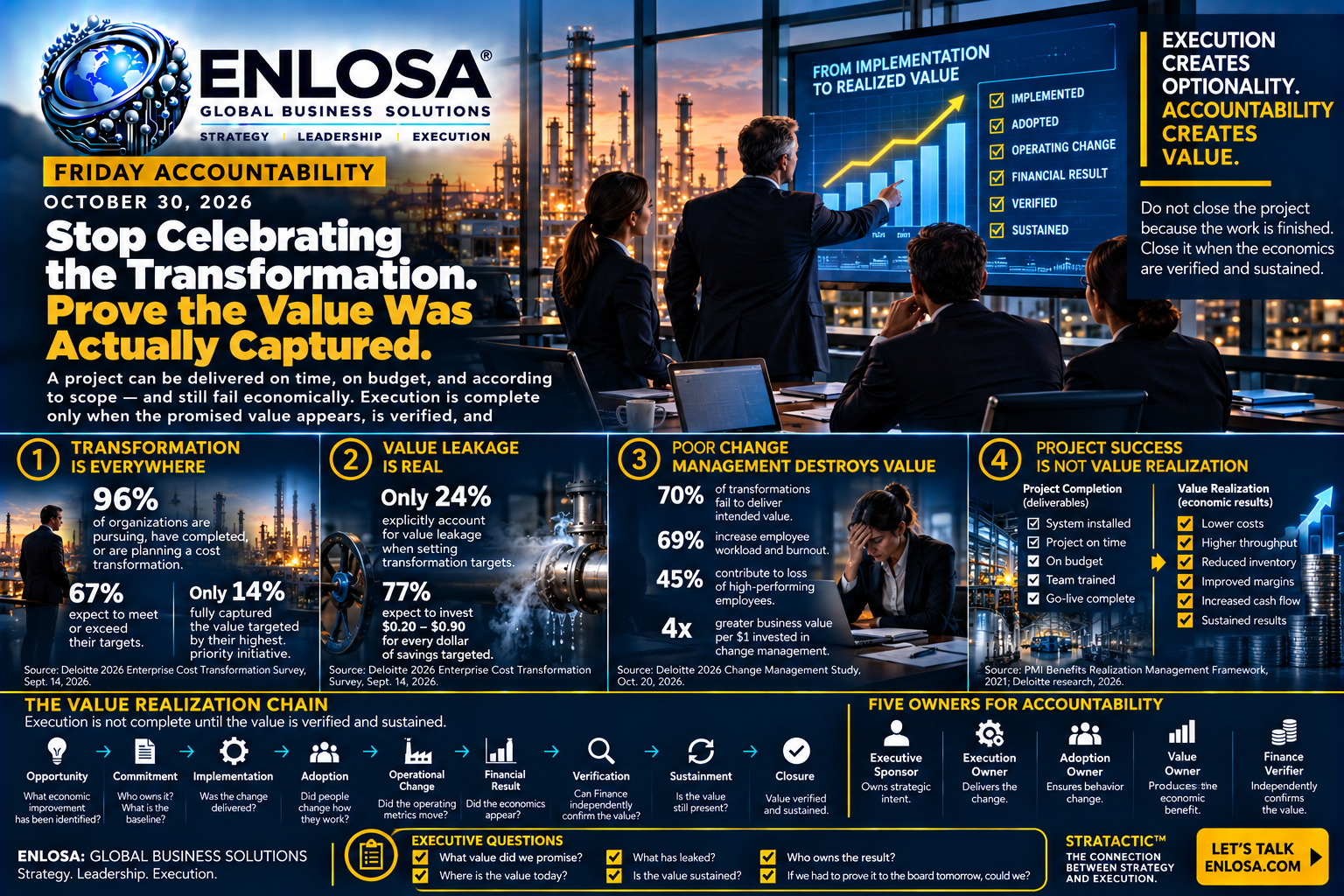
A project can be delivered on time, on budget, and according to scope—and still fail economically. Execution is not complete when the project closes. It is complete when the promised value appears, is verified, and remains in the business.
Friday, October 30, 2026 | Accountability & Value Realization
This week we have been building the pieces of a 2027 operating system.
Monday: Build the operating system—not merely the budget.
Tuesday: Clarify who has authority to make decisions.
Wednesday: Stress-test what happens if demand exceeds plan.
Thursday: Determine whether the enterprise can create the capacity required to capture that growth.
Friday brings us to the question that eventually matters most:
Did any of it actually create the value we promised?
Companies launch transformations constantly.
Cost programs. AI implementations. ERP deployments. Plant expansions. Procurement initiatives. Organizational restructurings. Automation. Shared services. Operating-model redesigns. Supply-chain transformations.
Yet organizations frequently declare success when the project team completes its work.
The system goes live. The equipment is installed. The consultants leave. The restructuring is announced. The new organization chart takes effect. The project status changes from yellow to green.
And leadership moves on.
But there is a problem.
Project completion is not value realization.
The transformation may be finished.
The economics may not be.
Deloitte: Almost Everyone Is Transforming. Very Few Capture the Full Value.
Deloitte’s 2026 Enterprise Cost Transformation Survey provides a striking picture of the gap between transformation ambition and actual economic delivery.
The survey of 500 senior executives found that 96% of organizations are pursuing, have completed, or are planning a cost transformation.
Leadership confidence is high.
67% expect to meet or exceed their overall transformation targets.
Yet only:
14% fully captured the value targeted by their highest-priority initiative in the prior year.
That is the accountability gap.
Organizations are extraordinarily good at launching transformation.
They are much less consistent at proving that transformation produced the economics promised in the original business case. Deloitte
The Transformation Is Not the Outcome
Suppose a company launches a $20 million productivity transformation.
The transformation office reports:
- System deployed.
- 120 processes redesigned.
- 800 employees trained.
- Automation live.
- Project delivered on schedule.
Those may all be legitimate accomplishments.
But none answers the financial question.
Did labor cost actually decline? Throughput increase? Inventory decrease? Working capital improve? Overtime fall? Scrap improve? Margins expand? Headcount avoidance occur? Cash flow increase?
Those are different measurements.
Activity proves that work happened.
Value proves that the work mattered.
The Wrong Finish Line Creates the Wrong Behavior
If leaders define the finish line as go-live, installation, implementation, training completion, organizational launch, or project closure, then the team will optimize toward those outcomes.
But businesses do not invest because they want software installed.
They invest because they expect something economically different afterward.
A new ERP is supposed to improve something. Automation is supposed to change something. A restructuring is supposed to produce something. A procurement initiative is supposed to save something. A capital project is supposed to generate something.
The deliverable is the means.
The economic result is the purpose.
Deloitte’s 14% Club Offers an Important Clue
Deloitte examined the small group of organizations that successfully delivered their largest strategic cost-management commitments.
It identified five recurring disciplines:
- Account for leakage. Deloitte recommends assuming that roughly 20% to 25% of targeted value may be lost to execution friction and incorporating that risk into the forecast rather than pretending every identified dollar will survive implementation.
- Fund before announcing. Transformation requires investment. Deloitte found that 77% of organizations expect to spend between $0.20 and $0.90 for every dollar of savings targeted.
- Establish a defensible baseline. The starting economics must be credible enough that leadership can later prove whether value actually changed.
- Enforce single ownership. Deloitte specifically recommends assigning each goal to one empowered leader rather than allowing competing scorecards and ambiguous accountability.
- Commit only to what can be defended. Public ambition should not exceed the organization’s ability to execute and verify the economics.
That is not merely cost-management advice.
It is an accountability system. Deloitte
Value Leakage Should Be Expected—not Discovered Later
Deloitte found another particularly important number:
Only 24% of surveyed organizations explicitly account for value leakage when setting transformation targets.
Yet implementation requires investment. Benefits are delayed. Assumptions change. People resist. New costs appear. Other functions spend some of the savings. Volumes change. Inflation moves. Customer behavior changes. Hiring occurs elsewhere. And some productivity improvements never become economic savings.
That means:
Gross identified value is not realized value.
Build the Value Bridge
Suppose a transformation identifies:
$10 million in savings.
The leadership presentation should not stop there.
Build the bridge.
$10.0M identified opportunity
minus implementation investment, technology, consultants, severance, temporary labor, dual-running systems, training, change costs, delayed implementation, inflation, operational disruption, benefits not adopted, and savings consumed elsewhere.
Then calculate:
Net realized economic value.
That number should eventually reconcile to actual financial performance.
Savings Do Not Exist Because They Are in a PowerPoint
There is a common transformation conversation:
“We identified $15 million of opportunity.”
That is useful.
But identification is not realization.
The next questions should be:
- How much was implemented?
- How much became operational?
- How much was adopted?
- How much reached the financial statements?
- How much remains after twelve months?
Without those questions, leadership may unknowingly count the same opportunity several times.
Follow the Value All the Way Into the Business
A useful accountability chain is:
Opportunity → Commitment → Implementation → Adoption → Operational Change → Financial Result → Verification → Sustainment
If the chain breaks anywhere, value disappears.
1. Opportunity
What economic improvement has been identified?
For example: $4 million procurement savings, $3 million labor productivity, $2 million inventory reduction, $1 million freight improvement.
At this stage, the value is hypothetical.
2. Commitment
Who has agreed to deliver it? What date? Against which baseline? Under what assumptions?
Now the number becomes a management commitment.
3. Implementation
Was the change actually delivered? New supplier? New process? Automation? Staffing model? Equipment? Pricing action? System?
This proves that the intervention occurred.
It still does not prove value.
4. Adoption
Did the organization actually change behavior? Are employees using the new process? Did the old process disappear? Are managers enforcing the change? Are customers behaving as expected? Did suppliers accept the commercial terms?
This is where many transformations begin leaking value.
5. Operational Change
Did the operating metric move?
- Labor hours per unit ↓
- Scrap ↓
- Purchase price ↓
- Inventory days ↓
- Lead time ↓
- Throughput ↑
- Service ↑
- Machine availability ↑
Now we have evidence that the operation changed.
6. Financial Result
Did the operating improvement translate economically?
EBITDA. Cash flow. Working capital. Gross margin. SG&A. Cost per unit. Capital avoidance. Revenue.
That is what justified the investment.
7. Verification
Can Finance independently confirm the value?
Not estimate. Not aspiration. Not “run rate.”
Verify.
8. Sustainment
Is the value still present six months later? Twelve months later?
Or did headcount return, supplier pricing creep back, inventory rebuild, overtime increase, or the old process return?
Value that disappears is not transformation.
It was temporary improvement.
Project Owner and Value Owner Should Not Always Be the Same Person
This distinction can dramatically improve accountability.
Every material transformation should have at least two clearly defined roles.
Execution Owner
Responsible for delivering the change.
Examples: CIO implements the ERP. Engineering installs the line. Procurement renegotiates the contract. Transformation Office redesigns the organization. Project team deploys the AI workflow.
The Execution Owner answers:
“Did we deliver what we said we would deliver?”
Value Owner
Responsible for ensuring the business result actually appears.
For example: the Operations VP owns productivity. The CFO owns validated cost reduction. The Supply Chain leader owns inventory reduction. The Commercial leader owns price realization. The Plant Manager owns throughput. The business-unit president owns EBITDA.
The Value Owner answers:
“Did the enterprise receive the economic benefit?”
These responsibilities overlap.
But they are not identical.
A Successful Project Can Still Be an Economic Failure
Imagine an automated production line.
Engineering delivers it on time, on budget, within specification.
Technically successful.
But after six months, yield remains below plan, operators require more training, maintenance downtime is higher than expected, labor savings never materialize, and throughput is 15% below business case.
The project team may correctly report:
Project successful.
The CFO may correctly report:
Investment return below plan.
Both statements can simultaneously be true.
That is exactly why project execution and value realization require different accountability.
PMI Has Made This Distinction for Years
Project Management Institute’s benefits-realization work emphasizes that project success cannot be defined only by traditional measures such as schedule, budget, scope, and quality.
Benefits may continue to appear—or fail to appear—after the project itself has closed.
PMI defines benefits realization management around identifying expected benefits, delivering them during execution, and sustaining them after project work transitions into normal operations. It also emphasizes the importance of explicit benefits ownership and accountability. Project Management Institute
That means the project closeout should not close the value discussion.
In many transformations:
That is when the value discussion becomes most important.
Transfer Accountability Before the Project Team Leaves
A dangerous moment occurs when implementation finishes, consultants leave, the project manager moves on, the transformation office closes the workstream, and operating management inherits the result.
Who now owns the benefit?
If that question was not answered before implementation, value realization becomes everyone’s responsibility—which usually means no one’s.
Before closure, explicitly transfer operational ownership, financial ownership, metric ownership, data ownership, process ownership, and benefit ownership.
Use Five Owners for Material Transformations
- Executive Sponsor — Why are we doing this? Owns strategic intent.
- Execution Owner — Will the initiative be delivered? Owns implementation.
- Adoption Owner — Will people actually change how they work? Owns behavior and process adoption.
- Value Owner — Will the operating result appear? Owns benefit creation.
- Finance Verifier — Can the economics be independently validated? Owns financial confirmation.
One person may hold more than one role.
But every role should exist.
Finance Verification Changes the Conversation
Transformation offices frequently report:
“Annualized savings: $8.4 million.”
The CFO should ask:
Where? Which cost center? Which account? Which headcount? Which supplier? Which inventory line? Which cash-flow impact? When? Compared with what baseline? What portion is volume? What portion is price? What portion is transformation?
That is not Finance being difficult.
That is economic accountability.
Build a Defensible Baseline Before Starting
Deloitte specifically identifies baseline discipline as one of the distinguishing characteristics of organizations that capture transformation value.
Why?
Because without a baseline, nearly any result can later be claimed as success.
Suppose labor cost falls 4%.
Was it transformation? Or lower volume?
Suppose procurement saves 6%.
Was it negotiation? Or commodity deflation?
Suppose inventory decreases.
Was it operational improvement? Or declining demand?
The baseline must define volume, mix, price, inflation, headcount, productivity, demand, exchange rates if applicable, commodity assumptions, and other material drivers.
Then benefits can be normalized.
Could the CFO defend this baseline to the board?
If not, do not use it to announce transformation value.
Separate Four Types of Value
1. Hard P&L Value
Actual expense removed.
Example: position eliminated, contract price reduced, facility closed, subscription terminated.
2. Cash Value
Working capital or cash-flow improvement.
Example: inventory reduced, payment terms improved, receivables collected faster.
3. Cost Avoidance
Future spending prevented.
Example: demand grows 15%, but headcount remains flat.
This is real value.
But it is not the same as current-year P&L reduction.
4. Capacity Creation
Resources become available for higher-value work.
Example: AI releases 5,000 engineering hours.
Again, potentially valuable.
But only if that capacity is intentionally redeployed.
Do not report all four as if they were the same dollar.
Run Rate Is Not Realized Value
This distinction matters particularly in cost programs.
Suppose an initiative implemented on October 1 generates $250,000 monthly savings.
Leadership might say:
“Annualized savings: $3 million.”
Correct as a run rate.
But only $750,000 may appear in the current year.
That matters for cash, EBITDA, investor guidance, bonuses, debt covenants, and budgets.
Report both:
Annualized Run Rate
and
Realized-to-Date Value
Do not confuse them.
Transformation Costs Matter Too
Deloitte found that 77% of organizations expect implementation investment of $0.20 to $0.90 for every dollar of targeted savings.
That is an enormous range.
It means a $10 million savings program may require significant investment before producing return.
The business case must include technology, consultants, severance, equipment, implementation teams, training, temporary capacity, dual systems, change management, cybersecurity, integration, governance, and transition costs.
Then calculate:
Net Value
not simply:
Gross Savings.
Transformation Value Must Also Carry a Clock
Imagine two initiatives.
Initiative A: $10 million value. Realized in four years.
Initiative B: $8 million value. Realized in twelve months.
Which is better?
The answer depends on investment, risk, cash timing, strategic importance, and cost of capital.
That means accountability must include not just:
How much?
But:
When?
Create a Value Realization Curve
Every transformation should show expected cumulative value by month.
For example:
- Month 3 — $0.5M
- Month 6 — $2M
- Month 9 — $4M
- Month 12 — $6M
- Month 18 — $9M
- Month 24 — $10M
Then leadership can compare:
Expected Value Curve
versus
Actual Value Curve
The gap becomes visible early.
Do Not Wait Until Year-End to Discover the Miss
If Finance verifies value only during annual budgeting, accountability arrives too late.
Material transformations need a regular cadence.
Potentially:
- Weekly execution review.
- Monthly benefit review.
- Quarterly business-case refresh.
Weekly: Are We Executing?
Milestones. Issues. Actions. Decisions. Ownership.
Monthly: Are Benefits Appearing?
Operational indicators. Financial value. Adoption. Leakage. Forecast.
Quarterly: Is the Original Business Case Still Valid?
Demand. Cost. Technology. Market assumptions. Capital. Strategic relevance.
Sometimes the accountable decision is not:
“Push harder.”
Sometimes it is:
Stop the initiative.
Accountability Includes the Courage to Kill Weak Initiatives
A transformation office can become emotionally invested in completing what it started.
But sunk cost does not create future value.
Define kill criteria at approval.
- Adoption remains below threshold.
- Implementation exceeds budget by 30%.
- Expected benefit declines below hurdle rate.
- Technology no longer differentiates.
- Customer assumption changes.
- Better alternative emerges.
- Strategic priority moves.
- Required investment increases materially.
Stopping a bad investment can be excellent execution.
The Adoption Gap Is an Economic Gap
Technology does not create value simply because it exists.
People must change how they work.
Deloitte’s October 2026 Change Management Study surveyed 1,000 executives responsible for large-scale change.
The results are sobering:
- 70% said their latest transformation failed to deliver its intended business value.
- 83% said poor change management contributed to unrealized value.
- 69% said the most recent initiative increased employee workload and burnout.
- 45% said poorly managed change contributed to the departure of high-performing employees.
Deloitte also found that greater investment in change management was associated with stronger adoption and that each dollar invested in change management was associated with approximately four dollars of realized business value in the study. Deloitte
That turns change management into an accountability issue.
Not an HR accessory.
Stop Asking Employees to Fund Transformation With Their Own Capacity
One common pattern is:
Implement new system. Keep old system temporarily. Add transformation meetings. Require training. Maintain normal production. Add reporting. Add testing. Add data cleansing. Add adoption tasks.
No work disappears.
The organization effectively asks employees to finance the transformation through workload.
That can create burnout, resistance, mistakes, slow adoption, talent loss, and eventually value leakage.
If new work enters the system, leadership should explicitly decide what old work exits.
Adoption Should Have a Value Metric
Do not measure only training attendance, login rate, or user activation.
Measure whether adoption changes the economics.
- AI adoption → engineer hours released.
- Procurement platform adoption → sourcing cycle shortened.
- Planning tool adoption → inventory reduced.
- Maintenance system adoption → downtime reduced.
- CRM adoption → conversion improved.
Adoption without business impact is utilization—not transformation.
Create the Value Realization Ledger
For every material transformation, maintain one simple management ledger.
- Initiative — What are we changing?
- Strategic Outcome — Why does it matter?
- Baseline — Where are we starting?
- Gross Value — What opportunity was identified?
- Required Investment — What must we spend?
- Expected Leakage — What friction should we anticipate?
- Net Value Target — What should actually remain?
- Execution Owner — Who delivers the change?
- Adoption Owner — Who ensures behavior changes?
- Value Owner — Who produces the operating benefit?
- Finance Verifier — Who independently validates it?
- Realized-to-Date Value — What has actually appeared?
- Run Rate — What is the current annualized effect?
- Cash Timing — When does value reach cash?
- Risk — What threatens realization?
- Next Action — What needs to happen now?
That ledger becomes the accountability conversation.
Build a Transformation Value Waterfall
The board should be able to see:
Identified Opportunity − Implementation Cost − Expected Leakage = Committed Net Value
Then compare:
Committed Net Value versus Realized Value versus Sustained Value
One slide.
No ambiguity.
The Accountability Chain
Friday’s operating framework is:
Promise → Owner → Baseline → Action → Adoption → Operating Result → Financial Verification → Sustainment → Closure
Notice the final word.
Closure.
Not implementation.
An initiative closes when the value chain closes.
The CEO’s Role: Stop Rewarding Activity as Value
CEOs should be careful with transformation language.
Statements such as “We launched,” “We implemented,” “We completed,” “We deployed,” and “We trained” describe activity.
The CEO should ask:
“What changed economically?”
That one question can transform program governance.
The CFO’s Role: Defend the Number
The CFO should establish a clear transformation-value methodology.
Define baseline, normalization, savings categories, cost avoidance, run rate, cash, timing, investment, attribution, leakage, and sustainment.
That prevents each project from inventing its own definition of success.
One enterprise. One value language.
The COO’s Role: Make the Value Operationally Real
Finance can verify value.
It cannot manufacture it.
The COO must ensure that processes change, capacity changes, behavior changes, metrics change, resources move, old work stops, and operating improvements become repeatable.
The P&L result begins in the operating system.
The Transformation Office’s Role Must Change Too
A transformation office should not be primarily a reporting organization.
Its role should be to challenge assumptions, track commitments, expose leakage, escalate decisions, validate ownership, coordinate cross-functional dependencies, keep value visible, and prevent premature closure.
A transformation office that only updates milestones can create the illusion of control without controlling value.
Boards Should Ask Different Questions
Instead of asking:
“How many initiatives are green?”
Ask:
- How much value was committed?
- How much is implemented?
- How much is operational?
- How much has Finance verified?
- How much cash has appeared?
- How much has leaked?
- Which initiatives are behind their value curves?
- Who owns recovery?
- Which initiatives should stop?
Boards do not need another transformation dashboard.
They need a value-accountability system.
A 30-Day Value Realization Reset
Week 1 — Rebuild the Baseline
Select the ten largest transformation commitments.
For each, confirm the original baseline, validate assumptions, and separate volume, price, inflation, and transformation effects.
Week 2 — Assign Ownership
Every initiative receives Execution Owner, Adoption Owner, Value Owner, and Finance Verifier.
No shared ambiguity.
Week 3 — Reconcile the Value
For each initiative compare original business case, current forecast, realized-to-date value, annualized run rate, cash realized, leakage, and required investment remaining.
Week 4 — Make the Decisions
Classify each initiative:
- Accelerate.
- Correct.
- Rescope.
- Reallocate.
- Stop.
- Close.
Then assign one action and one due date.
Questions for Your Leadership Team
- What economic result did we originally promise?
- What baseline are we measuring against?
- Who owns delivering the initiative?
- Who owns realizing the benefit after implementation?
- Who independently verifies the economics?
- How much gross value was identified?
- How much investment was required to create it?
- How much value leaked during implementation?
- How much value has actually reached the P&L, balance sheet, or cash flow?
- How much is only annualized run rate?
- Is adoption producing measurable operating change?
- Has the old process actually stopped?
- Is the value sustained six or twelve months later?
- Which transformation should we stop because the economics no longer work?
- When can Finance sign off that the promised value was actually captured?
If leadership cannot answer those questions—the transformation may be complete.
The accountability is not.
The ENLOSA Perspective
At ENLOSA: Global Business Solutions, we call the connection between strategy and execution Stratactic™.
But execution without value realization is incomplete.
This week’s sequence now forms an operating chain:
Monday — Operating System
Turn the budget into a dynamic management system.
Tuesday — Decision Rights
Clarify who—and what—has authority to act.
Wednesday — Environment
Challenge the assumptions with external signals.
Thursday — Capacity
Build the enterprise capability required to capture opportunity.
Friday — Accountability
Prove that the promised economics actually appeared.
Together:
Strategy → Decision → Capacity → Execution → Value → Verification
That last step matters.
Because companies do not create shareholder value by launching transformations, installing systems, completing projects, or producing presentations.
They create value when operations become economically better—and when those improvements can be demonstrated in margin, cash, working capital, growth, return on capital, resilience, and enterprise value.
Do not celebrate the transformation because the project is finished.
Celebrate it when the value is verified.
Friday Executive Call to Action
Before leaving this week, select the largest transformation initiative currently marked “complete” in your organization.
Put five numbers on one page:
- Original Value Target — What did the business case promise?
- Implementation Investment — What did it actually cost?
- Realized-to-Date Value — What economic benefit has actually appeared?
- Current Run Rate — What annualized value exists today?
- Remaining Value Gap — What has not yet been captured?
Then identify:
- Execution Owner
- Value Owner
- Finance Verifier
And ask one final question:
If we had to prove this transformation’s return to the board tomorrow using only financial and operating evidence—not project milestones—could we?
If the answer is no:
Do not close the transformation.
Close the value gap.
Execution is not complete until the value is verified.
References
- Deloitte — 2026 Enterprise Cost Transformation Survey, September 14, 2026. Deloitte surveyed 500 senior business leaders and found that 96% of organizations were pursuing, had completed, or were planning cost transformation; 67% expected to meet or exceed overall targets, yet only 14% fully captured the value targeted by their highest-priority initiative. Deloitte also found that 77% expected to invest $0.20–$0.90 for each dollar of savings targeted and only 24% explicitly accounted for value leakage. Source
- Deloitte — “Only 14% of Cost Transformation Efforts Work,” 2026. Deloitte identifies five disciplines associated with stronger delivery: accounting for leakage, funding implementation before announcing benefits, establishing a defensible baseline, enforcing single ownership, and making commitments the organization can credibly deliver. Source
- Deloitte + Workplace Intelligence — 2026 Deloitte Change Management Study, October 20, 2026. Among 1,000 executives responsible for large-scale change, 70% said their most recent transformation failed to deliver intended value, 83% linked poor change management to unrealized business value, 69% reported increased workload and burnout, and 45% reported loss of high-performing employees associated with poorly managed change. The study found that each dollar invested in change management was associated with approximately four dollars of realized business value. Source
- Project Management Institute — Benefits Realization Management Framework. PMI defines benefits realization as a discipline extending from identification of expected strategic benefits through delivery and continued sustainment after project work transitions to normal operations. Source
- Project Management Institute — Establishing Benefits Ownership and Accountability. PMI emphasizes explicit benefits ownership, defined responsibilities, cross-functional cooperation, and continued accountability for ensuring project outputs actually produce and sustain the intended business benefits. Source
- McKinsey & Company — “The Science Behind Successful Organizational Transformations.” McKinsey’s transformation research found that value loss can occur throughout the transformation lifecycle—including after implementation—and emphasizes embedding transformation disciplines into normal management processes to sustain the economics after projects conclude. Source
ENLOSA: Global Business Solutions
Strategy. Leadership. Execution.
enlosa@enlosa.com | +1 (877) 246-1109
#FridayAccountability #ValueRealization #Transformation #BusinessTransformation #CostTransformation #Execution #Accountability #BenefitsRealization #ValueCapture #ValueLeakage #OperationalExcellence #Finance #Operations #CEO #COO #CFO #TransformationOffice #ChangeManagement #WorkingCapital #EBITDA #CashFlow #CapitalAllocation #ROI #BusinessCase #Strategy #Leadership #ValueCreation #OperationalValueCreation #Stratactic #ENLOSA #EGBS
Leave a Reply