
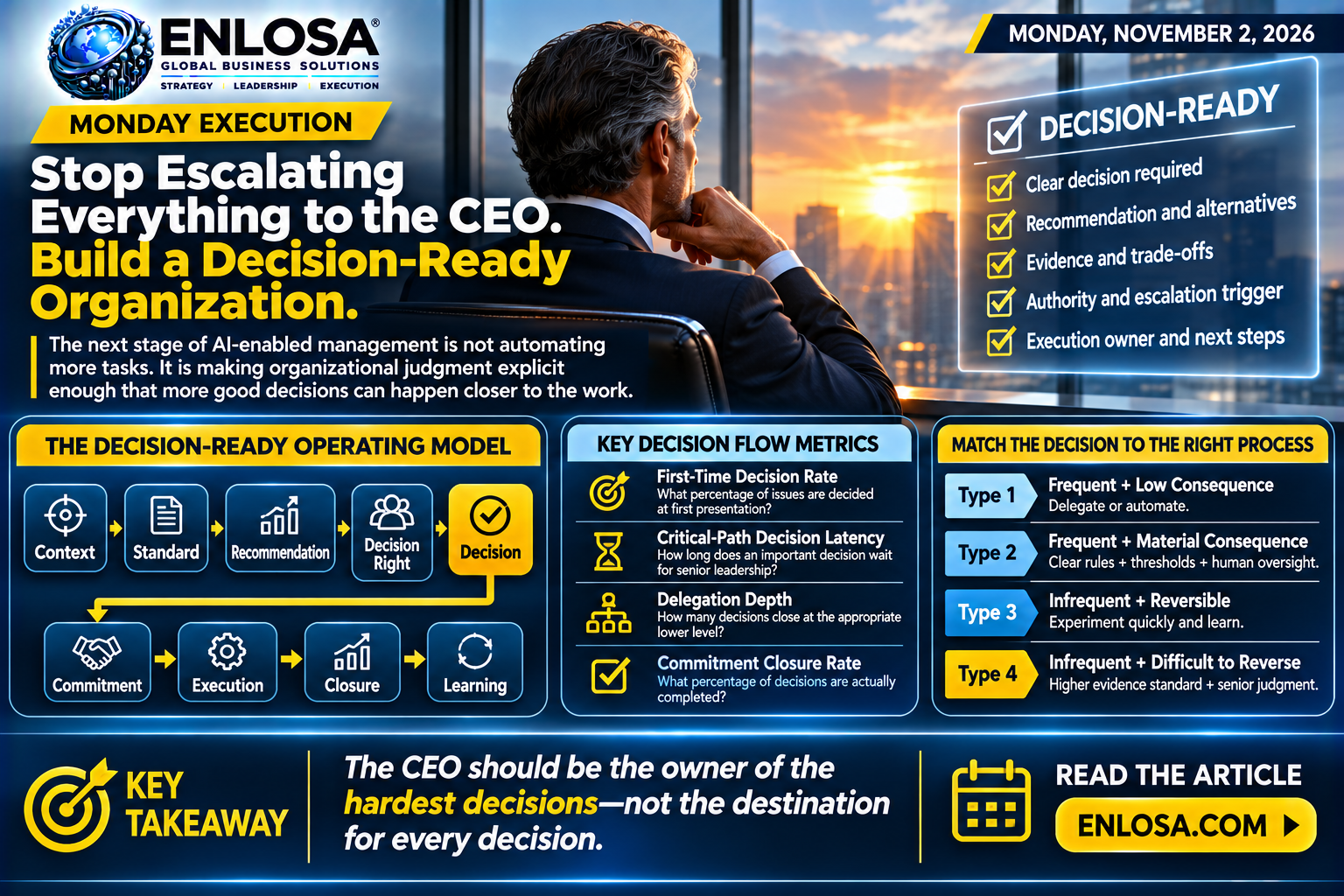
If your CEO disappeared from the calendar for one week, how many important decisions would stop moving? If the answer is “too many,” the problem may not be leadership capacity. It may be organizational design.
Monday, November 2, 2026 | Execution, Decision Rights & Organizational Intelligence
There is a familiar scene inside large organizations.
A business issue emerges.
Someone prepares an analysis.
The analysis moves upward.
A manager asks for more information.
A director adds another review.
Finance challenges the assumptions.
Legal wants clarification.
Operations raises a constraint.
Someone schedules a meeting.
The meeting ends without a decision.
More analysis is requested.
Another meeting is scheduled.
Eventually, the issue reaches the CEO.
And leadership asks:
Why does everything take so long?
The answer may be uncomfortable.
The organization has trained itself to escalate instead of decide.
The CEO Should Own the Hardest Decisions—not Every Decision
Today, McKinsey published new research examining how organizations can use AI to turn executive judgment into organizational intelligence.
Its central idea is important.
Great leaders possess more than information.
They possess judgment.
They know what question to ask first, which assumption deserves challenge, what evidence is sufficient, what risk is material, when more analysis will improve the decision, when more analysis is merely delay, which trade-offs matter, when an issue deserves CEO attention, and when the organization should simply decide and move.
Much of that knowledge is tacit.
It lives in the executive’s experience rather than in a policy manual.
McKinsey argues that AI now creates an opportunity to capture those decision standards and make them available more broadly across the organization—augmenting human judgment rather than replacing it. McKinsey & Company
That creates a powerful execution possibility:
What if the organization could learn how its best leaders think without requiring those leaders to attend every meeting?
One CEO: 1,800 Meetings
McKinsey’s article includes a case study that should get the attention of every executive team.
A CEO of a complex organization had logged approximately:
1,800 meetings in one year.
Nearly:
500 produced no decision and required follow-up.
Think about that.
Hundreds of meetings. Executive time. Preparation. Coordination. Follow-up. Rescheduling. Rework.
And still—no decision.
The organization redesigned meeting preparation around decision readiness rather than merely scheduling access to the CEO.
Within the first several months:
30% more decisions arrived ready on the first pass.
CEO escalations dropped substantially.
And approximately:
100 reusable knowledge assets
were created from previously implicit leadership standards. McKinsey & Company
That is not simply an AI story.
It is an execution story.
The Real Constraint Was Not the CEO’s Calendar
At first glance, the problem appears to be:
Too many meetings.
But that is only the symptom.
The deeper problem was:
Too many decisions required the CEO before the organization considered them legitimate.
That creates a structural bottleneck.
If every important decision requires CEO review, CEO interpretation, CEO challenge, CEO approval, and CEO reassurance, then the organization cannot move faster than one person’s calendar.
No matter how capable that person is.
Executive Dependency Is Not the Same as Executive Alignment
There is an important distinction.
A company should be aligned with the CEO’s strategy, standards, risk appetite, values, capital priorities, and performance expectations.
But it should not be unnecessarily dependent on the CEO’s physical presence.
A mature organization should increasingly be able to say:
“We understand the standard. We can make this decision.”
Instead of:
“We need to ask the CEO.”
That is how leadership scales.
The Decision-Ready Organization
A decision-ready organization does not eliminate escalation.
It improves it.
The objective is not: never escalate.
The objective is:
Escalate the right decisions, at the right level, with the right preparation, for the right reason.
That distinction matters.
Some decisions genuinely belong with the CEO.
Others belong with business-unit leaders, functional executives, plant managers, commercial leaders, procurement, finance, operations, project leaders, frontline managers, and increasingly—well-governed AI-enabled workflows.
Ask Why the Decision Is Being Escalated
When an issue reaches senior leadership, identify why.
- Authority — The person below genuinely lacks decision rights.
- Risk — The potential consequence exceeds their authority threshold.
- Capital — The decision involves investment beyond delegated limits.
- Cross-Functional Conflict — Two or more functions cannot resolve a trade-off.
- Strategic Consequence — The decision changes enterprise direction.
- Ambiguity — No precedent or clear standard exists.
- Fear — The person technically has authority but does not feel safe using it.
- Habit — “This is how we have always done it.”
The first six may justify escalation.
The last two represent organizational defects.
Escalation Can Become a Learned Behavior
Imagine a manager makes a reasonable decision.
Their executive leader later asks:
“Why didn’t you bring this to me first?”
What did the manager learn?
Not: use judgment.
They learned:
Escalate.
Now imagine another manager brings every minor issue upward.
The executive solves it quickly.
What did that manager learn?
Again:
Escalate.
Repeated long enough, the organization becomes conditioned.
People stop asking:
“What is the right decision?”
and begin asking:
“Who can approve this?”
That is a major difference.
Decision Rights Are Not Enough
Companies frequently solve this problem by creating a RACI chart.
Useful.
But insufficient.
Knowing who technically owns a decision does not guarantee that person can confidently make it.
Deloitte’s 2026 Human Capital Trends research shows that 60% of executives now regularly use AI to support decisions, yet only 5% of organizations consider themselves leaders in AI-enabled decision-making.
Deloitte also reports that 57% of organizations operate at low decision-making maturity. Deloitte
That means organizations do not merely have an AI problem.
Many have a more fundamental:
Decision capability problem.
AI can accelerate poor decision systems just as efficiently as good ones.
The Decision Must Have Both an Owner and a Standard
Decision rights answer:
Who decides?
Decision standards answer:
How do we know when the issue is ready to decide?
Both are required.
Suppose a business-unit leader technically owns a pricing decision.
But every proposal reaches the CEO because no one knows minimum margin requirements, acceptable strategic exceptions, customer concentration limits, working-capital implications, competitive thresholds, authority limits, or required evidence.
Then the formal decision right exists.
The practical decision right does not.
Codify Judgment, Not Just Policy
This is where today’s McKinsey argument becomes particularly interesting.
Organizations are usually good at documenting policies, procedures, delegation limits, approval matrices, specifications, and controls.
What they rarely document is:
How good executives reason.
For example:
- What makes a business case credible?
- What makes an acquisition strategically distinctive?
- What makes a capital request mature enough for approval?
- What causes the COO to question a production forecast?
- What causes the CFO to distrust a savings estimate?
- What makes the CEO conclude that the team has analyzed enough and should act?
That knowledge is extremely valuable.
Yet much of it disappears every time an experienced executive retires, leaves, changes roles, or simply is not present in the meeting.
Knowledge and Judgment Are Different Assets
Knowledge asks: What do we know?
Judgment asks: What does it mean?
Knowledge might say: Supplier lead time increased 18%.
Judgment asks: Does that justify increasing inventory?
Knowledge says: Demand is 12% above plan.
Judgment asks: Do we expand capacity or wait?
Knowledge says: AI could automate 30% of a workflow.
Judgment asks: Should it?
Knowledge says: The project is 20% over budget.
Judgment asks: Do we finish, rescope, or stop?
Information does not make decisions.
People interpret information inside a context.
AI Can Make the Standard Visible
McKinsey describes what it calls an executive AI—a system capable of capturing and organizing leadership standards, decision patterns, questions, inference methods, prior judgments, context, commitments, and lessons from previous decisions.
The objective is not to create an artificial CEO.
It is to help the organization understand:
What good looks like before work reaches the CEO.
That is a dramatically more useful application of AI than simply generating another presentation.
AI Should Improve the Quality of Escalation
A weak AI implementation asks:
“Can AI prepare the presentation faster?”
A stronger implementation asks:
Can AI identify why this issue is not yet decision-ready?
For example: missing evidence, unclear recommendation, unquantified risk, no owner, no alternatives, inconsistent assumptions, unresolved stakeholder conflict, no financial impact, no decision requested, or no implementation path.
That changes AI from content generator to:
Decision-quality infrastructure.
Gartner: AI Value Requires Operating-Model Redesign
Gartner’s recent operating-model research reaches a similar conclusion.
It reports that 74% of organizations prioritize redesigning structures and jobs alongside AI deployment, yet many still insert AI into existing workflows rather than redesigning how work and decisions actually operate.
The result can be more activity, more output, and more automation without fundamentally better outcomes. Gartner
Gartner puts the issue plainly:
AI value is an operating-model challenge—not merely a technology challenge.
That is especially true for decision-making.
Faster Analysis Can Make the Problem Worse
Suppose AI reduces analysis time by 80%.
Excellent.
Now instead of producing 20 business cases per month, the organization produces 100.
But every business case still requires four management reviews, Finance, a steering committee, a monthly executive meeting, and CEO approval.
What happened?
The organization increased the speed of work entering the bottleneck.
The bottleneck itself did not move.
That can actually increase queue length, management workload, escalations, meetings, and organizational frustration.
Automating upstream work without redesigning downstream decisions may simply create congestion faster.
Gartner: CEOs Are Struggling to Convert AI Into Financial Returns
Gartner recently reported that 44% of CEOs struggle to demonstrate financial returns from AI.
At the same time, 63% identify radical operating-model redesign as a major move for accelerating tangible AI returns through 2027. Gartner
That makes sense.
Technology alone rarely changes enterprise economics.
Work must change. Decision architecture must change. Accountability must change. Resources must move.
Build a Decision-Readiness Standard
Every major decision presented upward should answer seven questions.
1. What decision is required?
Not: “Discuss market expansion.”
Instead:
“Approve or reject entry into Market X by January 15.”
Make the decision explicit.
2. Who owns the recommendation?
A committee can contribute.
One person must recommend.
Name them.
3. What evidence matters?
Separate relevant evidence, interesting information, and noise.
More slides do not necessarily create more certainty.
4. What are the real alternatives?
Do not present preferred option, obviously bad option, and absurd option.
Present credible alternatives.
Including:
Do nothing.
Sometimes that is the real competitor.
5. What are the trade-offs?
Every meaningful decision creates something and gives something up.
Show value, risk, cash, time, capacity, customer consequences, and strategic optionality.
6. What happens if we wait?
Delay is also a decision.
Quantify it.
Lost revenue? More risk? Better information? Capital preserved? Competitive disadvantage?
7. What happens next if approved?
A decision without execution ownership is merely executive commentary.
Define owner, action, deadline, metric, and follow-up.
The Decision-Ready Test
- Is the decision explicit?
- Is the recommendation clear?
- Are alternatives credible?
- Are assumptions visible?
- Are the economics quantified?
- Are the risks understood?
- Are stakeholder disagreements surfaced?
- Is authority clear?
- Is an execution owner identified?
- Is the team actually asking leadership to decide something?
If the answer is no—the meeting may not be ready.
Stop Using Executive Meetings to Discover the Question
One of the most expensive organizational habits is bringing an issue into an executive meeting before anyone has determined what decision is required.
The meeting then becomes problem discovery, data reconciliation, assumption clarification, stakeholder negotiation, analysis request, and finally:
Another meeting.
That is not executive decision-making.
That is unfinished preparation.
A Meeting Should Have a Purpose Type
INFORM
No decision required. Leadership needs awareness.
DECIDE
A decision must leave the room.
SOLVE
A cross-functional issue requires real-time problem solving.
REVIEW
Leadership is verifying whether a prior commitment was executed.
These are different meetings.
Treating all of them the same creates confusion.
The Most Expensive Meeting Is the One That Produces Another Meeting
Consider the organizational cost.
Eight executives. Ninety minutes. Preparation teams. Analysts. Pre-reads. Travel or scheduling.
Then:
“Let’s come back next week.”
Sometimes that is appropriate.
Often it means something was missing.
Record why the decision was deferred.
Examples: missing data, unclear recommendation, executive disagreement, wrong decision maker, risk not quantified, no customer input, or weak financial assumptions.
Then use that information.
Every deferred decision should improve the organization’s decision standard.
McKinsey’s Learning Loop
This is one of the most valuable ideas in today’s research.
When a decision is deferred, challenged, or reframed, capture what was missing, what question changed the discussion, which assumption failed, and what additional evidence closed the issue.
Then update the organization’s decision guidance. McKinsey & Company
Over time:
The CEO teaches once.
The organization learns repeatedly.
That is leverage.
Measure Decision Flow
Most companies measure revenue, margin, inventory, quality, safety, projects, and headcount.
But few systematically measure how decisions move.
1. First-Time Decision Rate
What percentage of issues are decided at first presentation?
If low, preparation standards may be unclear, evidence may be incomplete, or executives may be unwilling to decide.
All three need attention.
2. Critical-Path Decision Latency
How long does an important decision wait for senior leadership availability?
A business opportunity should not sit for three weeks simply because the executive calendar is full.
If it does—the calendar has become an operational constraint.
3. Delegation Depth
How many decisions close at the appropriate lower level rather than escalating unnecessarily?
This is not delegation for its own sake.
It measures whether decision standards are sufficiently clear for authority to move closer to the work.
4. Commitment Closure Rate
What percentage of commitments made in meetings actually close?
Executives often believe a decision means execution has begun.
Not necessarily.
Measure: decision made, owner assigned, action completed, value realized.
Add One More: Escalation Quality
What percentage of escalations genuinely require executive judgment?
If most escalations are caused by missing authority, cross-functional disagreement, fear, ambiguous governance, or unclear standards—fix the system.
Do not simply give the CEO a better calendar.
Not Every Decision Deserves the Same Process
Deloitte’s 2026 decision-making framework recommends considering factors such as risk, frequency, urgency, time horizon, uncertainty, reversibility, and whether the decision expands or constrains future choices. Deloitte
Type 1 — Frequent + Low Consequence
Examples: routine operating adjustments, scheduling, standard purchasing, normal service recovery.
Response: Delegate or automate.
Type 2 — Frequent + Material Consequence
Examples: pricing exceptions, supplier decisions, inventory adjustments, credit decisions.
Response: Clear rules + thresholds + human oversight.
Type 3 — Infrequent + Reversible
Examples: pilot, new tool, limited market test, temporary organization experiment.
Response: Experiment quickly. Learn.
Type 4 — Infrequent + Difficult to Reverse
Examples: acquisition, factory closure, large capital investment, major restructuring, strategic market exit.
Response: Higher evidence standard. More challenge. Senior leadership judgment.
Do Not Apply Board-Level Governance to a $10,000 Decision
One cause of organizational slowness is governance designed around the worst possible case.
Every decision receives more approvals, more signatures, more documentation, and more committees.
Eventually, even routine work moves at strategic-decision speed.
That creates hidden cost.
Good governance is not maximum control.
Good governance applies the appropriate level of control to the consequence of the decision.
Decision Rights Need Trust Thresholds
Tuesday’s article last week argued that AI decision rights require explicit guardrails.
The same principle applies to people.
An authority matrix should state:
You may decide independently when:
- Risk is below X.
- Investment is below Y.
- Margin remains above Z.
- No regulatory issue exists.
- Customer impact remains within tolerance.
You must escalate when:
- Strategic direction changes.
- Risk exceeds tolerance.
- Capital exceeds authority.
- Ethical or regulatory concern emerges.
- Cross-enterprise implications exist.
- Two executive priorities conflict.
Those thresholds reduce ambiguity.
Authority Without Psychological Safety Is Fake Authority
Imagine telling managers:
“You are empowered.”
Then criticizing every decision they make differently from how you would have made it.
What happens?
Empowerment disappears.
Real delegation requires tolerance for decisions that are reasonable, evidence-based, within guardrails, but not identical to your preference.
If every delegated decision must reproduce the CEO’s personal choice exactly, it was never truly delegated.
The CEO’s Standard Should Travel. The CEO Should Not Have To.
That may be the core principle from today’s McKinsey research.
Leadership scale does not come from attending more.
It comes from making standards, judgment, priorities, risk tolerances, and strategic principles clear enough that the organization can act intelligently without constant executive intervention.
The CEO’s calendar should not be the company’s workflow engine.
Executive Time Is a Strategic Asset
Harvard Business School researchers Michael Porter and Nitin Nohria conducted a multiyear study of how CEOs use their time.
Their work emphasizes something obvious but frequently ignored:
CEO time is finite.
Unlike capital or talent, executives cannot acquire additional hours.
The CEO therefore has to use direct involvement selectively and rely on broader organizational mechanisms—strategy, people, culture, processes, and operating systems—to influence far more work than they can personally touch. Harvard Business Review
That makes unnecessary escalation more than an inconvenience.
It is a misallocation of one of the organization’s scarcest resources.
The CEO’s Judgment Ratio
McKinsey proposes another useful idea:
Judgment Ratio
What share of executive time is spent on work that genuinely requires that leader’s unique judgment?
Imagine the CEO spends Monday on routine approvals, repeated status meetings, reading material that could have been synthesized, reanswering questions previously resolved, settling conflicts managers should resolve, and approving decisions inside existing policy.
Then the CEO may be busy.
But executive leverage is low.
Reclaim Executive Time—Then Protect It
There is a trap.
AI saves three hours.
What happens?
Three more meetings appear.
McKinsey calls this risk refill: reclaimed executive hours are rapidly filled with other low-leverage activity unless the operating model intentionally protects them.
This matters.
The purpose of efficiency is not:
Fit more activity into the calendar.
It should be:
Move more executive attention toward work only the executive can do.
Strategy. Talent. Stakeholders. Long-term risk. Major capital allocation. Culture. Succession. Critical customers. Enterprise trade-offs.
HBR: CEOs Also Set the Tempo
Nitin Nohria’s current Harvard Business Review work emphasizes another important CEO responsibility:
Determining organizational pace.
Move too slowly and opportunities disappear.
Move too quickly and organizations can create mistakes, overload, and execution problems. Harvard Business Review
This connects directly to decision design.
A CEO should not merely accelerate every decision.
The CEO should determine:
Which decisions must move faster—and which deserve deliberate thought.
Speed is not the objective.
Appropriate decision velocity is.
Faster Is Not Always Better
Routine pricing exception? Probably faster.
Safety incident? Immediate.
$500 million acquisition? Probably not.
Customer service recovery? Fast.
Major footprint decision? Deliberate.
Routine hiring? Delegate.
Enterprise restructuring? Senior judgment.
The operating system should distinguish them automatically.
AI Adds a New Decision-Rights Problem
Deloitte warns that AI makes conventional decision-rights models increasingly complicated because authority may now move between humans, AI assistants, AI agents, managers, systems, and automated workflows.
Organizations need explicit override rights, escalation paths, authority limits, consensus rules, and accountability. Deloitte
The question becomes:
Who decides what, under what conditions, with what authority, and who owns the consequence?
That should be written before the AI begins acting.
A Practical Human–AI Decision Architecture
AI may:
- Gather evidence.
- Summarize.
- Compare.
- Model.
- Predict.
- Identify patterns.
- Generate alternatives.
- Challenge assumptions.
- Monitor thresholds.
- Recommend.
Humans should retain explicit ownership for:
- Purpose.
- Values.
- Strategic trade-offs.
- Ethics.
- Major capital commitments.
- Irreversible choices.
- High-consequence exceptions.
- Accountability.
The boundary will differ by organization.
But the boundary should exist.
Do Not Create an AI Version of the Same Bureaucracy
There is a possible bad outcome.
Instead of:
Analyst → Manager → Director → VP → CEO
the organization creates:
AI → Analyst → Manager → AI review → Director → VP → Committee → CEO.
More technology.
Same bureaucracy.
That is not transformation.
Digitizing a bad decision process does not make it good.
The Decision-Ready Operating Model
A stronger model looks like:
Context → Standard → Recommendation → Decision Right → Decision → Commitment → Execution → Closure → Learning
AI can support several stages.
But ownership must remain visible throughout.
Context
What changed? What problem exists? Why does it matter now?
Standard
What criteria apply? What evidence is sufficient? What risk tolerance exists?
Recommendation
What should we do? Who recommends it? Why?
Decision Right
Who has authority? Does it really require escalation?
Decision
Yes. No. Modify. Delay. Experiment. Stop.
Commitment
Who owns what next? By when?
Execution
Did the action occur?
Closure
Did the result materialize?
Learning
What should the organization remember next time?
That final step is where organizational intelligence compounds.
Build a Decision Memory
Imagine every major decision leaves behind a structured record: decision, context, options, assumptions, evidence, trade-offs, reasoning, owner, result, and lessons.
Now six months later, another team confronts something similar.
Instead of beginning from zero, the organization asks:
What have we already learned?
That could become one of AI’s highest-value enterprise applications.
Not generating more information.
Preventing the organization from repeatedly forgetting what it already knows.
Succession Planning Should Transfer Judgment
Today’s McKinsey article also raises an important succession issue.
When an executive leaves, the company retains presentations, emails, policies, board materials, budgets, and contracts.
What often leaves is why the executive made certain decisions, what patterns they recognized, what they considered unacceptable, what they learned from mistakes, and what evidence caused them to change their mind.
That is a major form of organizational intellectual capital.
Succession planning should therefore ask:
What judgment must be transferred—not merely what responsibilities?
The CEO Test
Here is a useful Monday exercise.
Imagine the CEO becomes unavailable for one week.
No email. No Teams. No calls. No approvals.
Which decisions stop?
Make a list.
Category A: These genuinely require CEO judgment. Good.
Category B: These require CEO authority because delegation limits are outdated. Fix them.
Category C: These escalate because standards are unclear. Codify them.
Category D: These escalate because functions cannot resolve conflicts. Fix governance.
Category E: These escalate because managers are afraid to decide. Fix leadership behavior.
That exercise can reveal organizational dependency quickly.
The COO’s Role: Build Decision Flow
For the COO, this is an execution architecture issue.
Map the top twenty recurring enterprise decisions.
For each determine frequency, owner, required inputs, authority, cycle time, escalation threshold, failure mode, output, and next action.
Then measure how long decisions wait.
You may discover enormous hidden capacity.
Not inside machines.
Inside management.
The CFO’s Role: Improve the Burden of Proof
Finance frequently influences whether a decision is ready.
The CFO should define financial thresholds, required scenarios, cash implications, sensitivity analysis, return requirements, baseline standards, value categories, and risk-adjusted economics.
But avoid turning every business decision into a miniature board investment committee.
The burden of proof should rise with consequence.
The CHRO’s Role: Develop Judgment, Not Just Competencies
Leadership development often focuses on communication, coaching, executive presence, and technical competencies.
Those matter.
But organizations should increasingly teach how to frame a decision, distinguish reversible from irreversible choices, evaluate evidence, make trade-offs, operate under uncertainty, escalate appropriately, and make a recommendation.
Judgment can be developed.
Deloitte’s research supports treating decision-making itself as an organizational capability.
The CIO’s Role: Build the Infrastructure for Organizational Intelligence
The technology opportunity is not simply another chatbot.
Create systems that can securely connect prior decisions, policies, operating data, meeting commitments, risk thresholds, financial assumptions, lessons learned, executive standards, and relevant external signals.
Then use AI to make that institutional knowledge available at the moment of decision.
But governance matters.
McKinsey specifically highlights issues including access, retention, privilege, discovery, data boundaries, and the risk of turning one leader’s judgment into permanent dogma.
The system must learn.
Not fossilize.
The CEO’s Role: Stop Being Rewarded for Saving Everyone
There is a leadership trap.
The CEO becomes very good at solving escalated problems.
That feels productive.
People appreciate it.
Problems close.
But every rescue teaches the organization:
Bring the next problem here.
Eventually the CEO becomes chief decision maker, chief conflict resolver, chief exception handler, chief meeting participant, and organizational bottleneck.
The better question is:
What would have to change so this issue never needs me next time?
That is leadership leverage.
A 30-Day Decision-Readiness Reset
Week 1 — Map the Escalations
Review the previous 30 to 60 days.
Identify decisions reaching CEO, decisions reaching executive committee, deferred decisions, repeated decisions, and decisions waiting more than one week.
Classify why they escalated.
Week 2 — Define Standards
For the ten most common decision types, define owner, authority, required evidence, financial threshold, risk threshold, escalation condition, and expected cycle time.
Week 3 — Redesign Executive Meetings
Every agenda item becomes INFORM, DECIDE, SOLVE, or REVIEW.
For DECIDE items require decision requested, recommendation, options, trade-offs, evidence, and owner.
Week 4 — Measure the Flow
Start tracking First-Time Decision Rate, Decision Waiting Time, Escalation Rate, Delegation Depth, Commitment Closure Rate, and Executive Judgment Ratio.
Then improve one constraint at a time.
Monday Executive Questions
- Which decisions unnecessarily reach the CEO?
- How many executive meetings last month produced no decision?
- What percentage of decisions are ready on first presentation?
- How long do critical decisions wait for executive calendars?
- Which decision standards exist only inside one executive’s head?
- Where do managers technically have authority but still hesitate to use it?
- Which recurring escalations indicate a broken operating process?
- Are our decision thresholds appropriate for the consequences involved?
- What could AI prepare, challenge, or codify before a decision reaches leadership?
- Which decisions should AI never make independently?
- Are we measuring AI activity or actual improvements in decision velocity and economic value?
- How often do executive commitments actually close?
- What knowledge disappears when an experienced leader leaves?
- Does our succession process transfer judgment or merely responsibility?
- If the CEO disappeared for one week, what would stop moving?
The answer to that final question can reveal more about organizational maturity than an organization chart.
The ENLOSA Perspective
At ENLOSA: Global Business Solutions, we describe the connection between strategy and execution as Stratactic™.
Decision architecture sits directly in the middle of that connection.
Strategy without decisions remains intention.
Decisions without authority create delay.
Authority without standards creates inconsistency.
Standards without judgment create bureaucracy.
Judgment without accountability creates risk.
And decisions without closure create activity without execution.
The complete chain is:
Strategy → Context → Decision Standard → Decision Rights → Judgment → Commitment → Execution → Accountability → Value → Learning
That is an operating system.
The Monday Execution Principle
The objective is not to make the CEO less important.
It is almost the opposite.
Make the CEO available for the decisions where CEO judgment creates the greatest enterprise value.
Do not consume that capacity on decisions the organization should already know how to make.
The best organizations do not scale by giving the CEO more meetings, more approvals, or more escalations.
They scale by making strategy clearer, standards explicit, decision rights stronger, managers more capable, knowledge reusable, and accountability visible.
The CEO’s judgment should scale through the organization.
The CEO’s calendar should not have to.
Monday Executive Call to Action
Before the end of today, pull the CEO’s or executive team’s calendar from last month.
Select every meeting that existed primarily to make a decision.
For each one, ask:
- Was a decision made?
- Was it made on the first pass?
- Did it genuinely require this executive?
- Why was it escalated?
- What was missing before the meeting?
- Could the standard be codified?
- Could the decision be delegated next time?
- Was the commitment completed afterward?
Then choose the three most frequently escalated decision types.
Redesign them.
Define context, standard, decision owner, authority threshold, escalation trigger, required evidence, execution owner, and closure metric.
And one month from now, measure whether fewer decisions are waiting for the top.
Because the objective is not simply:
Faster decisions.
It is:
Better decisions, made at the right level, with less friction, stronger accountability, and more executive capacity available for the choices that truly require it.
That is execution.
References
- McKinsey & Company — “Turning Executive Judgment Into Organizational Intelligence: Leveraging AI in CEO Leadership,” November 2, 2026. McKinsey examines how AI can codify tacit executive judgment, improve decision readiness, preserve organizational learning, and allow leadership standards to scale beyond executive calendars. Its case study describes an organization whose CEO had approximately 1,800 meetings in one year, nearly 500 without decisions; after redesigning for decision readiness, 30% more decisions arrived ready on the first pass, CEO escalations declined, and roughly 100 reusable knowledge assets were created. Source
- Deloitte — 2026 Global Human Capital Trends: Decision-Making With AI. Deloitte reports that 60% of executives regularly use AI to support decisions, but only 5% consider their organizations leaders in AI-enabled decision-making. Deloitte’s related decision-intelligence research finds that 57% of organizations operate at low decision-making maturity and recommends explicit decision frameworks, human accountability, dynamic decision rights, escalation paths, and override mechanisms. Source
- Gartner — “Operating Model Alignment Is the Key to Driving AI Value,” October 6, 2026. Gartner reports that 74% of organizations prioritize redesigning structures and jobs alongside AI deployment but warns that many continue applying AI within legacy workflows, increasing activity without fundamentally changing outcomes. Source
- Gartner — CEO AI Financial Returns Research, October 20, 2026. Gartner reports that 44% of CEOs struggle to demonstrate AI financial returns and that 63% identify radical operating-model redesign as a key action for improving tangible AI returns through 2027. Gartner recommends measuring outcomes such as decision velocity, unit economics, speed to market, and business impact rather than AI activity alone. Source
- Harvard Business Review — Michael E. Porter and Nitin Nohria, “How CEOs Manage Time.” Their multiyear study of CEO time use demonstrates the scarcity and strategic importance of executive attention and the need for CEOs to combine direct involvement with indirect organizational mechanisms such as strategy, culture, people, and operating processes. Source
- Harvard Business Review — Nitin Nohria, “How CEOs Set the Tempo,” November–December 2026. Nohria argues that an underappreciated CEO responsibility is determining organizational pace—knowing when execution should accelerate and when disciplined deliberation produces better outcomes. Source
ENLOSA: Global Business Solutions
Strategy. Leadership. Execution.
enlosa@enlosa.com | +1 (877) 246-1109
#MondayExecution #DecisionMaking #DecisionRights #CEO #ExecutiveLeadership #Leadership #AI #ArtificialIntelligence #OrganizationalIntelligence #OperatingModel #OperatingSystem #Execution #Accountability #DecisionVelocity #Management #COO #CFO #CIO #CHRO #LeadershipDevelopment #Transformation #OperationalExcellence #FutureOfWork #BusinessTransformation #Strategy #ValueCreation #Stratactic #ENLOSA #EGBS
Leave a Reply